
Struggling with unevenly baked dinners, or roasts that are burnt on the outside but raw in the middle? Your oven thermostat might be to blame. This small but crucial component regulates the heat inside your appliance, and when it starts to fail, your cooking definitely suffers. In this guide, we will break down the telltale signs that your oven thermostat is failing, how it impacts your kitchen routine, and how you can safely test and fix it.
Whether you are preparing a simple weekday meal or a complex holiday feast, a reliable oven is essential. When the thermostat fails, it loses its ability to monitor and adjust the internal temperature accurately. Fortunately, recognizing the early warning signs can save you from a ruined dinner and more costly appliance repairs down the road.
1. Your oven takes an unusually long time to preheat
A reliable oven should typically reach its set temperature within 10 to 15 minutes. If you notice that your oven is taking 30 minutes or more to preheat, your thermostat could be failing. When the thermostat works correctly, it signals the oven's control board to send continuous voltage to the heating elements until the desired temperature is achieved.
When the thermostat begins to degrade, it may inaccurately signal that the oven is hotter than it actually is. As a result, the control board will cycle the heating elements off prematurely, slowing down the preheating process dramatically. Before jumping to conclusions, always ensure that your bake and broil elements are physically intact and functioning. However, if the elements look fine but preheating remains sluggish, the thermostat or its connected sensor is the likely culprit.
2. Food consistently burns or undercooks
One of the most frustrating signs of a failing oven thermostat is unpredictable cooking results. If you are following recipes precisely, but your food consistently emerges either charred or completely undercooked, the thermostat is likely failing to regulate the internal heat.
When a thermostat is failing, it cannot maintain the constant temperature required for proper cooking. It might cause the oven to overshoot the set temperature, leading to burnt edges and raw centers. Conversely, it might cut off heat too early, leaving your meals undercooked. If your oven is consistently running too hot, you may also want to review our guide on why your oven is burning food for other potential causes. However, if the problem happens across all types of dishes, the thermostat's ability to read ambient temperature is almost certainly compromised.
3. You notice frequent, rapid temperature fluctuations
It is entirely normal for an oven's internal temperature to fluctuate slightly—usually between 20 and 30 degrees Fahrenheit—as the heating elements cycle on and off. However, if you notice wild, rapid temperature swings, your thermostat is no longer functioning correctly.
For example, if you set your oven to 350°F, but it drops down to 200°F before the heating elements kick back on, or if it shoots up to 450°F, the thermostat is failing to accurately communicate with the heating elements. This constant cycling creates an unstable environment that makes complex baking, such as cakes, breads, or souffles, nearly impossible. You can observe these fluctuations by placing a standalone oven thermometer inside the oven cavity and watching it throughout a cooking cycle. If the thermometer reads significantly different temperatures than what you set, your thermostat needs attention.
4. The oven display gives an inaccurate reading
Modern ovens with digital displays rely heavily on the thermostat and temperature sensor to provide accurate readouts. If your oven display says it has reached 350°F, but the food inside is barely warm, or if the display seems stuck on a certain temperature despite the oven clearly getting hotter, the thermostat is failing.
To verify this, place a standalone, heat-safe oven thermometer in the center of your oven rack. Set the oven to a standard temperature, like 350°F, and wait for the preheat chime. Compare the digital display reading to the physical thermometer inside the oven. If there is a constant, steady difference, you might just need to learn how to calibrate an oven for better accuracy. However, if the readout is completely erratic, constantly changes, or fails to correlate with the actual heat at all, the thermostat or sensor has failed and must be replaced.
5. Baked goods are coming out unevenly cooked
Have you noticed that your sheet pan dinners are perfectly cooked on one side but nearly raw on the other? Or perhaps your cookies are burnt on the bottom but doughy on top? While uneven baking can sometimes be linked to airflow issues or rack placement, it is often a key indicator of a failing oven thermostat.
When the thermostat is failing, it may not trigger the heating elements to cycle properly. In many ovens, the bake element (bottom) and broil element (top) must alternate precisely to maintain even heat distribution. If the thermostat is sending incorrect signals, one element may stay on for too long while the other remains off. If you are struggling with this issue, you can also check out our related guide on why your oven is not reaching temperature to inspect your heating elements. If the elements are working but simply not cycling correctly, the thermostat is the component to blame.
6. The oven does not reach the set temperature
Ultimately, if your oven simply cannot reach the temperature you set, no matter how long you wait, the thermostat is likely broken. This is the final stage of thermostat failure. The thermostat may permanently signal to the control board that the oven is already hot, preventing the heating elements from ever receiving the power they need to heat the cavity.
If you suspect this is the case, you will likely notice that the oven feels slightly warm but never hot enough to cook. This symptom is distinct from a broken bake element, which would usually result in the top broil element working while the bottom stays cold. If neither element seems to be getting the oven up to temperature, and your display suggests everything is fine, the thermostat is definitely failing to do its job.
How to test your oven thermostat with a multimeter
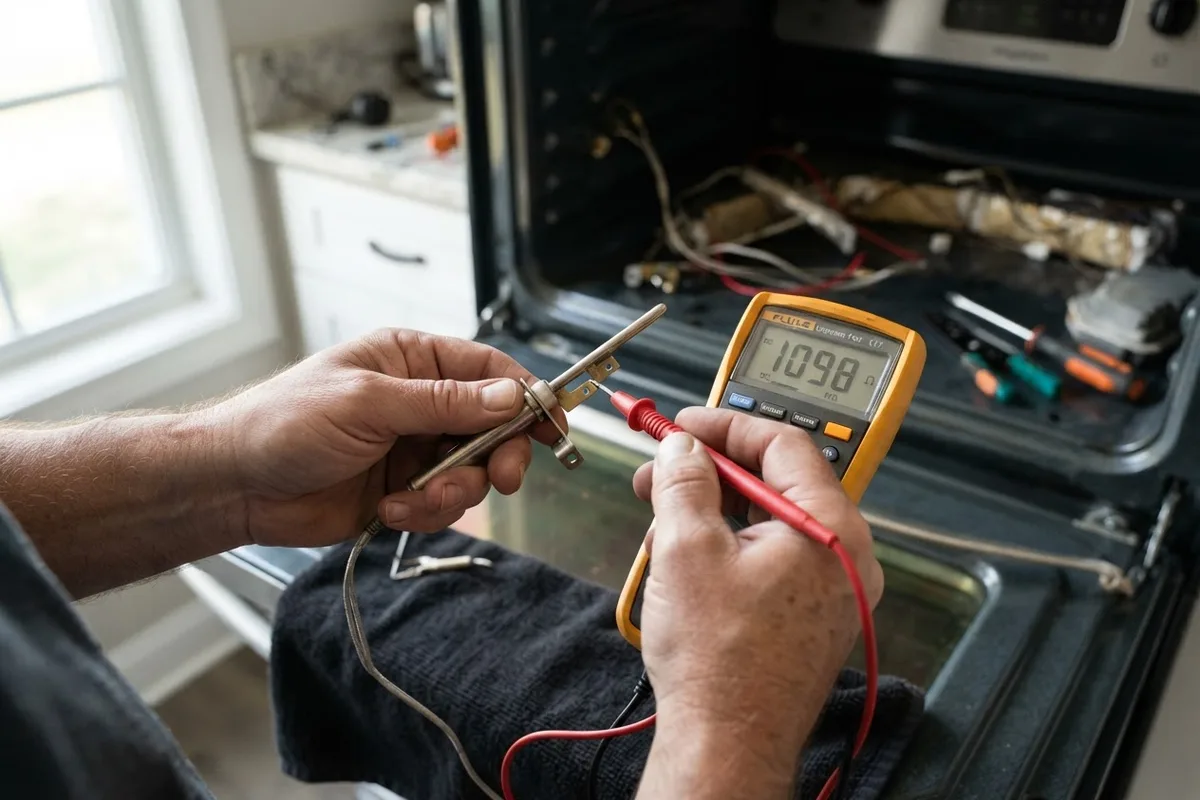
If you are experiencing these signs, you can test your oven thermostat or temperature sensor using a digital multimeter. Safety first: Before doing hands-on work with your appliances, always unplug the oven from the wall outlet or shut off the appropriate circuit breaker in your electrical panel. If you have a gas oven, you must also shut off the gas supply line before proceeding.
Once all power and gas are disconnected, follow these steps:
- Access the Thermostat: The thermostat or sensor is usually near the top corner of the back wall inside the oven cavity. Remove the oven's back exterior panel with a screwdriver to access its wiring.
- Disconnect the Wires: Gently pull the wire connectors off the terminals. Take a photo first for easy reconnection.
- Set Up Your Multimeter: Set your multimeter to the lowest ohms setting (Ω) or continuity.
- Test for Continuity: Place one multimeter probe on each terminal.
- Read the Results: A mechanical thermostat should read close to zero ohms (good continuity). An "OL" or infinite resistance reading means it has failed. An electronic sensor should show a specific room-temperature resistance (often 1,000 to 1,100 ohms, depending on the model). Zero or infinite resistance means it has failed.
If the component has failed, simply unscrew the old component, mount a new one, and reconnect the wiring. It is generally a straightforward DIY replacement.
Quick Reference: Oven Thermostat Symptoms vs. Fixes
| Symptom | Probable Cause | DIY Action |
|---|---|---|
| Takes 30+ mins to preheat | Thermostat prematurely cycling off elements | Test thermostat continuity; replace if dead. |
| Food consistently burnt | Thermostat allowing oven to overheat | Test thermostat/sensor; check calibration. |
| Unevenly baked goods | Erratic element cycling or bad heat distribution | Inspect elements and test thermostat. |
| Display shows wrong temp | Sensor out of calibration or failing | Calibrate oven or replace sensor. |
| Oven won't heat up | Thermostat permanently signaling oven is hot | Test for continuity; replace thermostat. |
| n## When to call a pro |
While diagnosing and replacing an oven thermostat or temperature sensor is often a manageable DIY project, there are times when it is best to call in a professional. If you are not comfortable working with your appliance's rear panel, or if you are unsure about using a multimeter, do not hesitate to seek help.
Safety first: Always stop and call a professional if you are dealing with a gas appliance and suspect a gas leak, if you smell gas, or if you need to perform work involving the gas lines or your home's main electrical panel. Furthermore, if you suspect issues with the oven's internal control board or complex wiring, it is safest to leave it to the experts. True Appliance Repair can match you with a local appliance pro to diagnose your oven safely and get your kitchen back in perfect working order. If your problem extends to other kitchen or laundry appliances, you can also easily connect with an independent local pro through our appliance repair services page.
FAQ
How much does it cost to replace an oven thermostat?
The cost to replace an oven thermostat typically ranges from $100 to $300, including parts and labor, though the exact price varies by your area and the specific oven model. The thermostat part itself is generally affordable, usually costing between $30 and $100, making it a cost-effective repair compared to replacing the entire appliance.
How long do oven thermostats usually last?
Most oven thermostats and temperature sensors are designed to last the entire lifespan of the oven, which is typically 10 to 15 years. However, because they are constantly exposed to high heat and environmental stress, they can degrade earlier. If your oven is more than a decade old and exhibiting temperature issues, a failing thermostat is a likely cause.
Can I still safely use my oven with a broken thermostat?
It is strongly recommended that you do not use your oven if you suspect the thermostat is broken. A failing thermostat cannot accurately control the heating elements, which can lead to severe overheating, burnt food, and even a potential fire hazard. If your thermostat is failing, it is best to keep the oven shut off and unplugged until the component is tested and replaced.
What is the difference between an oven thermostat and a temperature sensor?
Older oven models typically use a mechanical thermostat connected to a copper capillary bulb that expands with heat to regulate the temperature. Modern ovens generally use an electronic temperature sensor (often called an RTD sensor), which changes its electrical resistance based on the temperature. Both components serve the exact same purpose: monitoring and regulating the oven's internal heat.