
That stubborn white haze or milky discoloration spreading across your smooth cooktop can make an otherwise pristine kitchen look neglected. In most cases, cloudiness comes from mineral deposits, baked-on micro-layers of cooking oil, or abrasive cleaning residues rather than permanent glass damage. With a few gentle household supplies and the right technique, you can lift that cloudy film and restore a deep, mirror-like gloss.
Dissolve Mineral Haze With Warm Vinegar
If you live in an area with hard tap water, routine boiling spills leave microscopic calcium and magnesium deposits behind. High burner heat bakes these minerals directly onto the ceramic surface, creating a hazy white film that standard dish soap will not touch.
- Ensure the cooktop is completely cool to the touch, and turn off burner controls.
- Fill a clean spray bottle with undiluted distilled white vinegar.
- Mist the cloudy sections generously until the glass is fully saturated.
- Lay clean microfiber cloths or paper towels over the wet vinegar to slow down evaporation.
- Let the vinegar sit undisturbed for 20 to 30 minutes to break down the mineral scale.
- Lift the towels and wipe the glass firmly in circular motions using a fresh microfiber cloth, then buff dry.
Vinegar contains natural acetic acid that breaks down alkaline mineral scale without scratching delicate tempered ceramic glass.
Lift Baked-On Grease With Baking Soda Paste
Microscopic droplets of aerosolized cooking oil frequently settle on cooktop surfaces. Over weeks of meal prep, repeated heating carbonizes this thin grease layer, turning it into a hazy, cloudy coating that feels slightly textured under your fingertips.
- Lightly spritz the hazy zone with warm water or white vinegar.
- Sprinkle a generous, even coating of pure baking soda directly over the cloudy glass.
- Add a few drops of water until the baking soda forms a thick paste with the consistency of toothpaste.
- Dampen a soft microfiber cloth with hot water, wring it out until damp, and spread it over the paste.
- Allow the moisture and mild alkaline power of the baking soda to soften the baked-on oils for 25 to 35 minutes.
- Gently work the paste across the glass using light pressure with a non-scratch silicone sponge or soft towel, then wipe thoroughly with clean water.
Buff Away Etching Residue With Cooktop Polish
Standard household cleaners containing ammonia or bleach can chemically react with hot ceramic glass, leaving behind an iridescent or chalky white haze. When chemical deposits dry into the microscopic pores of the glass, a dedicated ceramic cooktop polishing cream provides the specialized chemical agents needed to pull the residue out.
- Shake a bottle of dedicated ceramic cooktop cleaner vigorously.
- Pour a quarter-sized dollop directly onto the center of the cloudy area.
- Using an approved non-abrasive yellow cleaning pad, work the cream in tight, overlapping circles with moderate, even hand pressure.
- Continue buffing for two to three minutes until the cleaner begins drying into a light white powder.
- Wipe away the powdered residue using a clean, dry microfiber towel.
- Inspect the surface under direct kitchen lighting; repeat the process once more if deep haze persists.
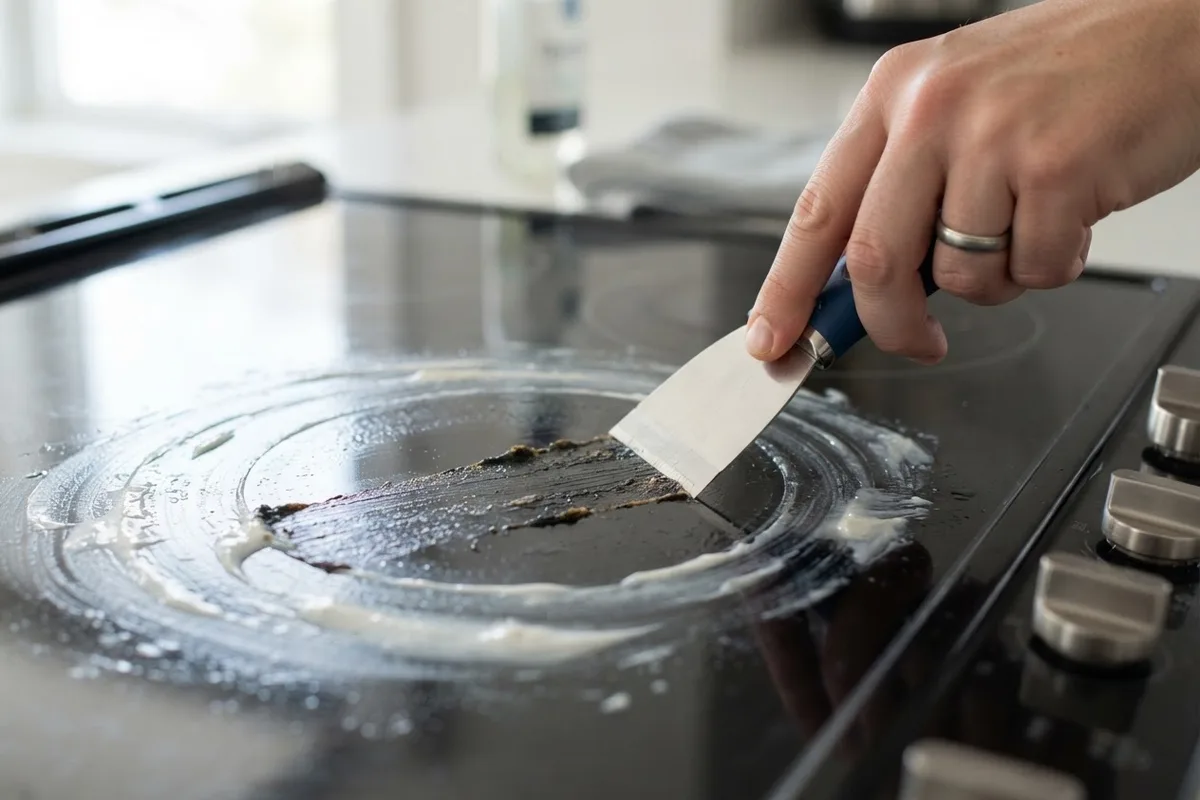
Scrape Stubborn Carbon Deposits With a Fresh Razor
Sometimes what appears to be a cloudy stain is actually an ultra-thin sheet of scorched starch, sugar, or cooking fat baked tightly onto the glass. When chemical pastes fail to lift the cloud, mechanical scraping with a specialized single-edge razor blade is the safest and most effective solution.
- Apply a thin layer of liquid dish soap or cooktop cleaner across the cloudy patch to serve as a safety lubricant.
- Hold a brand-new, rust-free single-edge razor blade at a strict 40-to-45-degree angle against the glass.
- Never hold the blade flat or use the sharp corners, which can gouge the surface.
- Apply steady, gentle downward pressure and slide the blade forward in smooth, short strokes.
- Watch as the cloudy layer lifts off in powdery, curled ribbons.
- Wipe the glass clean with a damp cloth and buff dry with a microfiber towel.
Stop Future Clouding With Pan and Base Maintenance
Even after successfully clearing the cloudy film, old cookware habits can reintroduce the problem during your very next meal. Aluminum and copper-bottomed pans often transfer microscopic metal marks onto glass tops under high heat, mimicking a cloudy white stain.
- Inspect the bottom of your pans before each cooking session for rough ridges, grease deposits, or mineral scale.
- Avoid using unenameled cast iron directly on glass surfaces, as rough iron bottoms grind fine particles into the smooth ceramic.
- Never slide cookware across burners; always lift pans completely when moving them.
- Keep burner rings free from boilover liquids by wiping the stove after every use once it cools.
- Periodically clean the undersides of your pots and pans with warm soapy water to stop burnt grease transfer.
| Cause of Cloudiness | Visual Appearance | Best DIY Removal Method | Preventive Measure |
|---|---|---|---|
| Hard Water Minerals | Faint white haze, chalky spots | Distilled white vinegar soak | Wipe boilovers quickly |
| Carbonized Cooking Oil | Yellow-white cloudy film, slightly rough | Baking soda paste compress | Clean cooktop after each meal |
| Cleaner Residue | Milky streaks or rainbow sheen | Ceramic cooktop polishing cream | Avoid ammonia and glass sprays |
| Scorched Food Layers | Dense cloudy patch over burner ring | 45-degree razor blade scrape | Keep cookware bottoms clean |
| Cookware Metal Transfer | Grayish-white cloudy smudges | Heavy-duty cooktop buffing cream | Lift pans instead of sliding |
When to Call a Pro
Most cooktop cloudiness is surface-level, but internal electrical issues or structural glass damage require professional evaluation. If the cloudiness looks like spiderweb micro-fissures beneath the surface, the glass may have undergone thermal shock from cold water hitting a scorching burner, compromising its structural strength.
Additionally, if a burner glows unevenly, stays stuck on maximum heat, or displays error codes on the digital display, the burner element or infinite control switch may be malfunctioning. Working around internal 240-volt range wiring requires proper diagnostic equipment. Always shut off the dedicated circuit breaker before attempting any hands-on inspection behind appliance access panels.
For complex internal component checks, oven and stove repair services can quickly isolate the underlying electrical failure. If your cooktop glass is cracked or an element has failed completely, True Appliance Repair can match you with a local appliance pro to assess whether a cooktop replacement or part swap is the most cost-effective path forward.
Professional cooktop repairs typically range from $150 to $450 depending on parts and local labor rates, while full glass surface replacements vary significantly by brand and model.
FAQ
Can I use regular glass cleaner like Windex on my glass stove top?
No, you should avoid standard blue glass cleaners containing ammonia on smooth ceramic cooktops. When heated, chemical residues from these cleaners bake into the glass finish, producing a cloudy, permanent haze that is exceptionally difficult to polish out. Stick to dedicated ceramic cooktop cleaners, warm water with mild dish soap, or distilled white vinegar.
Is the cloudy film on my cooktop permanent damage?
In the vast majority of cases, cloudiness is an accumulation of baked grease, minerals, or cleaner residue sitting on top of the glass. True permanent damage usually takes the form of pitting—caused by melted sugar fusing with silica—or thermal cracking. If the glass feels completely smooth and unaffected when scraped gently at a 45-degree angle with a razor blade, the haze is almost always removable.
Why does the white haze return after every use?
The cloudiness usually returns because micro-layers of grease remain on cookware bottoms, or hard water from boiling pots continues to splash onto the heated surface. To prevent recurring haze, wash the undersides of your pans regularly and buff the cooktop with a protective ceramic cream once a week, much like waxing a car to repel stains.
Will a razor blade scratch my smooth glass stove top?
A fresh single-edge razor blade will not scratch ceramic glass as long as you hold it at a 40-to-45-degree angle and use a liquid lubricant like soapy water or cooktop cream. Scratches occur when blades are bent, rusty, held at too steep an angle, or when the sharp corners dig into the surface without adequate moisture to reduce friction.