
When your dishwasher starts acting unpredictably right as holiday cooking and heavier daily dish loads ramp up, a worn-out electronic brain is often to blame. Because a replacement module isn't cheap, guessing wrong wastes both time and money. Walk through these six warning signs and safe reset checks to tell whether your dishwasher control board is failing or another part needs attention.
1. Unresponsive Touchpad or Random Buttons
When you press Start and nothing happens—or only half the cycle buttons respond—the main control board or the touchpad membrane behind it may be losing connection. Moisture from years of hot steam can slowly corrode the thin ribbon cable linking the buttons to the circuit board.
Try these safe steps before assuming the board is dead:
- Check whether Child Lock or Control Lock is turned on, since many models disable all keys except the lock button.
- Turn off the dedicated circuit breaker or unplug the dishwasher under the sink for five full minutes to clear a frozen processor.
- Restore power and test every key gently with dry fingers.
If several keys remain dead or trigger the wrong cycle, review our guide on dishwasher buttons not working to separate a worn keypad from a failing main board.
2. Flashing Lights and Repeated Error Codes
A dishwasher flashing lights like a holiday display or showing the same fault code right after a reset often signals scrambled logic on the main board. While error codes normally point to specific sensors or valves, a damaged processor can fire off false alerts that don't match what the machine is actually doing.
Follow these steps to verify whether the alert is real:
- Write down the exact blinking light pattern or code shown on the display.
- Shut off power at the breaker for five minutes, then restore power and start a short quick cycle.
- Watch whether the exact same code returns immediately before water even enters the tub.
Immediate error codes right at startup—especially communication faults—strongly point toward a failing control board rather than a mechanical part further down the line.
3. Cycles Stopping or Restarting Mid-Wash
If your machine shuts down halfway through a wash, leaves the display blank, or keeps restarting from minute one, the main board's relay switches or voltage regulator may be overheating. As electronics age, tiny solder joints crack and expand once the door warms up, cutting power to the rest of the cycle.
Use these checks to isolate a heat-related board glitch:
- Make sure the door latches firmly and doesn't pop loose when the tub warms up.
- Run an empty cycle and note the exact minute the machine stalls or resets.
- Feel the top or front edge of the door near the console for unusual heat right after it shuts off.
Consistent stalls at the same point in every cycle—without any tripped breaker—usually point back to an unstable control board or loose wire harness.
4. Dishwasher Won't Advance or Shut Off
A control board acts like a timer and traffic cop, telling each component when to start and stop. When a relay sticks in the closed position, the dishwasher can get trapped on a single step for hours, keep running after the timer hits zero, or turn a pump on when nobody pressed Start.
Perform these safe checks before opening any panels:
- Cancel the active cycle using the Cancel or Reset key and wait three minutes for the machine to stand down.
- Shut off the breaker and turn off the under-sink water supply valve if a component stays running continuously.
- Wait ten minutes, restore power without pressing Start, and listen closely.
If a pump or heater starts running again on its own the moment power returns, a stuck relay on the main control board is the likely culprit.
5. Burnt Smell or Scorch Marks on the Board
An acrid, burnt-plastic electrical smell coming from the upper door console is a serious warning sign that shouldn't be ignored. Power surges, trapped steam, or high-amperage heater currents can char relays and melt plastic pin connectors right on the circuit board.
You can do a careful visual inspection safely:
- Turn off the dishwasher's circuit breaker—or unplug the power cord—and verify the display is completely dead.
- Shut off the under-sink water supply valve as an extra precaution.
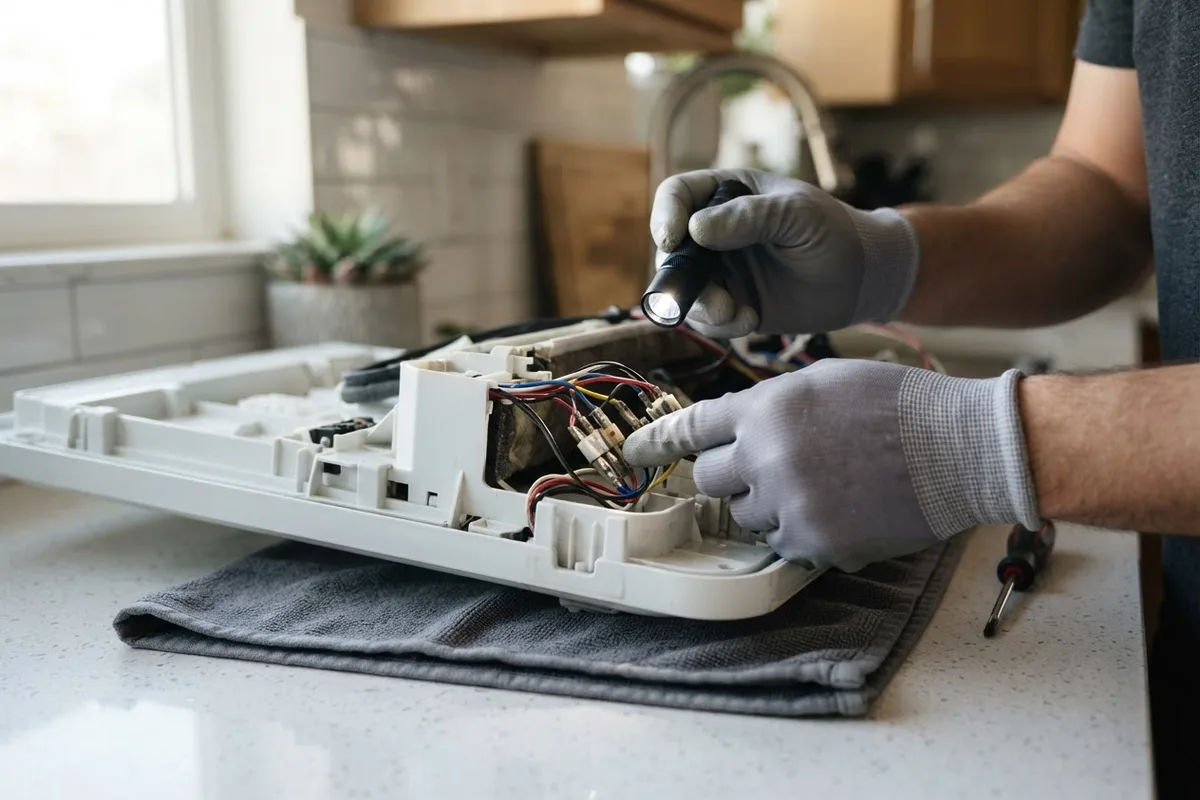
- Remove the inner door screws supporting the top console and look for darkened spots, melted wire plugs, or bulging capacitors on the board.
Stop immediately if you spot charred wiring or scorched fiberglass. Never try to scrape, solder, or bypass a burnt board yourself—keep the breaker off and call an appliance pro for safe replacement.
6. Breaker Trips as Soon as a Cycle Starts
A dishwasher that trips your home's circuit breaker the instant you press Start—or right when a specific phase kicks in—may have a shorted component on the control board. While faulty heating elements and motors also cause trips, damaged board traces can create a direct short inside the door console.
Stick to these basic safety checks only:
- Reset the breaker once and check whether it trips immediately before you even touch the dishwasher panel.
- Make sure no water has leaked onto the lower junction box or the outlet under the sink.
- Stop resetting the breaker if it trips a second time.
Repeated breaker trips are an electrical hazard, not a DIY project. Leave the circuit switched off and have an appliance technician or electrician trace the short safely.
Quick Check: Control Board vs. Simple Fixes
Because main boards typically cost $150 to $450 for parts and professional labor combined—though exact pricing varies by area and model—it pays to rule out cheaper look-alike failures first. Use this quick reference to compare common symptoms before ordering parts:
| Warning Sign | Likely Control Board Issue | Common Look-Alike Part | First Safe Check |
|---|---|---|---|
| Dead or scrambled buttons | Failed processor or ribbon fault | Worn touchpad or Child Lock | 5-minute breaker reset |
| Instant startup error codes | Corrupted logic memory | Loose wire harness plug | Check code after power reset |
| Stops mid-cycle when warm | Cracked solder joint on board | Weak door latch switch | Test door latch alignment |
| Runs nonstop when off | Welded relay on circuit board | Stuck float switch | Listen after restoring power |
| Burnt electrical smell | Scorched relay or connector | Overheated junction box wire | Shut breaker off and inspect |
If your dishwasher is more than eight to ten years old and needs a costly main board, compare repair quotes against the price of a new unit before deciding.
When to Call a Pro
Simple breaker resets and checking for a loose door latch are safe for most homeowners, as long as the power stays off while panels are open. However, stop and call an appliance pro if you discover burnt board traces, melted wire harnesses, or repeated circuit breaker trips. Never work inside your home's main electrical panel yourself.
An experienced technician can test voltage at the board safely, confirm whether a faulty heater or motor overloaded the relay, and prevent a brand-new board from burning out the moment it's installed. If you're ready for hands-on diagnostics, True Appliance Repair can match you with a local appliance pro who works on your dishwasher brand. You can also reach out through our contact page to schedule a local service visit.
FAQ
How much does it cost to replace a dishwasher control board?
Most homeowners pay between $150 and $450 for a control board replacement including parts and labor, though exact costs vary by area and model. High-end stainless units with integrated touchscreens can run higher. Always confirm the diagnosis before buying non-returnable electronic parts.
Can a power surge ruin a dishwasher control board?
Yes. Even a brief voltage spike from a storm or power grid flicker can damage sensitive microchips and relays on the board. Plugging cord-connected models into a surge-protected outlet—or having an electrician install whole-home surge protection—helps protect modern appliance electronics.
How do I reset my dishwasher control board safely?
Turn off the dedicated circuit breaker for your dishwasher—or unplug it under the sink—for five full minutes. This drains residual power from the board's capacitors and clears temporary software glitches. Restore power and run a short cycle to see if normal operation returns.
Is it worth replacing a control board on an older dishwasher?
If your dishwasher is under seven years old and in good shape otherwise, replacing the board usually makes financial sense. Once a machine passes eight to ten years, putting several hundred dollars into an older model often isn't worthwhile compared to a replacement unit.