
Pulling on a dishwasher handle only to meet stiff resistance is a frustrating kitchen surprise, especially when clean dishes are locked inside right before mealtime. A door that refuses to unlatch usually stems from an engaged control lock, a misaligned strike plate, trapped thermal steam, or an interrupted wash cycle. With a few systematic troubleshooting steps, you can safely unbind the door latch and restore your kitchen routine without damaging the appliance.
Always prioritize personal safety and appliance protection before attempting any physical troubleshooting on a sealed appliance. Turn off the dishwasher's power at the dedicated wall switch or trip its breaker in your home's main electrical panel. If the machine recently finished running or stalled mid-cycle with scalding water pooled inside, let the unit cool for at least forty-five minutes so hot liquid or escaping vapor cannot burn your skin.
Deactivate the Child Lock Feature
Most modern dishwashers feature a control lock or child lock setting designed to prevent children from opening the door while the wash arms spin at high speeds. When this digital lock is active, the control module can keep an internal electronic latch solenoid energized or disable the console release switches entirely.
- Inspect the control display for an illuminated padlock icon or a small glowing indicator light positioned above labels such as "Control Lock," "Child Lock," or "Lock 3 Sec."
- Locate the corresponding unlock button printed on the control console. On most major brands, this function shares space with buttons like "Heated Dry," "Steam Clean," "Options," or "Start/Cancel."
- Press and hold the designated lock button firmly for three to five continuous seconds until you hear a series of auditory chimes or see the status light switch off.
- Once the indicator light disappears, grasp the door handle and pull outward with steady, even force.
- If the control console remains completely dark or unresponsive to your touches, the keypad might be locked by a transient system crash, which requires a hard electrical reboot.
Inspect the Door Handle and Catch Mechanism
Over years of daily kitchen use, the internal plastic pivot pins and mechanical linkages within the door handle assembly can fatigue, crack, or slip out of position. If the handle feels loose, flaps without spring tension, or lifts freely without clicking, the outer lever has likely disconnected from the interior release pawl.
- Verify that electrical power to the dishwasher is completely disconnected at the breaker box before inserting any tools near the door frame.
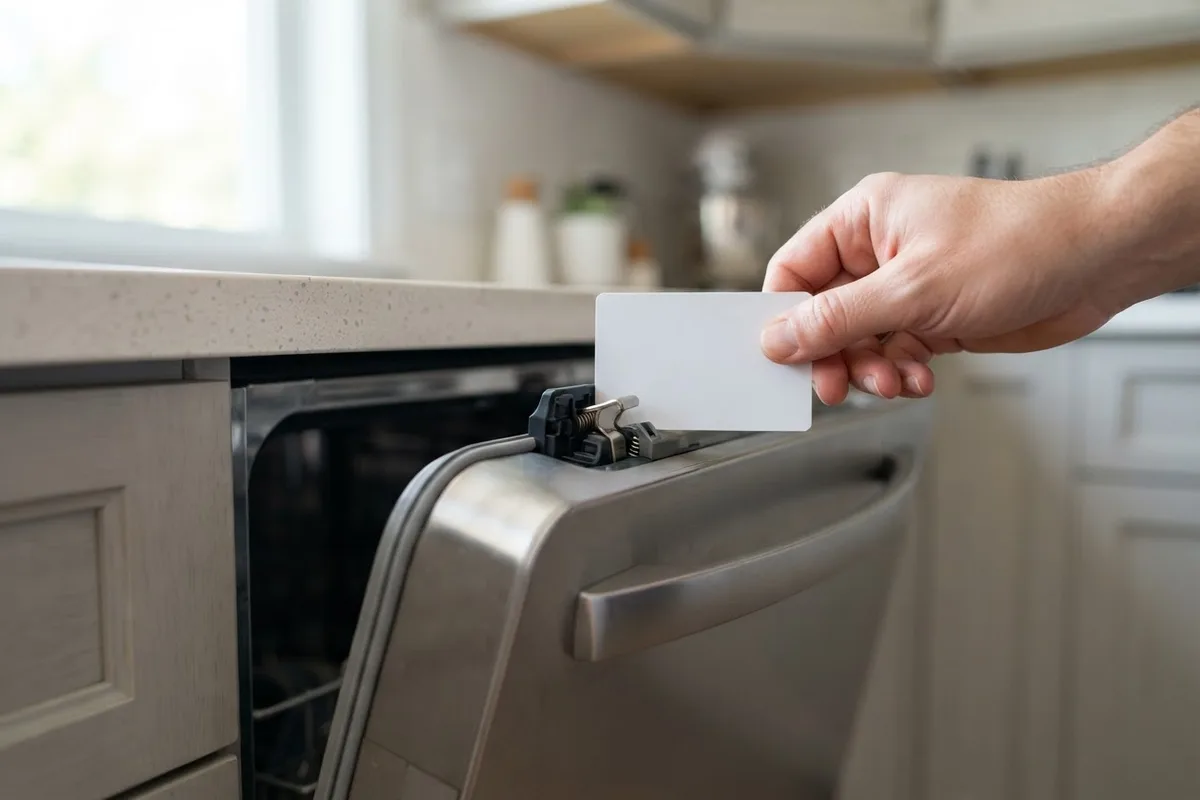
- Take a thin, flexible plastic putty knife, an old rewards card, or a stiff nylon trim removal tool and gently slide it into the narrow seam directly above the center handle.
- Slowly sweep the card horizontally along the top edge of the door until you make contact with the spring-loaded metal strike hook or plastic latch jaws.
- Lightly press upward or angle the edge of the card against the latch tongue while applying gentle outward pressure on the handle to disengage the hook.
- Never pry against the door frame using metal flathead screwdrivers, kitchen knives, or heavy metal pry bars. Metal tools will gouge the outer finish, crack the plastic control console, or puncture the watertight rubber tub gasket.
Run a Hard Electrical Reset
Dishwashers operate using complex microprocessors that supervise cycle temperature, drain timers, motor speed, and door interlocks. A momentary line voltage surge, sudden brownout, or interrupted drain sequence can cause the main circuit board to hang, leaving active electronic solenoids clamped tightly shut.
- Walk to your home electrical service panel and flip the dishwasher's circuit breaker to the full "OFF" position.
- If your dishwasher connects to a standard three-prong wall outlet under the kitchen sink rather than a direct junction box, unplug the power cord directly from the wall receptacle.
- Allow the appliance to remain completely without power for ten to fifteen full minutes so the board's internal storage capacitors discharge all residual electrical current.
- Flip the breaker switch back to "ON" or firmly plug the power cord back into the wall outlet.
- Listen closely as the appliance powers back up; you should hear the computer complete a short startup diagnostic and cycle the door latch release motor.
If the door opens after the reboot but routinely jams during future washes, consult our detailed troubleshooting guide on why your dishwasher door is not latching properly to evaluate your door strike adjustments.
Release a Stuck Thermal Latch or Solenoid
Many high-efficiency and quiet-package dishwashers use a bi-metal thermal interlock or a continuous electromagnetic solenoid. These protective mechanisms are engineered to keep the door firmly clamped shut until internal tub temperatures drop below scalding thresholds or until steam sensors detect that the drying cycle has completed.
- If the wash cycle completed recently, give the appliance 45 to 60 minutes to naturally radiate its heat into the room and drop to ambient temperature.
- Touch the outer door skin with the back of your hand. If the stainless steel or composite panel still feels hot, the heating element may have run excessively long. You can explore thermal safety issues in our guide on why your dishwasher is overheating.
- Once the exterior cools, place the flat of your palm against the upper center of the door panel and push inward firmly. While pushing inward to relieve tension on the thermal locking pin, squeeze the door release lever.
- If an electromagnetic solenoid remains locked due to a failed thermal sensor, cutting breaker power allows the bi-metal strip inside the latch to cool and contract, releasing the mechanical hook.
| Lock Malfunction | Physical Symptom | Primary DIY Action | Typical Component Cost |
|---|---|---|---|
| Control Lock Active | Padlock LED illuminated on panel | Hold unlock button 3–5 seconds | $0 |
| Broken Handle Link | Handle moves loosely with no catch | Release catch with plastic card | $25 – $65 |
| Control Board Crash | Frozen screen or completely dark | 10-minute circuit breaker reset | $0 |
| Thermal Sensor Delay | Outer door hot to the touch | Allow 60 minutes to cool | $30 – $85 |
| Dish Rack Binding | Door bowed slightly outward | Push inward firmly while pulling handle | $0 – $40 |
| Standing Water Interlock | Water visible through door bottom | Run manual cancel/drain sequence | $45 – $110 |
Clear Rack Obstructions and Standing Tub Water
Physical blockages inside the wash cabinet can apply heavy outward pressure against the door liner, wedging the strike tongue tightly against the locking pawl. Furthermore, select smart models incorporate float-switch interlocks that refuse to unlatch if dirty wash water fails to drain at cycle completion.
- Examine the side seam margins where the dishwasher door meets the surrounding cabinetry. The gap should remain straight and uniform from top to bottom on both sides.
- If the gap pinches near the top edge, an oversized stockpot, tall baking sheet, or displaced utensil basket handle may be pressing firmly against the inner door panel.
- Lean your hip or forearm firmly against the upper-middle section of the door to compress the rubber door seal, relieving mechanical friction on the latch hook, then squeeze the release lever.
- If you peek through the lower door seam and spot standing water covering the bottom filter, the machine may be holding the lock for safety. Turn power back on, press and hold the "Cancel/Drain" key for three seconds, and let the drain pump empty the tub completely before attempting to open the door again.
Should persistent latch friction continue after opening the door, check our practical overview on fixing a dishwasher door that pops open during use for instructions on resetting hinge springs and leveling cabinet legs.
When to Call a Pro
When a dishwasher door stays stubbornly shut after you have disabled the control lock, power-cycled the household breaker, and attempted safe manual latch manipulation, the issue often stems from melted internal wiring harnesses, a burned microswitch terminal, or a warped tub chassis. Trying to force open a jammed door with crowbars or screwdrivers will bend internal hinge pivots, warp the stainless steel wash chamber, or crack the front door glass, transforming a straightforward switch replacement into a major appliance overhaul.
Professional diagnostic and repair visits for faulty dishwasher latches, control boards, and thermal interlocks typically range from $120 to $260 depending on your regional labor rates and machine brand. If you detect an electrical burning odor, observe scorched console plastics, or cannot disengage the latch safely, discontinue DIY efforts. True Appliance Repair can match you with an experienced local technician who can safely open the door, diagnose electrical failures, and get your kitchen running smoothly again.
FAQ
Can I force my stuck dishwasher door open using a screwdriver?
No, you should never use screwdrivers, pry bars, or metal knives to force open a stuck dishwasher door. Metal tools will chip the enamel paint, bend the internal door strike, crack expensive electronic consoles, and tear the perimeter rubber gasket, causing major water leaks during future cycles. Use only flexible plastic cards for manual releases, or contact a repair specialist if gentle techniques do not work.
Why does my dishwasher stay locked after the cycle finishes?
Many dishwashers keep the door locked automatically during sanitizing and heated dry cycles to prevent burns from hot steam and scalding water. In most cases, the internal safety mechanism releases on its own once internal temperatures drop to a safe level, which normally takes between 20 and 45 minutes after the timer reaches zero.
How can I tell if my door latch microswitch has failed?
If your dishwasher door opens physically but the appliance refuses to recognize that the door is shut, or if the unit will not start and constantly displays a flashing door alert, the microswitch inside the latch assembly has likely failed. A technician tests these small electronic switches for electrical continuity using a multimeter with the appliance completely disconnected from power.
Does cutting breaker power always open an electric dishwasher lock?
Turning off the circuit breaker works on dishwashers equipped with an electromagnetic solenoid lock or a bi-metal thermal latch. Without continuous electrical power, solenoids automatically drop into their open position, and thermal metal strips cool down and contract, usually freeing the door latch within ten to fifteen minutes of shutting off the electricity.