
A dishwasher door that pops open mid-cycle instantly brings your wash cycle to a halt, leaving dishes covered in soapy residue and sometimes splashing water onto your kitchen floor. In most cases, internal water pressure, expanding heat, rack misalignment, or a shifting latch assembly pushes the door just past its release threshold.
Before you spend money on an unexpected replacement, you can troubleshoot and resolve the underlying issue using simple hand tools. Here is how to track down why your dishwasher door keeps popping open and secure it so your appliance completes every cycle without interruption.
Turn Off Power and Water Supply Before Inspecting
Before performing any physical inspection, safety comes first. Any time you examine moving mechanical assemblies, electrical strike switches, or water seals, you need to eliminate risk.
- Locate your home electrical service panel and switch off the dedicated circuit breaker supplying power to the dishwasher, or unplug the unit from beneath the sink.
- Turn the shutoff valve on the hot water supply line (commonly located under the kitchen sink) clockwise until fully closed.
- Open the dishwasher door fully and inspect the interior tub for lingering hot steam or standing water.
- Allow the heating element and tub to cool down completely before touching internal components.
Taking these initial precautions keeps you safe from accidental electrical shocks or unexpected cycle restarts while your hands are working around the latch.
Reposition Overhanging Dishes and Adjust the Racks
One of the most common reasons a door suddenly unlatches mid-wash is internal physical pressure from loaded dishware or an unseated rack. As the spray arms rotate and jet water throughout the tub, an oversized plate or protruding cutting board can nudge the interior door liner until the latch clicks open.
- Open the door and pull both the top and bottom dishracks all the way out.
- Look closely at the rear end caps and guide wheels on each rack rail. Ensure every wheel sits securely inside its metal track.
- Check if tall baking sheets, oversized skillets, cutting boards, or long utensil handles placed on the lower rack stick out past the front perimeter.
- On adjustable upper racks, ensure the height-adjustment clips on both left and right sides are clicked firmly into the exact same height notch. If one side is tilted, the rack bumper will push unevenly against the door.
- Slide both racks completely back into the tub. Gently push the door shut to verify that the door inner liner clears the front edge of the racks with at least a quarter-inch of breathing room.
Realigh and Tighten the Door Latch and Strike Plate
The door latch mechanism relies on a precise connection between the strike plate mounted to the upper frame of the tub and the catch mechanism housed inside the top door panel. Over months of daily use, opening and closing vibrations loosen the mounting screws, causing the catch to slip out under normal tub expansion.
- Open the door to expose the inner stainless steel or plastic door liner.
- Use a Phillips or Torx screwdriver (commonly T15 or T20) to check the mounting screws along the upper edge of the inner door panel.
- Examine the plastic latch handle and internal microswitch assembly. If the latch assembly wiggles when touched, tighten its anchoring screws.
- Look at the metal strike plate tab located at the top center of the main cabinet tub. If the strike loop is bent downward or loose, loosen the mounting bracket screws, straighten the tab, slide it slightly forward or backward to improve engagement, and retighten.
- Test the closure: shut the door firmly until you hear a crisp, distinct mechanical click. Try gently pulling on the handle without pressing the release button; the door should stay firmly locked.
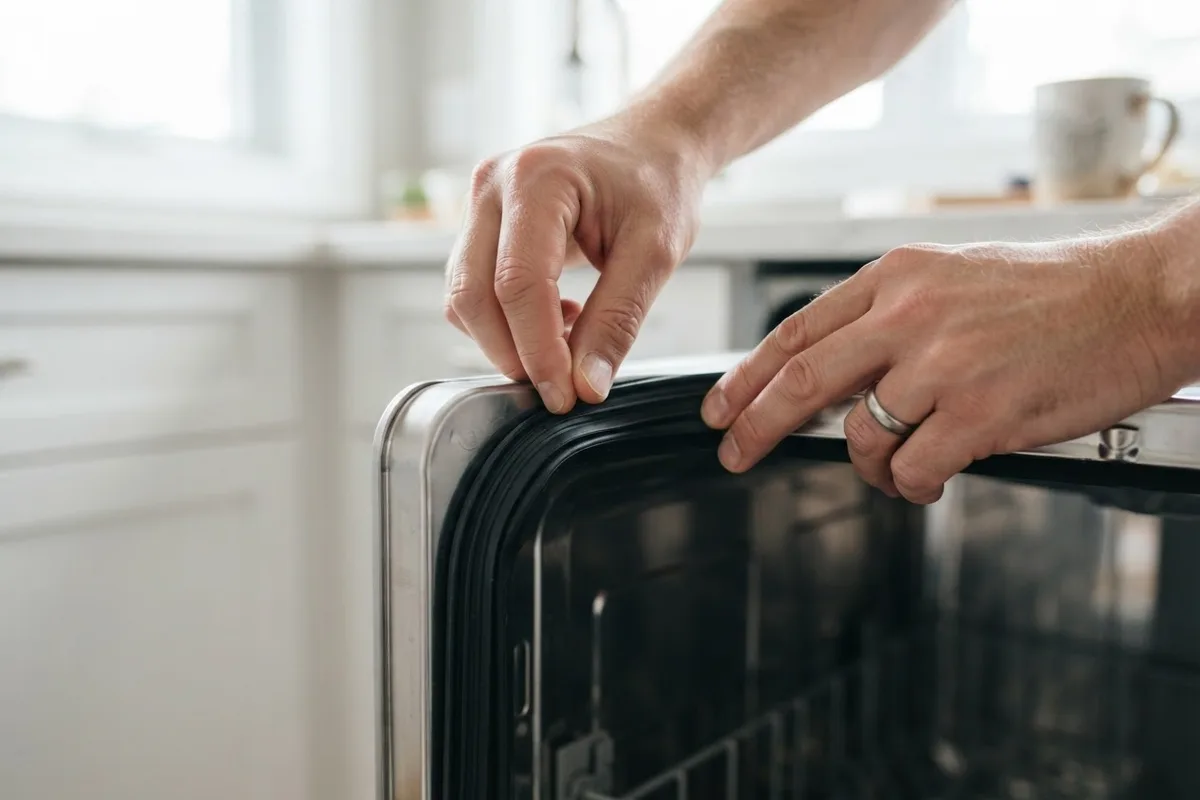
Reseat or Replace the Rubber Perimeter Door Gasket
The black or gray rubber door gasket seals water inside the tub. Over time, heat cycles can warp the rubber, or debris can build up behind the channel, pushing the gasket outward. When the seal becomes too thick or pops loose from its track, it pushes back against the door with enough force to pop the latch loose as the tub heats up.
- Inspect the entire rubber seal that runs along the left, top, and right perimeter of the tub opening.
- Check for twisted sections, high spots, or areas where the gasket has pulled out from the metal retention channel.
- Clean out the mounting channel with a soft microfiber cloth and warm soapy water to clear out mineral scale or dried detergent build-up.
- Starting at the top center of the tub, press the gasket firmly and evenly into the groove with your thumb, working outward toward the bottom corners. Avoid stretching the rubber as you press it in.
- If the rubber feels brittle, cracked, or permanently flattened, pull the old seal out entirely and press a new manufacturer-specified replacement gasket into the channel. If you also notice moisture along other seams, check our guide on why your dishwasher vent is leaking water for additional sealing checks.
Level the Appliance and Square the Cabinet Opening
If your dishwasher is not perfectly level, or if it sits wedged crookedly inside your kitchen cabinetry, the entire tub frame can twist slightly. A twisted chassis prevents the latch from seating fully into the strike pocket, making it prone to springing open as soon as the motor creates wash pressure.
- Remove the bottom toe-kick panel (access panel) near the floor by removing the two lower retaining screws.
- Place a small spirit level across the front top lip of the dishwasher tub with the door open.
- Check the level along both the left-to-right axis and the front-to-back axis along the inner side walls.
- Use an adjustable wrench to raise or lower the threaded leveling legs on each front corner. Turn clockwise to raise a corner, or counter-clockwise to lower it.
- Ensure the mounting brackets screwed into the underside of the countertop or adjacent cabinet side panels are not pulling the top frame out of square.
- Close the door slowly and watch the gaps along both the left and right vertical edges. The spacing between the door edge and the cabinet frame should remain identical from top to bottom.
| Issue / Cause | Visual Sign | Quick DIY Fix |
|---|---|---|
| Rack Interference | Door bounces slightly when pushed shut | Realign rack tracks and reposition oversized cookware |
| Loose Latch Screws | Latch housing moves or rattles | Tighten Torx/Phillips screws on inner door panel |
| Bent Strike Plate | Latch fails to produce a crisp snap | Straighten strike tab on upper tub frame and retighten |
| Displaced Gasket | Rubber seal bulging out of metal channel | Press gasket evenly into groove starting at top center |
| Chassis Out of Level | Uneven vertical gap along side of door | Adjust front threaded leveling legs with a wrench |
Replace Damaged Door Springs or Friction Hinges
Dishwasher doors use heavy-duty counterbalancing springs and tension cables connected to lower hinge pivots. If one spring snaps or a friction pad binds, the uneven tension pulls the door sideways, putting lateral strain on the latch until it pops free during wash vibration.
- With the breaker off and water supply closed, remove the toe-kick panel to view the lower left and right hinge corners.
- Look for the long steel counterbalance springs running along the base of the machine.
- Inspect the nylon tension pulleys and cords attached to each spring. If a cord is frayed or a spring has lost tension, both sides must be replaced as a matched set.
- Verify that the door drops smoothly and stops naturally at a 45-degree angle when released gently. If the door feels excessively heavy or snaps shut violently, the spring tension requires adjustment.
- If mechanical drive components like the wash motor vibrate unusually hard while the unit runs, explore our troubleshooting guide on why your dishwasher is humming to eliminate pump binding issues.
When to Call a Pro
Most causes of a dishwasher door popping open can be resolved in under an hour with basic screwdriver adjustments and rack clearing. However, some problems involve structural framing issues, warped inner stainless tubs, or failing electronic control board latch sensors that require deeper technical diagnosis.
If adjusting the leveling legs, replacing the strike plate, and reseating the gasket do not solve the problem, or if you notice scorch marks near the door's internal wiring harness, leave the unit turned off. In these cases, reaching out for professional dishwasher repair services is the safest next step. True Appliance Repair can match you with an experienced independent local appliance pro to inspect the hinges, control latches, and internal alignment quickly. Professional appliance diagnostic visits typically range from $80 to $150 across most US regions, with final repair costs varying by area, brand, and required replacement parts.
FAQ
Why does my dishwasher door pop open only during the heated dry cycle?
During the heated dry phase, internal air temperatures rise rapidly, creating positive thermal pressure inside the sealed tub. If the door latch is marginally loose or the air vent passage is slightly restricted, this expanding warm air pushes the door open just enough to release the catch.
Can a bad water inlet valve make my door pop open?
Yes. If an inlet valve overfills the tub with too much water, the wash motor forces surging waves against the door panel during spray cycles. The physical force of excessive sloshing water can hammer against the door liner until the latch releases.
How tightly should my dishwasher door latch close?
When closed properly, the door should latch with an audible click and require moderate hand force to pull open. There should be virtually no free play or wiggling when you press gently against the top corners of the closed door panel.
Is it safe to run the dishwasher if I have to tape or prop the door shut?
No. Never prop, clamp, or tape a dishwasher door shut to force a cycle to run. If the latch is loose, water and steam can escape, creating water damage across subflooring and cabinet bases, as well as risking electrical shorts inside the door panel.