
You press start, close the door, and expect the familiar rush of water—only to hear a continuous, low electrical buzz. When a dishwasher hums without filling, washing, or cycling through its stages, it usually means electric current reaches a motor or valve that cannot physically move.
Catching this issue quickly prevents the motor from overheating or burning out its internal windings. Before taking anything apart, always flip the dedicated breaker in your electrical service panel or unplug the appliance beneath the sink to protect yourself from shock.
Here are the five most common reasons for a humming dishwasher and how to troubleshoot each one safely.
1. Clear Debris Jamming the Wash Impeller
A small foreign object—such as a piece of broken glass, a fruit pit, a toothpick, or a stray twist tie—is the top reason a circulation motor hums without turning. The motor attempts to spin the wash impeller, but the blockage locks the blades tight.
- Cut all power to the appliance at the breaker panel.
- Pull out the bottom dish rack and remove the lower spray arm (it usually twists or unclips easily).
- Unscrew the pump intake cover at the base of the wash tub.
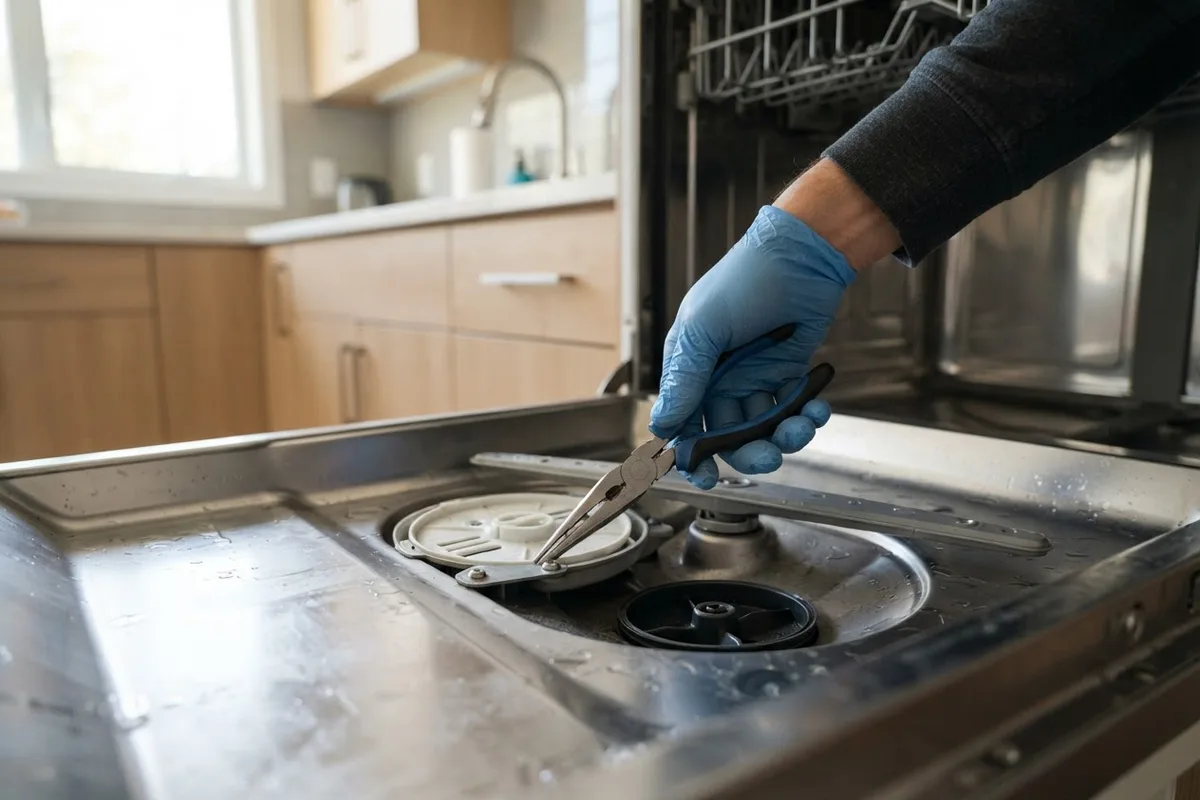
- Wear thick work gloves to protect against hidden broken glass, and carefully inspect the impeller blades.
- Rotate the impeller manually with a gloved finger or pencil. If it feels locked, use needle-nose pliers to remove trapped debris until the blades spin freely.
2. Unstick a Frozen Motor Shaft
Dishwashers that sit idle for several weeks—especially after vacations or in vacation homes—frequently suffer from seized motor seals. Mineral residue dries out around the pump shaft, creating just enough friction to hold the motor rotor in place when powered on.
- Disconnect power to the unit.
- Access the circulation motor, either through the lower front kickplate (toe kick) or from beneath the tub.
- Locate the exposed fan blade or slotted shaft at the rear of the circulation pump motor.
- Use a flathead screwdriver or your fingers to spin the motor shaft manually two or three full rotations.
- Once the shaft breaks free of mineral stiffness, restore power and start a short cycle to confirm it spins smoothly on its own.
3. Check for a Clogged Water Inlet Valve
If the humming happens right at the beginning of the cycle when the machine normally fills with water, the electric solenoid on the water inlet valve may be energized while water flow is physically blocked.
- Shut off both the electrical breaker and the hot water shutoff valve under the kitchen sink.
- Remove the lower front access panel to locate the water inlet valve where the braided water line attaches.
- Disconnect the water supply line and place a small bucket underneath to catch residual drips.
- Inspect the fine wire mesh screen inside the valve inlet port. Hard water scale, pipe sediment, or rust can completely choke this screen.
- Clean the screen gently with a soft toothbrush and diluted white vinegar, or replace the entire inlet valve assembly if the solenoid remains mechanically stuck.
If hard water scale is a recurring issue in your kitchen plumbing, you can read our guide on how to remove hard water from appliances to protect internal components.
4. Inspect the Drain Pump for Obstructions
Modern dishwashers use a dedicated drain pump motor separate from the main wash pump. If your cycle completed its wash stage and now produces a steady hum without pumping wastewater out, the drain impeller is likely jammed.
- Disconnect electrical power completely.
- Sponge out any standing water resting in the bottom basin.
- Remove the sump filter assembly and the plastic drain pump cover cap (often secured by a single Torx screw or locking tab).
- Inspect the small plastic drain impeller for wrapped string, hair, or lodged food particles.
- Clear any debris and verify the small blades spin with moderate, distinct magnetic resistance (a slight "click-click" feel as you rotate it is normal for magnetic drain pumps).
5. Test for a Faulty Motor Start Capacitor
Many dishwasher circulation pumps rely on a small cylindrical start capacitor to give the motor the initial electrical boost required to begin spinning. If this capacitor degrades or fails, the motor receives running voltage but lacks the torque to break inertia, resulting in a persistent hum.
- Disconnect the appliance from power.
- Locate the capacitor mounted near the main circulation pump under the unit.
- Inspect the capacitor casing for visible bulging, dark scorching, or leaking fluid.
- If you have experience using a digital multimeter set to capacitance mode, safely discharge the capacitor across a high-ohm resistor and check its microfarad (µF) reading against the rating on the label.
- If the capacitor tests out of spec or shows physical swelling, swap it with an exact manufacturer-specified replacement part.
Diagnostic Quick-Reference Guide
| Hum Location / Timing | Most Likely Cause | DIY Difficulty | Next Step |
|---|---|---|---|
| Immediately at cycle start (no water entering) | Blocked water inlet valve screen | Easy | Clean inlet screen; check shutoff valve |
| After fill cycle completes | Jammed wash pump impeller | Moderate | Remove sump cover, extract debris |
| After weeks of non-use | Seized motor shaft seal | Easy to Moderate | Spin motor shaft manually via access panel |
| Mid-cycle or end-cycle (water remaining) | Trapped debris in drain pump | Moderate | Clear drain pump cover and impeller |
| Continuous hum with free-spinning motor | Blown start capacitor / failed motor | Advanced | Test capacitor or replace motor assembly |
When to Call a Pro
While clearing food debris or freeing a stiff impeller is a straightforward weekend task, some motor failures require specialized tools. If the motor hums because of shorted internal stator windings, severe bearing wear, or an electrical fault inside the main control board, replacing internal drive components can be complex.
Professional repairs for dishwasher pump and motor replacements typically range between $150 and $400 depending on your appliance model and local labor rates. If your unit is older or showing broader wear, check our overview on how to extend appliance lifespan to evaluate whether a repair makes sense. When you prefer an experienced technician to handle complex motor disassembly, True Appliance Repair can match you with an independent local appliance pro in your neighborhood.
FAQ
Can running a humming dishwasher cause a fire?
A humming motor that cannot turn draws locked-rotor amperage, which causes heat to build up inside the motor windings. Modern appliances have built-in thermal overload protectors that shut off power before a fire starts, but leaving the unit humming continuously can permanently burn out the motor or damage internal wiring.
Why does my dishwasher hum even when turned off?
If you hear a hum while the machine is off, an internal electrical relay on the control board may be stuck closed, continuously energizing the drain pump or fill valve. Turn off the circuit breaker immediately to prevent component damage while you inspect the board or wiring.
How do I know if my dishwasher motor is burned out?
If you have completely cleared all debris, verified the shaft turns freely by hand, and tested the capacitor, but the motor still only hums without spinning when energized, the internal copper windings have likely shorted or degraded. At that point, the motor requires replacement.
Is it worth replacing a dishwasher circulation pump?
If your dishwasher is under eight years old and the rest of the tub, racks, and door seals are in solid shape, replacing the pump assembly is generally cost-effective compared to buying a brand-new unit. For older machines nearing the end of their operational life, replacement may be the more economical long-term choice.