
When you turn on a cooktop burner, you expect a crisp, uniform ring of blue flame ready to simmer sauce or sear dinner. When half the ring refuses to ignite or spits ragged flames on only one side, cooking temperatures fluctuate and pans heat unevenly. Before assuming you need an expensive replacement, you should know that an uneven flame is almost always caused by everyday kitchen residue, trapped wash water, or a slightly misaligned part.
Troubleshooting your range cooktop takes just a few basic household supplies and less than an hour of your time. Before starting any hands-on inspection, always confirm the burner knobs are in the "Off" position and that all grates and metal parts are completely cold to the touch. Unplug the range power cord from the wall outlet or flip the cooktop circuit breaker to prevent accidental sparks while you work.
1. Realign the Burner Cap on the Base
The most frequent cause of a lopsided or broken flame ring is a burner cap sitting slightly askew. When you wipe down the range surface after cooking, a sponge or cleaning cloth can easily nudge the heavy cast-iron or enameled cap off its center ridge. Even a millimeter of tilt disrupts the balanced flow of air and gas beneath the cover, causing the flame to surge on the open side while starving the other.
- Wait until the range top is cool to avoid burns.
- Lift the cast-iron grate off the cooktop and set it aside on a soft towel.
- Pick up the burner cap and inspect the underside for small positioning notches, pins, or an indented lip.
- Lower the cap squarely onto the burner head, gently rotating it until you feel it drop into its molded grooves.
- Gently tap the outer rim with your fingertips; the cap should sit completely flat without rocking, wobbling, or sliding.
Once the cap is seated flat, reconnect power, turn the control dial, and check if the flame ring forms a complete, uniform circle around the circumference.
2. Clear Spills from Blocked Burner Ports
Boil-overs from pasta pots, greasy frying splatters, and burnt marinara frequently drip down into the burner ring. When these liquids dry and bake under intense heat, they turn into rock-hard carbon crust that plugs individual flame slots (ports). Gas cannot pass through blocked ports, forcing fuel out of neighboring openings and leaving entire sections of the burner completely dark.
- Remove the burner grate and lift the burner cap off the base.
- If your model uses removable burner heads, lift the metal head straight up off the cooktop surface.
- Inspect the perimeter ring of tiny holes or vertical gas slots under good task lighting to spot blackened debris.
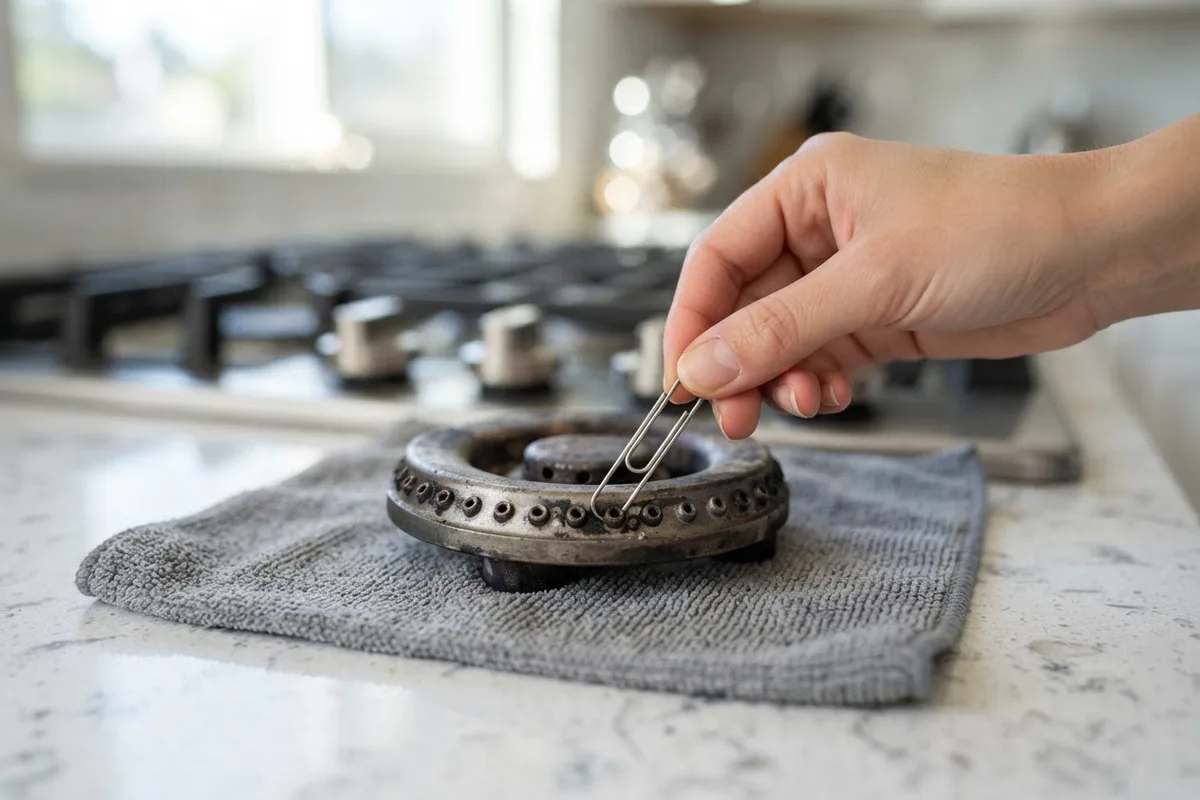
- Straighten a standard steel paperclip or use a stiff wooden toothpick to push through each blocked port, dislodging built-up carbon.
- Avoid using sewing needles, straight pins, or wooden toothpicks with excessive force, as snapping a brittle tip inside an orifice creates a permanent obstruction.
- Use a shop vacuum with a narrow crevice attachment to lift loose soot and food particles out of the burner base cavity.
After clearing every channel, restore the burner head and cap, then light the burner to verify that gas flows evenly from all angles.
3. Dry Trapped Moisture After Cleaning
If you recently scrubbed your stovetop or deep-cleaned your range as part of a seasonal holiday appliance checklist, moisture may be trapped inside the burner casting. Water is dense enough to block gas passages and quench sparks. When liquid settles inside the tiny mixing chambers, the gas cannot escape smoothly, resulting in a sputtering, popping, or half-lit burner flame.
- Disassemble the burner assembly by removing the grate, cap, and removable head.
- Blot all surfaces thoroughly with a dry microfiber cloth, paying close attention to the underside channel where fuel mixes with air.
- Shake the metal burner head firmly over a sink to expel any water droplets hiding inside internal recesses.
- Place damp burner components on a baking sheet inside a warm oven set to 200°F for roughly 15 to 20 minutes to evaporate lingering moisture.
- Let the parts cool to room temperature, reinstall them on the stove, and test the flame again.
Never attempt to dry gas stove components with an open flame or a propane torch, which can warp thin cast metal and damage precision-machined channels.
4. Scrub Carbon Buildup Around the Igniter Electrode
Each gas burner features a small white ceramic pillar with a metal tip protruding alongside the burner base. This is the spark igniter electrode. Over months of regular cooking, a thin film of grease, sugary sauce, and carbon coats both the metal pin and the ceramic insulator. This residue diverts electrical current, producing a sluggish or misplaced spark that fails to ignite the adjacent ports promptly, leaving the initial flame weak and uneven.
- Ensure the range is unplugged or the circuit breaker is switched off to avoid an accidental electric jolt.
- Examine the white ceramic spark peg for sticky amber grease or dark carbon streaks.
- Dip a soft-bristled toothbrush or cotton swab into standard isopropyl rubbing alcohol (do not soak the area).
- Gently scrub the metal spark tip and the surrounding white ceramic sleeve until the surface is spotless.
- Use a dry microfiber cloth to buff the electrode dry and let the alcohol fumes dissipate completely for 10 minutes.
Cleaning this contact point restores an energetic, directed spark that lights the full perimeter of the burner head instantaneously.
5. Clean the Brass Gas Orifice with Compressed Air
Deep inside the center cavity of the burner base sits a small brass fitting known as the burner orifice or spud. This precision nozzle meters the exact volume of natural gas or liquid propane entering the burner. When fine lint, pet hair, or dried cooking residue slips through the burner port and settles on this tiny nozzle hole, fuel volume drops sharply, starving one side of the flame ring.
- Shut off the gas shutoff valve behind the stove or at the supply line before working near fuel nozzles.
- Remove the burner head to expose the inner brass spud at the bottom of the burner well.
- Shine a flashlight directly into the opening to check for fuzz, dust, or grease deposits.
- Take a can of dry compressed air, insert the thin straw, and give three to four short bursts into the well to blow dust out of the orifice passage.
- Never poke metal wires, drill bits, or safety pins into the brass orifice hole; widening this soft brass opening even slightly alters the fuel-to-air ratio and creates hazardous high flames.
Once the well is clear, reinstall the burner head, restore the gas supply valve, plug in the appliance, and light the burner on medium.
Gas Stove Flame Troubleshooting Guide
| Flame Symptom | Most Likely Cause | Best DIY Solution |
|---|---|---|
| Flame burning on only half the burner | Dislodged or cocked burner cap | Center the cap in its base alignment grooves |
| Gaps in the flame ring with hissing sound | Food spills plugging outer ports | Clear slots using an unbent paperclip and vacuum |
| Flame sputtering with yellow tips after cleaning | Liquid trapped in burner passages | Dry parts in a 200°F oven for 15 minutes |
| Burner clicks repeatedly with lopsided fire | Dirty ceramic spark electrode | Clean electrode pin with rubbing alcohol |
| Weak, miniature flame around the whole base | Clogged brass orifice nozzle | Clear debris using short bursts of compressed air |
When to Call a Pro
Most uneven flame issues resolve after clearing blocked ports, drying wet metal, and centering the burner cap. However, if your flame remains lopsided, burns predominantly yellow or orange after cleaning, or creates a strong smell of unburned gas in the kitchen, you should stop troubleshooting immediately.
Persistent flame problems can indicate an internal gas pressure regulator failure, a cracked burner casting, or a failing burner control valve in the range manifold. Working on gas supply lines, internal manifolds, and pressure regulators requires dedicated leak-detection tools and specialized knowledge to keep your home safe.
When basic DIY cleaning does not resolve the issue, True Appliance Repair can match you with an independent local appliance pro to diagnose your range safely. Typical diagnostic and minor mechanical service calls for gas ranges generally range between $130 and $260, though final costs vary by area and model. If you ever detect a strong, persistent rotten-egg odor, shut off the main gas valve behind the unit, exit the home, and call your local gas utility right away, or reach out online once the area is confirmed safe.
FAQ
Why is one side of my gas stove flame higher than the other?
An uneven flame height almost always points to a burner cap that is sitting tilted on its base or grease deposits partially blocking the gas passage on one side. When the cap is cocked, gas escapes more easily through the wider opening, creating a tall flame on the high side while starving the lower side. Turn the burner off, let it cool completely, and ensure the cap rests firmly in its alignment grooves.
Can I soak gas stove burner heads in water to remove burnt grease?
You can soak removable burner heads in warm water with mild dish soap or a mixture of baking soda and vinegar to loosen stubborn carbon crust. However, you must let every component dry 100 percent before reinstalling them on the stove. Trapped water inside internal burner cavities will prevent smooth ignition and cause the flame to sputter unevenly.
What color should my gas stove flame be?
A healthy gas stove burner flame should burn a crisp, steady blue with tiny light-blue cones at the base of each port. Occasional specks of orange are normal and usually caused by harmless airborne dust or high indoor humidity from a nearby humidifier. However, continuous yellow or floppy orange flames indicate improper combustion or incorrect air-to-fuel mixtures that need professional attention.
Why does my gas stove burner pop when I turn it off?
A soft pop or "extinction pop" occurs when the fuel supply is suddenly cut and the remaining gas-and-air mixture inside the burner head burns off rapidly. While a faint pop can happen occasionally on normal burners, a loud or sharp bang usually means the air shutter is misadjusted, the burner cap is loose, or ports are partially clogged, causing an irregular flame pattern right before shutting down.