
A dishwasher door that drops like a brick instead of lowering gently is more than just a nuisance—it is a safety hazard for toes, children, and pets. Under normal conditions, heavy counterweight springs and nylon cables work in tandem to counterbalance the weight of the stainless steel or composite door panel. When these components stretch, slip, or snap, gravity takes over and forces the door to fall completely open.
Restoring smooth, balanced operation is a straightforward home project that usually takes under an hour. By understanding how the door tension mechanism works, you can diagnose the broken component and make a quick repair without replacing the entire unit. Before starting any hands-on work, safety comes first: unplug the dishwasher or turn off its dedicated breaker at the home's main panel, and turn off the water supply line under the kitchen sink.
1. Inspect the Door Balance Springs for Damage
The primary force holding your dishwasher door in balance comes from a pair of heavy-duty metal tension springs located behind the lower access panel or along the bottom side frames. Over years of daily opening and closing, these springs can stretch out, unhook from their mounting slots, or snap entirely due to metal fatigue.
To check the springs, remove the lower access panel (also known as the toe kick) at the base of the machine using a Phillips-head screwdriver or nut driver. Shine a flashlight into the left and right lower side channels. You should see a metal spring attached to the cabinet frame on each side. If one spring is hanging loose, stretched out, or broken into two pieces, the door will lose its counterweight balance instantly.
- Disconnect power to the appliance and shut off the water supply valve.
- Remove the toe kick screws and set the panel aside.
- Look for a heavy steel spring along each lower side rail.
- Unhook the broken spring using needle-nose pliers and compare its length to the opposite side.
- Replace both springs as a matching pair to maintain equal tension across the door.
Replacement springs typically cost between $15 and $35 per set, depending on your appliance model. Installing fresh springs on both sides ensures the door lowers smoothly and stays partially open at a comfortable resting angle.
2. Replace Snapped Door Tension Cables and Pulleys
On many modern dishwasher designs, the heavy metal springs do not connect directly to the door hinges. Instead, they attach to flexible nylon cables or woven cords that wrap around plastic pulleys mounted to the lower side frame. Because these cables slide back and forth over plastic wheels every time you load dishes, they eventually fray and snap.
If you hear a loud pop sound right before the door starts falling open, a snapped door cable is almost certainly the culprit. Inspecting the pulleys is equally important; if a plastic pulley wheel cracks or stops spinning, the cable will drag against sharp metal edges and wear out prematurely.
- Pull the dishwasher slightly out from under the countertop after removing the mounting bracket screws attached to the cabinet top or sides.
- Locate the nylon cord running from the spring hook up to the door hinge curve.
- Check if the cord is snapped, frayed, or derailed from the wheel track.
- Examine the plastic pulley wheel to ensure it spins freely without binding or flat spots.
- Thread a new cable assembly through the pulley guide, attach one end to the hinge tab, and hook the other end securely onto the tension spring.
Using a full cable and pulley kit helps prevent future failures. Addressing mechanical friction early also protects your unit from wider structural issues, much like taking pro-active steps for preventing water leaks protects kitchen subflooring.
3. Adjust the Spring Tension Mount Settings
Sometimes a dishwasher door drops too quickly even though neither the springs nor the cables are broken. This frequently happens after installing a heavy custom wood cabinet panel on a panel-ready dishwasher model. The added weight overcomes the factory tension setting, making the door drop rapidly when unlatched.
Most dishwasher frames feature multiple adjustment slots or an adjustable screw gear designed to recalibrate spring tension for light or heavy door panels. Increasing the tension compensates for heavy decorative paneling and restores balance.
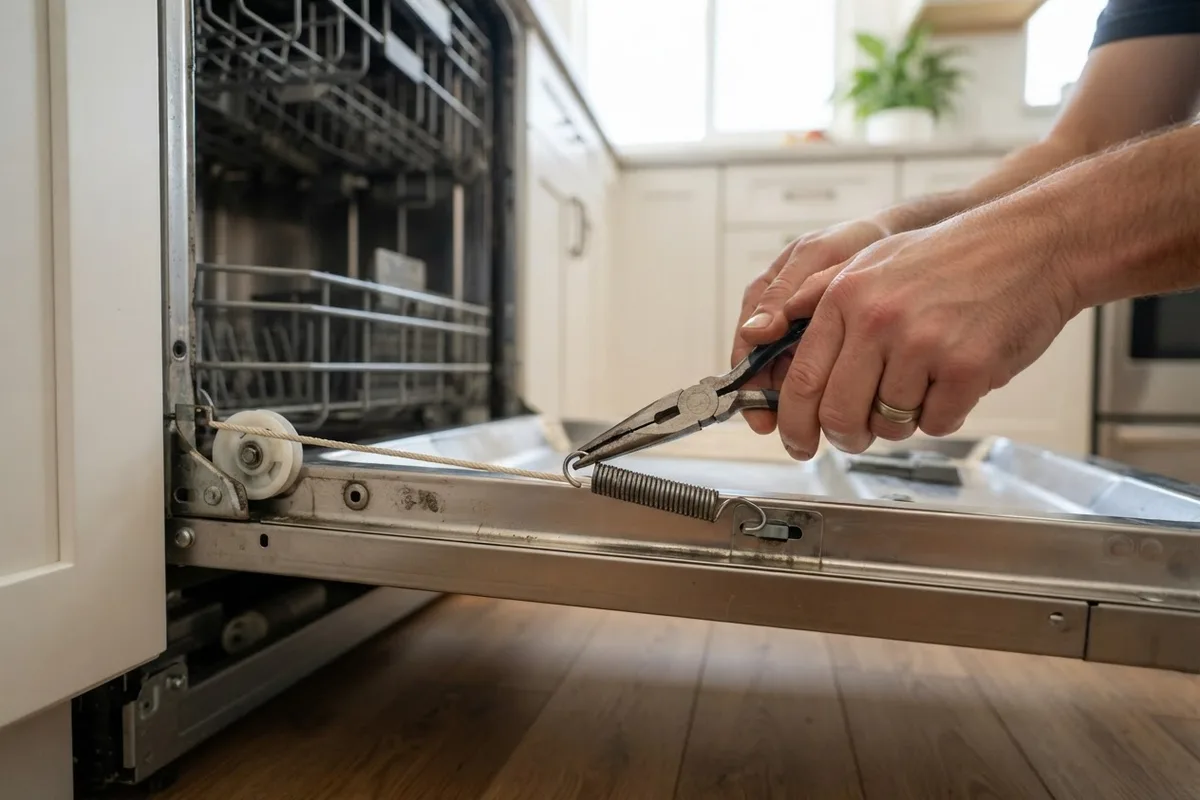
- Locate the tension adjustment holes along the lower side frame or the adjustment screw located near the front bottom corner.
- If your model uses multi-hole anchor brackets, move the spring hook to a higher or deeper notch on the frame to increase pulling force.
- If your model uses a tension screw system, turn the adjustment bolt clockwise with a socket wrench to tighten the spring cable.
- Test the door by opening it to a 45-degree angle; a properly adjusted door should hover in place without falling open or pulling shut on its own.
- Recheck the balance after installing any decorative trim strips or cabinet faceplates.
Fine-tuning the tension prevents the door latch from taking excessive impact when closing, which extends the operating lifespan of both the latch mechanism and the inner door seal.
4. Align Bent Hinges and Hinge Arm Pin Links
If the door drops unevenly or leans to one side as it falls open, the issue may stem from damaged door hinges or bent hinge link arms. Hinges can warp if someone leans heavily on the open door, if a child sits on it, or if a heavy item drops onto the inner door liner while loading racks.
A bent hinge arm prevents the balance springs from pulling evenly, causing the door to bind, drop suddenly, or leak water around the bottom tub gasket. Inspecting the hinge arms requires looking at the lower connection points on both sides of the door shell.
- Open the door completely and examine the gap between the door edge and the dishwasher tub frame on both sides.
- Check whether the hinge pins are seated firmly inside their mounting bushings or if the metal arms look twisted or buckled.
- Inspect the lower door corner seals for pinching or distortion caused by misaligned hinge travel.
- Unscrew the inner door panel screws to gain access to the hinge mounting bolts if replacement is necessary.
- Replace any bent hinge arm immediately; attempting to hammer or bend a hardened steel hinge back into shape usually weakens the metal further.
Keeping door hinges plumb and square ensures smooth travel and prevents unnecessary wear on surrounding trim and cabinet structures.
5. Clear Obstructions Around the Lower Toe Kick
A dishwasher door may drop abruptly or fail to sit level if the lower toe kick plate, insulation blanket, or surrounding cabinetry interferes with the door's full range of motion. If insulation material shifts behind the access panel, it can catch on the spring cable assemblies, causing them to bind and then suddenly release.
Likewise, improperly installed wood trim or flooring installed over existing tile can restrict clearance along the bottom edge of the door frame, forcing the hinges out of alignment over time.
- Remove the lower toe kick and look for loose fiberglass or felt insulation hanging near the spring pathways.
- Tuck insulation back into designated side pockets and secure it away from moving pulleys and cords.
- Check that the kitchen flooring does not pinch the bottom edge of the door panel when fully lowered.
- Verify that cabinet side screws are not protruding into the side channels where the door balance springs stretch.
- Reinstall the toe kick, ensuring it sits flush without making contact with the door bottom as it swings open.
Cleaning out debris and re-securing insulation ensures that the tension mechanism operates silently and smoothly without catching.
Dishwasher Door Component Troubleshooting Guide
Use this quick reference guide to identify common door balance symptoms, potential causes, and typical repair approaches:
| Symptom | Likely Cause | Typical Fix | Estimated Parts Cost |
|---|---|---|---|
| Door drops heavy instantly | Snapped door spring or cable | Replace springs and cables as a pair | $15 – $40 (varies by model) |
| Door falls unevenly / leans | Bent door hinge or damaged pin | Replace damaged hinge arm assembly | $30 – $75 (varies by model) |
| Creaking or squeaking sound | Dry pulley wheel or rubbing cord | Replace plastic pulley wheels & cables | $10 – $25 (varies by model) |
| Door drops after cabinet panel install | Under-tensioned balance setting | Adjust spring bracket position or bolt | $0 (Adjustment only) |
| Door catches then drops suddenly | Loose insulation snagging cable | Clear and re-secure cabinet insulation | $0 (DIY cleanup) |
When to Call a Pro
While replacing door springs, cables, and pulleys is manageable for many DIY-inclined homeowners, some situations require specialized assistance. If your dishwasher is a fully integrated model built tightly into custom cabinetry, pulling the machine out safely without scratching hardwood floors or damaging under-counter plumbing can be tricky.
Additionally, if you discover bent frame rails, electrical wiring damage inside the door shell, or persistent leveling problems, turning to a qualified service technician is the safest route. Always stop and call a professional if you encounter exposed wiring, gas line proximity in combination units, or complex sealed-system components. When expert help is needed, True Appliance Repair can match you with a local appliance pro to diagnose and resolve structural door balance issues quickly.
If you are tackling broader kitchen maintenance, explore our guides on general appliance repair services to keep all your household equipment running reliably.
FAQ
Can I use my dishwasher if the door spring is broken?
While the dishwasher may still run cycles, using it with a broken door spring is risky. The unsupported door can drop suddenly and injure feet or hands, and the uneven weight distribution can bend the remaining hinge arm or crack the inner door liner over time.
Should I replace both dishwasher door springs at the same time?
Yes, it is strongly recommended to replace both springs simultaneously. Dishwasher springs wear down at the same rate, so if one spring snaps, the remaining spring is likely fatigued and near the end of its lifespan. Replacing both ensures equal tension across the frame.
Why does my new dishwasher door feel so heavy?
New dishwashers often ship with factory tension settings configured for basic door weights. If your unit features a heavy stainless steel front or a custom wood panel, you simply need to adjust the spring tension brackets or tension adjustment screws located near the base of the machine.
How long do dishwasher door balance cables usually last?
Dishwasher door balance cables and springs typically last between 5 and 9 years depending on usage frequency. Regular household use causes natural wear on plastic pulleys and nylon cords, making cable inspection a smart routine check during home updates.