
You load up after dinner, press start, and 20 minutes later the "Clean" light glows—yet your dishes are still dirty and barely wet. When a dishwasher rushes through a two-hour cycle, the problem is usually a hidden setting, a brief latch or power glitch, a stuck float, or a misread sensor. Use these six safe DIY checks to find out why your cycle is cutting short and restore full washes.
1. Check for Quick Wash, Rinse-Only, or Demo Mode
Before assuming a part failed, verify that your dishwasher did not simply run a short program. Modern consoles make it easy to tap the wrong button while wiping the front panel or loading after a busy holiday meal.
- Inspect the active cycle lights and make sure Rinse-Only (often 10 to 20 minutes) or Quick/Express Wash (often 30 to 60 minutes) is not selected.
- Check your manual for Showroom or Demo Mode, a display setting that cycles through panel lights in a few minutes without washing.
- Press and hold Cancel or Reset for three to five seconds to clear the active memory.
- Select Normal or Heavy, confirm you know how to load a dishwasher properly so nothing bumps the door, and run a test cycle.
2. Hard-Reset the Control Board at the Breaker
Brief power flickers, storms, or voltage dips can scramble the dishwasher's microprocessor. When that happens, the timer may skip wash and rinse phases altogether and jump straight to the end-of-cycle chime.
- Press Cancel on the control panel and wait for the display lights to go dark.
- Walk to your home's breaker box and flip the dedicated dishwasher circuit breaker to OFF (or unplug the cord under the kitchen sink if your unit uses a standard plug).
- Leave the power off for a full five minutes so the internal capacitors discharge completely.
- Flip the breaker back to ON, select a Normal cycle, and latch the door firmly without interrupting the run.
If the cycle runs for its usual two to three hours, a temporary board glitch was the sole cause.
3. Inspect the Door Latch and Top Seal Alignment
Your dishwasher relies on tiny microswitches inside the door latch to confirm the door is securely closed. As hot water warms the cabinet, slight expansion can shift a loose latch or bowed door just enough to break switch contact, prompting some models to abort or fast-forward to the end.
Safety first: Flip the dishwasher breaker OFF or unplug the unit before touching latch hardware or screws.
- Slide both racks all the way back and make sure no tall pan handle, cutting board, or silverware handle pushes against the inner door.
- Inspect the metal strike plate at the top center of the tub opening and gently snug any loose mounting screws with a screwdriver.
- Run your fingers along the rubber perimeter seal to check for folded, stiff, or pinched sections pushing the door outward; if the rubber is split, follow these steps for fixing a torn dishwasher door gasket.
- Close the door and listen for a firm, solid click rather than a soft bounce.
4. Test and Free a Stuck Overfill Float Switch
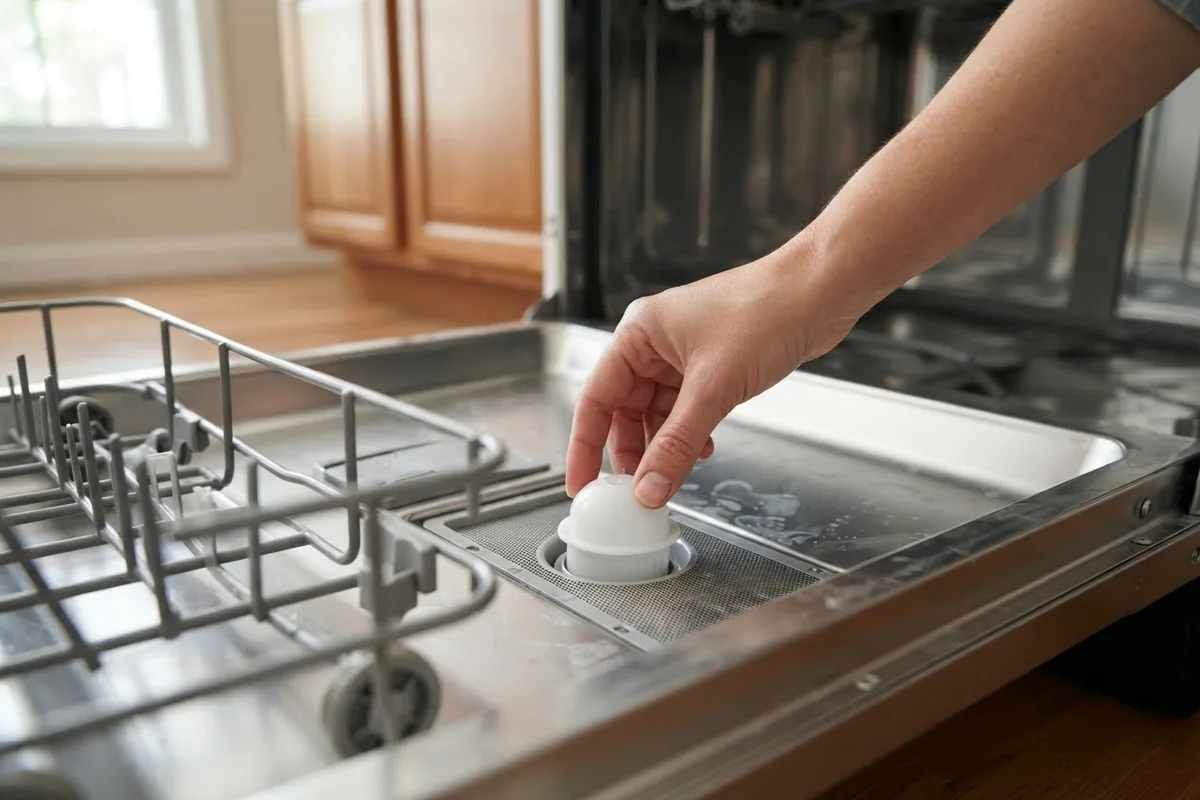
Inside the front corner of most dishwasher tubs sits a plastic cap called the overfill float. As water enters, the float rises; if it lifts too high, a switch underneath stops the fill to prevent flooding. When a float sticks in the raised position, the control assumes the tub is already full, cuts off water fill immediately, and on many models ends the cycle early.
Safety first: Turn off power at the breaker and shut off the hot water supply valve under the sink before reaching into the tub or removing parts.
- Pull out the lower dish rack completely so you have clear access to the tub floor.
- Locate the round or oval plastic float dome near the front corner and gently lift and release it.
- Listen for a light clicking sound from the microswitch beneath the tub; the dome should drop back down smoothly on its own.
- If the float feels stiff or stays lifted, pull the cap straight up (on removable models) and clear any stray utensil tip, bottle cap, or food scrap wedged under the stem before reseating it flat.
5. Verify Hot Water Flow and Supply Valve Pressure
Dishwashers monitor incoming water flow during timed fill windows. If the under-sink supply valve was bumped partially closed or a braided supply line kinked behind a trash pull-out, the machine may sense low water pressure and skip ahead to protect the heating element and wash pump.
Safety first: Always turn off the dishwasher breaker and close the under-sink hot water shutoff valve before disconnecting any supply fitting.
- Run the hot water tap at your kitchen sink for 30 to 60 seconds to confirm steady pressure and hot water (around 120°F).
- Open the sink base cabinet and locate the hot water shutoff valve feeding the dishwasher; turn the handle fully counterclockwise so it is completely open.
- Trace the braided supply line as far as you can see to verify it is not pinched or tightly kinked against cabinet walls or storage bins.
- Restore power and listen during the first two minutes of a Normal cycle for a strong, steady rush of incoming water. If the flow still sounds faint, the internal water inlet valve may be failing.
6. Spot a Failing Temperature or Soil Sensor
Auto and Sensor cycles adjust wash length using two small electronic parts: a thermistor (which reads water temperature) and an optical turbidity sensor (which measures how cloudy the wash water looks). When either sensor drifts out of range, the control board can mistakenly assume the load is already hot and spotless, trimming an hour or more off the cycle.
- Run a fixed Heavy or Normal cycle instead of Auto/Sensor and time how long it lasts from start to finish.
- If timed cycles run the full length while Auto still cuts off in under an hour, a failing turbidity sensor is a strong suspect.
- Carefully open the door about 25 minutes into a cycle (standing back from steam) and check whether the tub interior feels warm; lukewarm or cold water points toward a faulty thermistor or heating circuit.
- Write down any flashing lights or error codes on the display along with the model number inside the door frame before booking a repair.
Quick-Reference: Fast Finish Symptoms and Likely Causes
| What You Notice | Most Likely Cause | DIY or Pro |
|---|---|---|
| Ends in 10–25 min with no heat | Rinse-Only or Demo Mode active | DIY (change cycle) |
| Ends in 30–60 min on every load | Quick or Express Wash selected | DIY (select Normal/Heavy) |
| Hums briefly, then jumps to Clean | Stuck float switch or closed water valve | DIY check first |
| Cuts off early when bumped | Loose door latch or shifted gasket | DIY inspect / Pro replace latch |
| Only Auto/Sensor finishes early | Failing turbidity sensor or thermistor | Pro repair |
| Random short runs + error codes | Failing main control board | Pro repair |
When to Call a Pro
Homeowners can safely handle cycle resets, breaker reboots, checking the under-sink water shutoff valve, tightening a loose strike plate, and freeing a stuck float dome. Stop and bring in a technician if your dishwasher still finishes early after those checks, or if troubleshooting points to internal wiring, a water inlet valve, a thermistor, a turbidity sensor, a faulty latch assembly, or a failing control board. Never open a home electrical panel cover beyond flipping a standard breaker switch, and stop using the machine right away if you notice a burning smell or a repeatedly tripping breaker.
Typical US repair costs vary by area and model, but here are broad ballpark ranges to help you budget:
- Door latch or float switch replacement: roughly $150 to $275 (varies by area and model).
- Thermistor, turbidity sensor, or water inlet valve replacement: roughly $175 to $350 (varies by area and model).
- Main control board replacement: roughly $250 to $500+ (varies by area and model).
If you want a trained set of eyes to test sensors and switches safely, True Appliance Repair can match you with a local pro for dishwasher repair.
FAQ
How long should a normal dishwasher cycle take?
Most modern US dishwashers take two to three hours on a Normal cycle. Newer energy-efficient models use less water and lower pump wattage, so they rely on longer soak and wash times rather than rapid blasts of hot water. A Normal cycle wrapping up in 20 to 40 minutes is almost always a sign of a wrong setting or a fault.
Why does my dishwasher skip straight to the clean light?
Jumping directly to the Clean light usually points to a control board glitch, Showroom/Demo Mode being toggled on, a loose door latch losing switch contact, or a stuck overfill float preventing the tub from filling. Start by canceling the cycle, resetting the breaker for five minutes, and confirming the float dome moves freely.
Can low hot water temperature make a dishwasher finish early?
Usually, cold incoming water makes a dishwasher run longer while it waits for the heating element to warm the tub. However, if the water temperature sensor (thermistor) is faulty and sends a false high-temperature reading to the control board, the machine can skip heating phases and finish far earlier than normal.
Is it safe to keep running a dishwasher that finishes too fast?
Running a short cycle once or twice while troubleshooting is generally fine as long as there is no leak, burning smell, or tripped breaker. Avoid continuing to run it if the tub is not filling with water, since dry-running a wash pump or heating element can cause preventable damage and higher repair bills.