
You load up your dinner dishes, press the start button, and... nothing happens. No lights, no hum, and zero sign of life from your kitchen workhorse. When your dishwasher refuses to turn on, it disrupts your daily routine fast, but the underlying cause is often something simple you can fix yourself.
Before assuming you need an expensive replacement, work through these five proven troubleshooting steps. With a few basic tools and safety precautions, you can diagnose why your unit lost power and get your kitchen running smoothly again.
1. Test the Outlet and Reset the Circuit Breaker
When a dishwasher shows no signs of power—meaning no control panel lights or chime—the problem is frequently outside the appliance itself. Dishwashers draw significant electrical current during heating and wash cycles, which can occasionally trip a household breaker or blow a dedicated fuse.
First, turn off power at the main circuit breaker before inspecting any connections. Locate your electrical panel and check if the breaker tied to the dishwasher has tripped into the middle or off position. Flip it firmly to the "Off" position and back to "On" to reset it. If your dishwasher is plugged into an under-sink outlet rather than hardwired, unplug the unit and test the receptacle using a standard handheld nightlight or multimeter. Many modern kitchens place dishwashers on a GFCI (Ground Fault Circuit Interrupter) outlet or branch circuit; press the "Reset" button on the GFCI outlet to ensure power flows properly.
If the breaker trips again immediately after reset, do not continue resetting it. A repeatedly tripping breaker indicates a short circuit in the appliance wiring or household electrical panel, which requires professional evaluation.
2. Inspect and Test the Door Latch Switch
Dishwashers are designed with a safety mechanism that prevents them from running while the door is unlatched. If the door latch assembly fails to close securely or the internal door switches fail electronically, the control board assumes the door is wide open and will not send power to start a wash cycle.
To inspect the door latch, open the dishwasher door and examine the plastic catch on the tub frame and the latch handle on the inner door panel. Look for visible cracks, misaligned plastic, or foreign objects blocking the latch. If the catch engages mechanically with a distinct click but the machine still won't turn on, the internal microswitches may be defective.
Before taking anything apart, safety first: always unplug the dishwasher or switch off the circuit breaker. Remove the inner door panel screws using a Torx or Phillips screwdriver to access the latch assembly. Inspect the wire harness attached to the door switches for burned marks, loose terminals, or broken wires. A replacement door latch assembly generally costs between $20 and $60, making it one of the most budget-friendly DIY fixes available.
3. Deactivate Child Lock and Delay Start Settings
Sometimes a completely unresponsive dishwasher isn't broken at all—it's simply locked or scheduled for a delayed run time. Modern control panels feature safety locks to prevent accidental starts by children and delay timers to run cycles during off-peak energy hours.
If your control panel shows illuminated lights or glowing icons but refuses to initiate the cycle when you press start, check for a lock icon or lit indicator light labeled "Control Lock" or "Child Lock." Most models require holding down a specific button (often labeled "Light," "Options," or marked with a padlock icon) for three to five seconds to unlock the control pad. Refer to your owner's manual for the exact key combination.
Similarly, check whether a "Delay Start" timer was accidentally activated. If a 2-, 4-, or 8-hour delay is programmed, the machine will remain silent until that countdown finishes. Canceling the cycle by pressing and holding the "Start/Reset" button for three seconds will clear all delayed settings and restore normal control function. If your control panel lights up but the spray action fails once running, check our guide on why your dishwasher spray arm is not spinning.
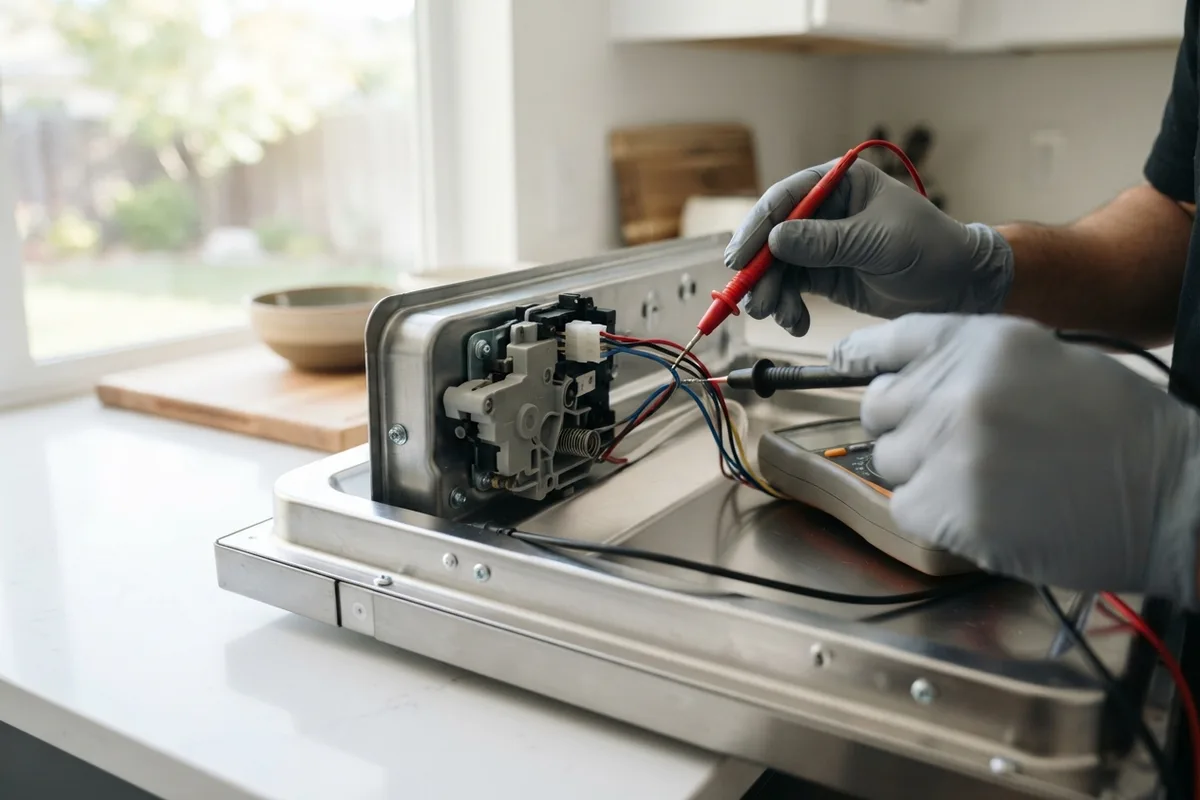
4. Test and Replace a Blown Thermal Fuse
If your electrical outlet supplies power and the door closes tightly, but the control panel remains entirely dark, a blown thermal fuse is a prime suspect. The thermal fuse is an essential safety device mounted on the main control board inside the door panel. It is designed to cut off all electrical power if the dishwasher overheats due to a wiring glitch, heating element surge, or short circuit.
When a thermal fuse trips, it shuts down the machine permanently until the fuse is replaced. To check the fuse, shut off power at the circuit breaker and remove the inner door panel screws. Locate the control board near the top of the door assembly. The thermal fuse is a small plastic component plugged directly into the circuit board with two wire leads.
Disconnect the wires and test the fuse for electrical continuity using a digital multimeter set to ohms (Ω). Touch the meter probes to the two metal terminals of the fuse. If the meter reads infinite resistance (no continuity), the fuse is blown and must be replaced. Replacement thermal fuses typically cost between $15 and $35. When installing a new fuse, always use the wire harness adapter included in the kit, as updated fuse designs prevent future thermal failures.
5. Check the Main Control Board and Internal Power Terminal Block
If all other components test clean, the issue may lie with the electrical connection where household power enters the machine, or with the main electronic control board itself. Dishwashers feature a junction box located behind the lower kickplate panel where house wiring connects to the appliance terminal block.
Before inspecting this area, unplug the appliance or switch off the dedicated circuit breaker. Remove the lower access panel (kickplate) at the base of the unit. Remove the metal junction box cover and inspect the wire nuts connecting the house wires to the dishwasher wires. Loose twist-on wire connectors or charred wire insulation can sever electrical contact and stop the unit from receiving power.
If the junction box connections are secure, the electronic control board located inside the door may have suffered a component failure. Inspect the board visually for scorched circuit traces, swollen capacitors, or a faint burning odor. Replacing a damaged control board generally costs between $150 and $300 for the part alone, depending on your appliance brand and model.
| Issue / Symptom | Likely Cause | Typical DIY Fix / Action | Relative Part Cost |
|---|---|---|---|
| Completely Dark Panel | Tripped Breaker or GFCI | Reset breaker or GFCI outlet | $0 |
| Door Clicks, Won't Start | Faulty Door Latch Switch | Replace door microswitch assembly | $20 - $60 |
| Lights On, Buttons Unresponsive | Child Lock / Delay Activated | Hold lock button for 3–5 seconds | $0 |
| No Power After Overheat | Blown Thermal Fuse | Test with multimeter & replace fuse | $15 - $35 |
| Scorched Wire Smell / Dark Panel | Damaged Control Board / Wiring | Inspect junction box or replace board | $150 - $300 |
When to Call a Pro
While resetting a breaker or swapping out a door switch is straightforward, complex electrical troubleshooting carries inherent risks. If you smell burning insulation, see charred internal wiring, or notice that your home's circuit breaker trips immediately every time the dishwasher is energized, stop troubleshooting right away. Electrical wiring problems and circuit board replacements require specialized tools and expert diagnostic training.
Additionally, if your machine powers on and runs but dishes remain dirty or restricted to certain zones, consult our article on why your dishwasher is not washing the top rack for targeted mechanical fixes.
When basic DIY steps don't solve the issue or you feel uncomfortable opening control panels and testing high-voltage circuits, professional help is just a call away. True Appliance Repair can match you with a local appliance pro who can safely pinpoint electrical faults and replace damaged parts quickly.
FAQ
How much does it cost to fix a dishwasher that won't turn on?
Repair costs vary depending on the root cause and your geographic location. Simple fixes like resetting a tripped breaker or clearing child lock settings cost nothing. Replacing minor parts like a door latch switch or thermal fuse ranges from $80 to $200 including technician labor. Major repairs involving the main control board or motor assembly typical run between $200 and $450, though exact prices vary by area and model.
Why does my dishwasher have no lights on the control panel?
When the control panel is entirely dark, power is not reaching the interface. Common culprits include a tripped circuit breaker, a tripped GFCI outlet under the sink, loose wiring inside the lower junction box, or a blown internal thermal fuse. Always verify your breaker box first before disassembling the unit.
Can a clogged dishwasher prevent it from turning on?
While a clogged filter or drain line typically causes water accumulation and cycle cancellation rather than complete power loss, some advanced modern units feature flood protection sensors. If water collects in the bottom pan due to a leak or severe clog, the safety switch may lock out the cycle to prevent water damage until the drain issue is resolved.
How do I know if my dishwasher thermal fuse is blown?
To confirm a blown thermal fuse, disconnect power to the machine, locate the fuse near the top control board inside the door panel, and remove its wire leads. Test the terminals using a multimeter set to measure resistance (ohms). If the meter indicates zero continuity (open loop), the thermal fuse has blown and must be replaced.