
You open your dishwasher expecting sparkling glassware, only to find gritty plates and soap residue clinging to your top-rack bowls. When dishes on one level remain dirty after a complete cycle, the primary culprit is usually a dishwasher spray arm that stopped spinning. Spray arms rely entirely on targeted water pressure and mechanical clearance to rotate—meaning even minor blockages or pressure drops will bring them to a complete halt.
Before performing any hands-on troubleshooting, always put safety first. Turn off the power to your dishwasher at the main electrical breaker panel or unplug the unit from the wall outlet beneath your sink. If you need to access water connections or internal components, shut off the hot water supply valve as well.
Here are 5 practical DIY steps to diagnose and resolve a spray arm that refuses to turn.
Clear Tall Items Blocking Spray Arm Rotation
Unlike washing machine agitators or dryer drums, standard dishwasher spray arms do not possess dedicated electric drive motors. Instead, they operate like garden sprinklers: pressurized water shoots out of angled jets on the underside and top of the plastic arm, creating a reaction force that pushes the arm in a continuous circle.
If tall baking sheets, oversized cutting boards, long spatula handles, or dangling basket straps extend downward or upward past the rack frame, they create a physical barrier. As the spray arm attempts to rotate, it impacts the item and stops mid-cycle, leaving large sections of the rack entirely unwashed.
To test for mechanical obstruction, load your dishwasher as you normally would. Before closing the door, manually spin both the upper and lower spray arms with your hand. Each arm should spin freely for 360 degrees without scraping against dinnerware, silverware, or the internal walls of the tub. If you hear a click or feel resistance, rearrange tall platters toward the outer edges of the bottom rack away from the central arc of the spray arm.
De-Clog Spray Arm Nozzles With a Toothpick
Over time, hard water mineral deposits (calcium and lime scale) alongside micro-food particles like fruit seeds, rice grains, and popcorn hulls get pumped through the wash system. These small debris items become trapped inside the narrow jet openings along the spray arm body.
When multiple nozzles become obstructed, water flow drops significantly. Without equalized water pressure shooting at the correct angle through each jet, the spray arm loses the hydrodynamic thrust needed to rotate.
To clean clogged spray nozzles, remove the affected spray arm:
- For lower spray arms, unscrew the central retaining nut counterclockwise or lift the arm directly off its central support hub.
- For upper spray arms, unscrew the mounting collar beneath the upper rack assembly.
- Hold the spray arm under a running faucet to inspect water flow through each hole.
- Use a wooden toothpick, plastic needle, or soft toothbrush to gently dislodge debris from every jet opening. Avoid metal drill bits or sharp wire that could enlarge or deform the engineered spray angles.
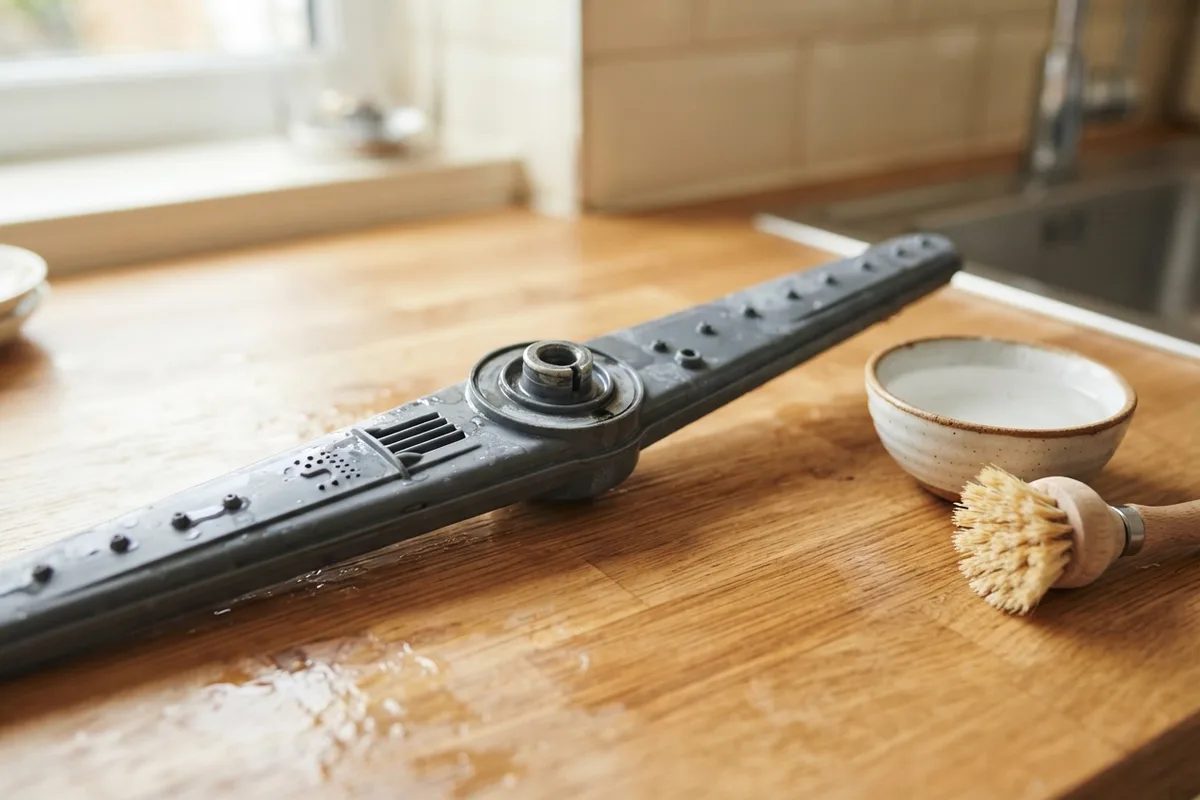
- Submerge the spray arm in a basin filled with equal parts warm water and distilled white vinegar for 30 minutes to dissolve mineral scale, then rinse thoroughly and snap it back into position.
Inspect and Clean the Lower Spray Arm Seal
At the center point where the spray arm attaches to the water delivery tube or sump manifold, there is a plastic bearing ring, hub assembly, or rubber seal. This component allows the arm to spin smoothly on its axis while maintaining a tight fluid seal.
If sand, coffee grounds, or hard water scale migrate into the bearing sleeve, friction increases exponentially. The reduced thrust from incoming water jets can no longer overcome the resistance of a gritty, bound-up bearing ring.
With the spray arm removed from the tub, examine the central plastic hub and support spindle. Inspect the plastic or rubber washers for signs of severe warping, cracking, or mineral buildup. Clean the mounting stem thoroughly using a damp microfiber cloth and mild dish soap. If the plastic mounting nut or hub shows deep grooves or heat distortion, replacing the low-cost mounting hub assembly will restore fluid rotation.
Check the Water Inlet Valve for Adequate Pressure
Even clean, unobstructed spray arms cannot rotate if the dishwasher tub fails to fill with an adequate volume of water. If the water level inside the tub is too low during wash cycles, the main circulation pump draws in air bubbles alongside water. This condition, known as pump cavitation, drastically reduces water pressure delivered to the wash arms.
If you suspect low water levels, your unit might also exhibit symptoms like those outlined in our guide on why your dishwasher is not filling water.
To check the water fill level:
- Run a normal cycle for 5 minutes until the filling phase finishes and the wash pump starts.
- Open the door carefully (unlatching it slowly to allow spray arms to stop).
- Look at the bottom of the tub. Water should completely submerge the heating element or reach within 1/4 inch of the filter housing.
- If the water level is noticeably shallow, turn off power to the machine and inspect the inlet screen on the hot water inlet valve behind the lower access kickplate. Clean away any rust flakes or sediment restricting incoming home water pressure.
Inspect the Chopper Blade and Water Pump Impeller
Pressurized water flows to the spray arms via the main wash circulation pump. Located beneath the filter assembly at the bottom of the tub, the pump utilizes an impeller wheel to force water upward into the spray arms. Many modern units also feature a small food chopper blade that pulverizes food remnants before water enters the recirculation loop.
If broken glass fragments, plastic twist-ties, or bone chips bypass the fine mesh filter, they can jam the food chopper blade or shear off vanes on the pump impeller. A damaged impeller cannot build the hydraulic pressure required to spin the spray arms.
To inspect the sump assembly:
- Unplug the dishwasher and disconnect the power supply.
- Remove the lower rack, drain filter cylinder, and fine mesh filter plate.
- Remove the retaining screws securing the pump inlet cover or diffuser hood.
- Wear protective gloves and reach into the sump housing to feel for stray debris, broken glass, or string wrapped around the impeller shaft.
- Manually turn the pump impeller with your fingers to ensure it rotates smoothly without binding. Clear away any foreign objects and reassemble the filter components.
Dishwasher Spray Arm Troubleshooting Matrix
| Issue Observed | Primary Cause | Recommended DIY Solution |
|---|---|---|
| Arm hits top rack or tall plates | Overloaded or improperly stacked dishware | Rearrange tall items to outer edges; adjust rack height |
| Nozzles blocked with white crust | Hard water mineral scale | Soak spray arm in warm vinegar bath for 30 minutes |
| Arm loose or wobbly on mount | Worn central bearing hub or cracked nut | Inspect plastic hub for wear; replace hub assembly |
| Low spray pressure across all arms | Clogged sump filter or low water fill level | Clean circulation pump screen and inlet valve mesh |
| Water present but spray arm immobile | Broken pump impeller vanes or jammed chopper | Clear debris from pump housing or call a repair pro |
When to Call a Pro
Most spray arm rotation problems resolve quickly once you clear physical obstructions, clean mineral scale out of tiny nozzles, or rinse out the filter assembly. Adding routine maintenance tasks like this to your home care routine is one of many effective appliance maintenance tasks that save money over the life of your equipment.
However, if you have verified proper water levels, cleaned all spray nozzles, and checked rack clearances, but the spray arm still refuses to spin, the internal wash pump motor or electronic control board may have failed. Replacing a main pump motor, diagnosing mainboard control relays, or addressing sealed electrical faults requires technical expertise and specialized diagnostic tools.
Always stop work immediately and contact a pro if you encounter damaged wiring, electrical burning odors, or persistent water leaks beneath the appliance. For safety-critical repairs, True Appliance Repair can connect you with a qualified local specialist in your area. Typical professional dishwasher pump or motor repairs generally range from $150 to $350, though exact costs vary by geographical area, machine brand, and model complexity.
FAQ
How do dishwasher spray arms turn without a motor?
Dishwasher spray arms utilize water pressure generated by the circulation pump. Water enters the hollow arm under high pressure and exits through angled nozzles at the ends and along the body. This angled discharge creates kinetic reaction force—similar to a lawn sprinkler—which pushes the arm around its central axis.
Can vinegar damage dishwasher spray arms?
Soaking plastic spray arms in diluted white vinegar for 30 to 60 minutes is safe and effective for dissolving calcium and limescale deposits. However, avoid using concentrated industrial acids or harsh solvent chemical cleaners, which can degrade rubber seals, warp thin plastic moldings, or corrode metal mounting hardware.
How often should I clean my dishwasher spray arms?
It is good practice to inspect spray arm jet holes every 1 to 3 months, especially if your home has hard municipal water or well water. Routine inspection prevents scale from hardening inside internal passages, keeping spray patterns wide and rotation steady.
Why does my top spray arm not clean dishes as well as the bottom arm?
The upper spray arm receives water routed through a long vertical feed tube extending from the sump pump at the bottom of the tub. Because water must travel uphill, any slight drop in pump efficiency, low water fill volume, or debris accumulation in the supply pipe impacts upper rack water pressure first.