
Opening your dishwasher to a blast of acrid heat, warped plastic containers, or glowing red elements at the wrong stage is alarming. While dishwashers rely on high heat to sanitize dishes, excessive temperatures signal an internal component failure that stresses parts and wastes energy.
Before inspecting any mechanical parts, always shut off power at the household breaker box and turn off the water supply valve beneath your kitchen sink.
Here is why your dishwasher is overheating and how to troubleshoot the issue step-by-step.
Reset the Control Board and Cycle Settings
Modern dishwashers utilize microprocessors to regulate cycle temperatures, water intake, and heated dry durations. A temporary electronic glitch or an accidental combination of cycle boosters (such as "Sanitize" combined with "Hi-Temp Wash" and "Extended Heat Dry") can push internal temperatures higher than expected.
- Check the active cycle settings on your control panel. Turn off specialized sanitizing or high-heat options for your next load to see if baseline temperatures return to standard levels.
- Perform a hard electrical reset. Turn off the dedicated dishwasher circuit breaker at the main panel for 5 to 10 minutes.
- Restore power and run a standard, unheated test cycle.
If the machine continues to superheat water during normal or delicate cycles, the issue stems from a hardware sensor or switching component rather than a user setting.
Inspect the Temperature Sensor (Thermistor)
The temperature sensor—frequently called a thermistor or NTC (Negative Temperature Coefficient) sensor—monitors the water temperature inside the dishwasher tub. It sends continuous electrical resistance data to the control board to signal when the heating element should switch off.
When a thermistor gets coated with mineral scale or fails internally, it may report falsely low water temperatures to the control board. In response, the board keeps sending current to the heating element, driving water temperatures past safe limits.
- Disconnect power to the dishwasher at the circuit breaker.
- Remove the lower kickplate beneath the door to access the underside of the wash tub.
- Locate the thermistor, which is typically mounted directly through the bottom of the tub into the water sump.
- Unclip the wire harness and wipe the sensor face clean of any hard water buildup, grease, or debris using a soft cloth and warm water.
- If the sensor body is discolored, warped, or cracked, swap it with a matching manufacturer replacement part.
Inspect the Heating Element for Warping or Grounding
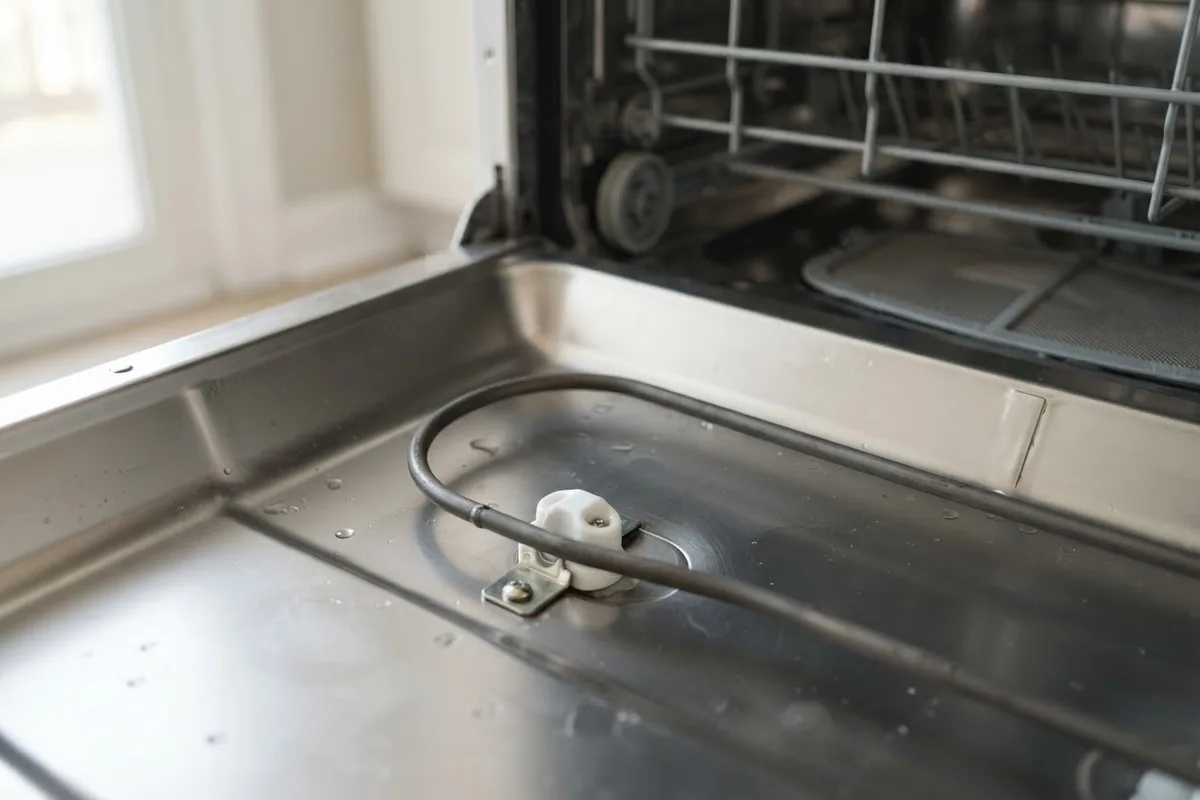
The circular heating element at the bottom of your dishwasher tub warms water during wash cycles and radiates heat during dry cycles. If the element suffers internal damage, its outer sheath can develop a short to ground. When this occurs, current flows through the element constantly, regardless of what temperature the control board commands.
Inspect the element thoroughly:
- Look for physical damage: Check the metal coil for blistering, deep pitting, dark burn spots, or obvious warping that lifts it off its support clips.
- Check element clearance: Ensure the element is not pressing directly against lower plastic tub walls or the spray arm assembly.
- Test continuity: With power completely disconnected, you can unhook the element wiring terminals under the tub and test terminal resistance with a multimeter. A standard residential dishwasher element typically reads between 15 and 30 ohms. A reading of zero ohms or infinite resistance indicates an internal short or break requiring replacement.
Check for Low Water Fill Levels
Dishwashers require a specific volume of water to absorb and disperse the heat produced by the heating element. If your dishwasher is not filling properly due to a restricted water supply valve or a clogged inlet screen, the element ends up heating a shallow puddle of water or dry air, causing extreme localized heat.
- Run a normal cycle for 5 minutes, let it finish filling, and open the door.
- Check the water level at the bottom of the tub. The water should reach the base of the heating element or sit just below the float switch dome.
- If water covers only a fraction of the tub floor, shut off the water valve beneath the sink and disconnect the water supply line from the dishwasher inlet valve.
- Clean the fine mesh sediment screen inside the inlet valve fitting using a soft nylon brush to remove mineral deposits.
- Ensure your home's hot water shutoff valve is turned fully open.
Examine the Main Control Board Heating Relay
The main control board houses electromagnetic relays that act as electronic switches. The heating relay closes to send 120-volt power to the element and opens to cut power when the target temperature is reached. Over thousands of cycles, the electrical contacts inside this relay can weld together from electrical arcing, causing the heating element to run continuously whenever the unit has power.
| Overheating Symptom | Likely Cause | Recommended Action |
|---|---|---|
| Element stays red-hot after cycle ends | Welded control board relay | Replace main control board |
| Water boiling hot during delicate cycle | Faulty thermistor/temperature sensor | Clean or replace thermistor |
| Plastic items melting on bottom rack | Heating element touching rack / warped | Realign or replace element |
| Burnt odor with low water in tub | Clogged water inlet valve | Clean inlet screen; check fill level |
If your heating element stays warm or hot even when the dishwasher is turned completely off or sitting idle, the heating relay on the control board is almost certainly stuck closed, and the board should be replaced.
When to Call a Pro
Basic maintenance—such as adjusting cycle settings, cleaning sensor probes, and inspecting the tub interior—is straightforward for most homeowners. However, troubleshooting high-voltage control boards, testing live circuits, or replacing hard-to-reach wiring beneath the unit requires specialized diagnostic tools and training.
If you have verified that your cycle settings and water fill levels are correct but the machine continues to overheat, avoid running the unit to prevent thermal fuse trips or melted internal components. If hands-on electrical testing goes beyond your comfort level, True Appliance Repair can match you with an experienced local appliance pro to diagnose the issue quickly. For other kitchen appliance maintenance questions, explore our complete appliance repair resources to keep your home running smoothly.
FAQ
What temperature should my dishwasher reach during a normal cycle?
Most standard residential dishwashers heat water to between 120°F and 140°F during normal wash cycles. High-temperature sanitizing cycles typically heat water to between 150°F and 155°F to eliminate bacteria. Temperatures consistently exceeding 160°F indicate a malfunctioning sensor, stuck relay, or restricted water supply.
Why are plastics melting on the top rack of my dishwasher?
Modern dishwashers disperse heated air throughout the tub, but if the water level drops too low or the heating element runs non-stop, internal ambient air temperatures climb rapidly. Even "dishwasher-safe" plastics on upper racks will deform if the control board fails to cut power to the heating element.
Can a clogged dishwasher cause it to overheat?
Yes. If severe sediment buildup restricts water circulation, the circulation pump cannot push water across the heating element efficiently. The element then superheats stationary water and air inside the sump area rather than distributing warmth evenly across the load.
How much does it cost to fix an overheating dishwasher?
Repair costs typically range from $120 to $300 across the US, depending on whether the fix involves a simple thermistor swap, a new heating element, or a complete control board replacement. Exact pricing varies by local labor rates, appliance brand, and model specifics.