
When you turn down your electric stove burner to simmer sauce, you expect the heat to dial back immediately. If the element remains glowing red-hot regardless of where you set the control knob, you are dealing with a stove burner stuck on high heat. This issue is not only frustrating and prone to burning your food, but it also creates a serious safety hazard if left unattended.
Before attempting any troubleshooting or hands-on inspection, always disconnect the range from its power source by unplugging the unit or switching off the dedicated breaker at your home's main electrical panel. Working on high-voltage appliance wiring without cutting power can cause severe electrical shock.
1. Replace a Faulty Infinite Burner Control Switch
The single most common reason an electric stove burner stays stuck on high heat is a failed infinite switch. The infinite switch is the rotary control behind the burner knob that regulates how much electrical power cycles to the cooking element. Inside the switch, bi-metal contacts open and close continuously to cycle power on and off based on your temperature selection. Over time, these internal metal contacts can arc and weld themselves together in the closed position, allowing continuous 240-volt power to flow straight to the burner.
To replace a faulty infinite switch on a standard electric stove:
- Disconnect power: Unplug the stove or turn off the circuit breaker at the main electrical box.
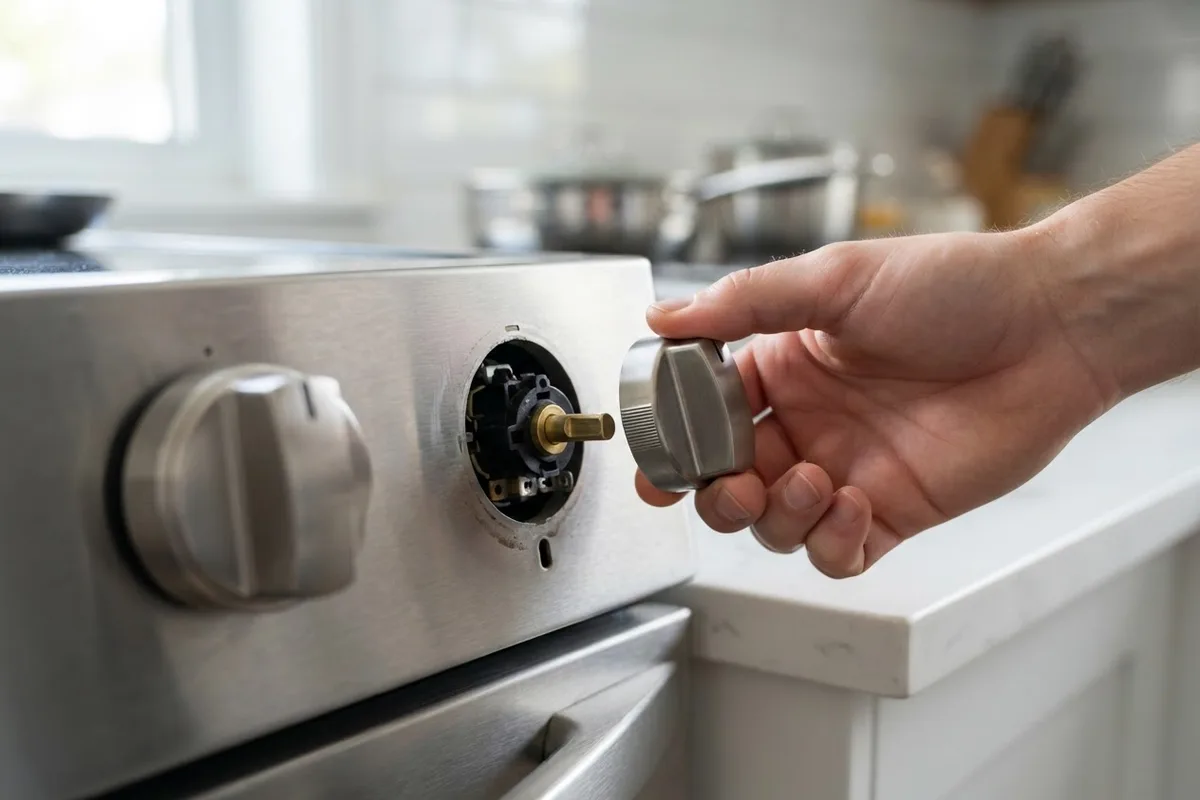
- Remove the control knob: Pull the burner knob straight off its shaft on the front console.
- Access the switch panel: Unscrew the rear access cover panel behind the control console using a nut driver or screwdriver.
- Label the wires: Take a clear digital photo of the wiring connections attached to the switch terminals.
- Disconnect and unbolt: Pull the wire leads off the switch terminals using needle-nose pliers, then remove the mounting screws holding the switch to the console.
- Install the new switch: Mount the replacement switch, attach the wires to their corresponding terminals according to your photo, replace the rear panel, and restore power to test.
Replacing an infinite switch usually takes 20 to 30 minutes and restores full temperature control to your stove burner.
2. Inspect and Clean Corroded Burner Receptacle Terminals
On traditional coil-top electric stoves, the burner element plugs into a small plastic block called the burner receptacle. This receptacle houses two metallic terminal sockets that supply electrical current to the coil burner. Dirt, spilled grease, and heavy moisture can cause severe corrosion inside these terminal blocks, leading to arcing, short circuits, or erratic electrical resistance that prevents the element from cycling properly.
To inspect and service the burner receptacle assembly:
- Shut off power: Ensure the appliance is completely unplugged or the circuit breaker is tripped off.
- Remove the burner coil: Lift the front of the heating element slightly and pull it straight out of the receptacle block.
- Examine the terminals: Look inside the terminal openings on the receptacle block and at the prongs on the end of the heating element coil. Look for pitting, dark burn marks, green oxidation, or melted plastic.
- Clean or replace: If you notice light corrosion on the coil prongs, rub them clean using fine 220-grit sandpaper or wire brush. However, if the plastic block is scorched or melted, replacing the entire receptacle block kit is necessary.
- Install the replacement kit: Unscrew the receptacle bracket from the cooktop frame, cut the supply wires, strip back 1/2 inch of insulation, wire nut the new ceramic block wires in place, and reassemble.
Performing basic routine appliance maintenance checks regularly keeps terminal contacts clean and prevents premature electrical failures across all your kitchen appliances.
3. Test and Replace a Malfunctioning Dual Element Switch
Many modern radiant glass cooktops feature dual or triple heating zones that allow you to select between a small inner ring and a larger outer ring depending on cookware size. These multi-zone elements utilize a specialized dual-element infinite switch. If the internal selector mechanism inside a dual switch shorts out internally, it can force both the inner and outer burner loops to run at maximum power constantly.
To troubleshoot and resolve a faulty dual element control switch:
- Verify power is disconnected: Never touch internal range wiring while the appliance is connected to live electricity.
- Access the control module: Remove the knob and unfasten the control housing access panel.
- Inspect the switch for thermal damage: Look for heat discoloration, melted plastic casing, or a burnt electrical odor surrounding the dual switch terminals.
- Test continuity with a multimeter: Set your multimeter to the ohms (Rx1) setting. Touch the meter probes across the primary supply terminal (usually marked L1) and the element load terminals (H1 and H2). With the switch set to the "Off" position, the meter should show open circuit (infinite resistance). If the meter reads 0 ohms while off, the internal contacts are welded shut.
- Swap the switch: Unscrew the defective dual switch, transfer the wiring leads one by one to the new part to avoid wiring errors, and secure the housing back into position.
4. Check for Stuck Relays on Electronic Control Boards
Higher-end electric ranges and smooth glass cooktops often replace individual rotary mechanical switches with a centralized electronic control board or touch display module. These boards use small mechanical relays—electronic switches on the circuit board—to open and close the power circuits going to each surface burner. If a heavy current spike occurs, the internal relay contacts on the circuit board can fuse together permanently, locking the surface element on high heat whenever the range has main power.
When dealing with an electronic board issue:
- Disconnect electricity immediately: A stuck relay will often keep the burner heating non-stop even when the digital display says the stove is turned off.
- Access the main board: Remove the back panel of the upper console to reveal the main printed circuit board (PCB).
- Check for board damage: Inspect the board closely for black scorch marks, swollen capacitors, or blown trace lines near the output relays.
- Replace the control board assembly: Because micro-soldering individual relays on a circuit board is complex, the standard repair involves disconnecting wire harness connectors and replacing the complete electronic control board assembly.
If you are uncomfortable handling delicate electronic components or diagnosing circuit boards, seeking assistance from professional oven and stove repair services ensures the repair is performed safely and correctly.
5. Test the Radiant Element Temperature Limiter Switch
Smooth-top glass cooktops feature radiant heating elements mounted beneath a tempered glass ceramic surface. To protect the glass top from cracking under excessive temperatures, each radiant element includes a built-in center component known as a thermal limiter switch (or high-limit thermostat). This sensor rod extends across the top of the heating coil and cuts power if the temperature exceeds safe glass tolerances.
If the internal contacts within the limiter switch fail in a shorted position, the element may run continuously at maximum wattage without cycling off:
- Ensure the cooktop is unplugged and fully cooled down.
- Lift the glass cooktop panel: Depending on your range model, remove the front retaining screws under the cooktop lip and hinge or lift the glass top upward.
- Locate the limiter rod: The limiter is attached to the metal housing of the radiant element assembly with wire terminals connecting to the element harness.
- Test the limiter contacts: Use a digital multimeter set to ohms to test continuity across the limiter switch terminals. Check the appliance service manual for the exact resistance specifications at room temperature.
- Replace the assembly: On most modern radiant glass ranges, the thermal limiter is integrated directly with the burner assembly, requiring replacement of the radiant element assembly as a complete unit.
Troubleshooting Summary: Electric Stove Burner Stuck on High
Use this reference table to quickly identify the likely cause, typical repair difficulty, and estimated component cost range for a stove burner stuck on high heat.
| Problem Cause | Key Symptom | Difficulty Level | Typical DIY Part Cost |
|---|---|---|---|
| Faulty Infinite Switch | Coil or surface element stays red-hot continuously on all dial settings | Moderate | $35 - $90 (varies by area/model) |
| Corroded Receptacle Block | Element glows intensely or sparks near the socket connection | Easy | $15 - $35 (varies by area/model) |
| Failed Dual-Element Switch | Inner and outer cooktop rings stay stuck on high simultaneously | Moderate | $45 - $110 (varies by area/model) |
| Stuck Control Board Relay | Burner heats continuously even when digital display indicates Off | Advanced | $120 - $280 (varies by area/model) |
| Failed Thermal Limiter | Smooth glass top burner overheating rapidly without thermostatic cycling | Moderate | $60 - $150 (varies by area/model) |
When to Call a Pro
While replacing a basic coil receptacle or an accessible infinite control switch is a manageable DIY project for many homeowners, certain electric stove repairs carry higher electrical risks.
You should stop and contact a professional technician if:
- You encounter burned, melted, or frayed main wiring inside the control console or range body.
- Your home's main circuit breaker trips continuously whenever the stove is plugged in.
- The stove uses an integrated electronic control board and you are unfamiliar with testing high-voltage multi-pin harnesses.
- You suspect an internal short circuit within your home's 240-volt wall receptacle or junction box.
Working with high-voltage electricity requires extreme care. When complex electrical diagnostics or main board replacements are necessary, True Appliance Repair can match you with a local appliance pro to diagnose and restore your range safely.
FAQ
Why is my glass top stove burner turning bright red and staying on high?
A glass top stove burner stays bright red when its infinite control switch or electronic relay fails in the closed position, delivering uninterrupted 240-volt power. On glass cooktops, a malfunctioning thermal limiter switch can also prevent the element from cycling down to lower power levels.
Can I still use my stove if one burner is stuck on high heat?
It is not safe to use your stove if one burner is stuck on high. Even if you avoid using that specific burner, a stuck switch or failed relay can overheat internal wiring or cause the element to turn on unexpectedly. Unplug the range or switch off its circuit breaker until the issue is repaired.
How much does it cost to fix an electric stove burner stuck on high?
Component costs for fixing a stuck burner range from $15 to $90 for standard parts like receptacle blocks or infinite switches (varies by area/model). If the main electronic control board requires replacement, part costs typically range between $120 and $280, plus local labor if you hire a professional.
Is it hard to replace an infinite burner control switch yourself?
Replacing an infinite switch is generally straightforward for homeowners comfortable with basic tools. The repair involves disconnecting power, removing the rear console panel, labeling wires, and swapping the old switch for a new one. Always take photographs of wire placements before disconnecting any terminals.