
Flipping the wall switch to hear a piercing screech from the kitchen sink is enough to make any homeowner wince. When you have a garbage disposal making a squealing noise, the culprit is almost always metal-on-metal friction—either from a hidden bottle cap, a jammed shredding ring, or worn internal bearings. Before replacing the whole unit, walk through these six safe, straightforward DIY checks to find the source of the squeal and quiet your sink.
Safety First: Always unplug the garbage disposal under the sink or switch off its dedicated circuit breaker at your electrical panel before putting your hands, tools, or a flashlight near the drain opening. Never rely on the wall switch alone.
1. Clear Trapped Metal Under the Splash Guard
The most common reason for a high-pitched screech is a small piece of metal—like a twist tie, dime, or canning lid ring—scraping against the outer shredding ring. Because it sits beneath the rubber baffles, you cannot see it just by glancing into the sink.
- Unplug the power cord underneath the sink and verify the unit will not turn on by flipping the wall switch.
- Pull the removable rubber splash guard out of the sink drain, or fold the rubber flaps upward to expose the grinding chamber.
- Shine a bright flashlight straight down into the chamber, paying close attention to the narrow groove around the perimeter.
- Use needle-nose pliers or long kitchen tongs to pull out any metal fragments, fruit pits, or glass shards. Never reach into the chamber with bare fingers.
- Reinstall the splash guard, plug the unit back in, and run cold water to test the sound.
2. Free a Binding Flywheel With an Allen Wrench
Sometimes sediment, rust, or hard food particles wedge directly under the rotating turntable (flywheel), causing it to drag and squeal loudly against the stationary housing without fully stalling.
- Disconnect the power cord under the sink.
- Locate the small hexagonal hole in the very center of the bottom housing of the disposal.
- Insert a 1/4-inch Allen wrench (often called a disposer wrenchette) into that center hole.
- Work the wrench clockwise and counterclockwise several times. You should feel gritty resistance give way to smooth, even rotation.
- Remove the wrench, look inside the top of the drain with a flashlight, and use tongs to grab any debris that popped loose.
- Restore power, turn on a strong stream of cold water, and switch the unit on for 10 seconds to flush out the loosened grit.
3. Unstick Seized Impeller Blades From the Plate
The two blunt lugs mounted on top of the flywheel are designed to swivel freely using centrifugal force. If sticky grease or fibrous food glue a lug at an awkward angle, its edge can scrape against the side wall and produce a rhythmic squeal.
- With the unit unplugged, shine a flashlight down into the chamber to locate the two swivel impellers.
- Use the wooden handle of a long spoon or a wooden dowel to press against each impeller blade.
- Gently rock each blade back and forth on its pivot pin to see if one is stiff or frozen in place.
- Pour a cup of hot tap water mixed with two tablespoons of degreasing dish soap over the stuck pivot, let it sit for 10 minutes, and work the blade again with the wooden handle until it swings loosely.
- If the disposal does not respond at all after freeing the blades, see our guide on why a garbage disposal is not turning on for electrical reset steps.
4. Flush Out Dry, Gritty Grinding Chambers
Running a disposal without enough water—or after grinding starchy foods like potato peels—leaves a dry, abrasive paste along the inner walls. As the flywheel spins against this dried buildup, it can emit a sharp squeak or whistle.
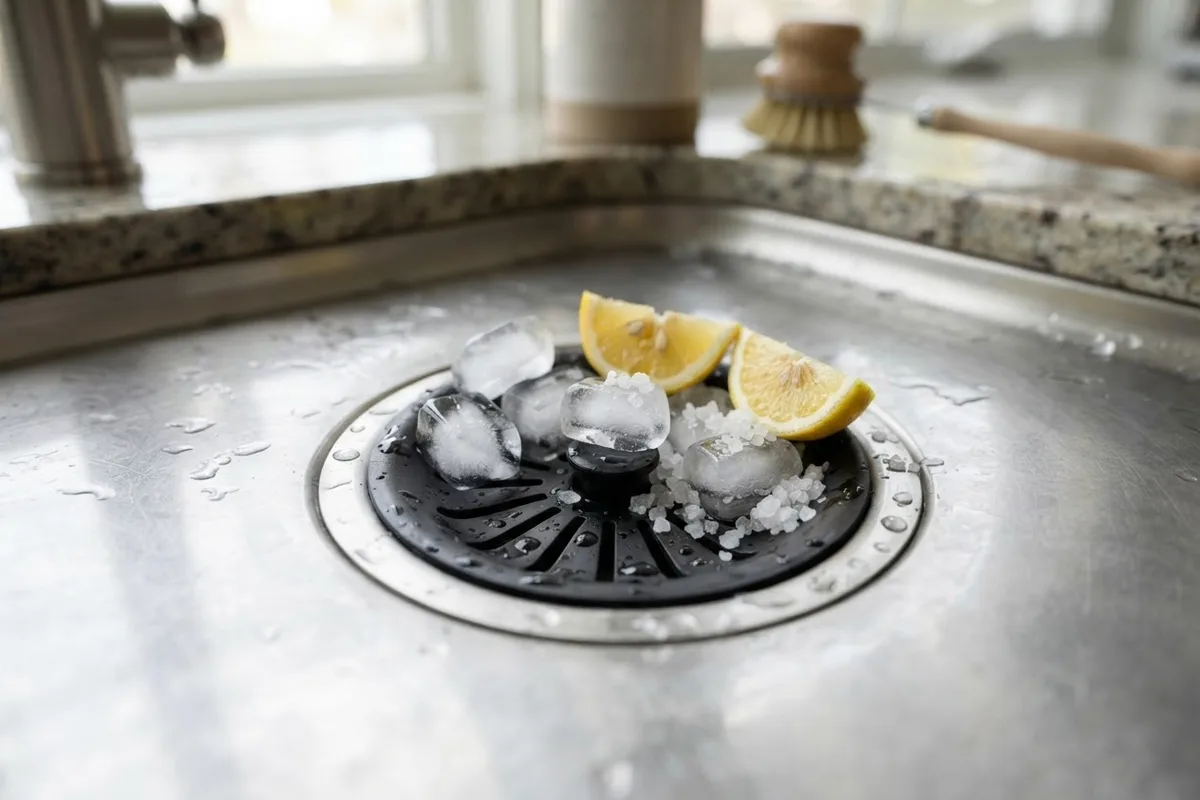
- Keep the disposal unplugged and drop six to eight ice cubes into the chamber along with 1/2 cup of coarse rock salt.
- Add half of a lemon or lime cut into small wedges to help cut sticky residue.
- Plug the disposal back in, turn on a medium stream of cold water, and flip the switch on for 15 to 20 seconds.
- The hard ice and salt scrub away dried starch and rust scales from the shredder ring while lubricating the rubber water seal around the shaft.
- Let the cold water run for an extra 30 seconds after turning the switch off so the pulverized slush washes completely down the trap.
5. Tighten a Loose Sink Mounting Assembly
When the mounting ring under the sink loosens from daily vibration, the heavy disposal shifts slightly off-center. This tilt puts uneven pressure on the motor shaft and causes the metal collar to rub and squeak loudly.
- Unplug the unit and clear items out from the cabinet under the sink so you have a clear view of the collar.
- Grip the body of the disposal with both hands and gently try to wiggle it side to side. It should feel completely solid against the sink basin.
- Check the three mounting screws pressing against the metal backup flange. If any screw is loose, tighten it evenly with a screwdriver so the flange sits perfectly flat.
- Inspect the lower mounting ring (the collar with the three small ears). Insert a screwdriver or your disposer wrench into one of the loops and push firmly to the right until it locks securely onto the upper ramp.
- Check the black rubber tailpiece gasket where the discharge tube exits the side; snug those two bolts evenly so the pipe does not vibrate.
6. Diagnose Worn Motor Bearings and Shaft Seals
If the grinding chamber is spotless, the flywheel spins freely by hand, and the unit still lets out an ear-splitting metallic squeal the second it starts, the internal motor bearings have likely dried out and failed.
- Unplug the disposal and place a dry paper towel directly underneath the bottom housing.
- Feel around the bottom plate and the red reset button for any brownish, rusty water stains.
- When the internal watertight shaft seal wears out over time, sink water seeps down into the lower motor compartment and washes the factory grease out of the sleeve bearings.
- Once those bearings run dry, they screech loudly whenever the motor spins and will eventually seize up completely (if the sound turns into a click, read our guide on why a garbage disposal is clicking).
- Because garbage disposal bearings and internal seals are pressed into a sealed housing, they cannot be lubricated or replaced separately—a noisy bearing means it is time to replace the unit.
Quick-Reference Guide: Garbage Disposal Squealing Sounds
| Squeal Pattern | Likely Cause | Best Action | Typical US Cost Range* |
|---|---|---|---|
| Irregular, metallic scraping screech | Foreign metal object under the baffle | Remove object with pliers (power off) | $0 (DIY) |
| Squeal only at startup, then fades | Sticky impeller lug or dry starch buildup | Scrub with ice, rock salt, and cold water | $0–$5 (DIY) |
| High-pitched whistle with vibration | Loose sink mounting collar or tilted housing | Tighten mounting screws and locking ring | $0 (DIY) |
| Constant, piercing shriek + rust drips | Failed shaft seal and worn motor bearings | Replace the garbage disposal unit | $150–$450 (varies by area/model) |
Note: Typical US price ranges include basic unit and labor estimates; actual costs vary by area, horsepower, and plumbing configuration.
When to Call a Pro
Removing a stray spoon, scrubbing away hard water grit, or snugging a loose mounting lug are safe projects for any homeowner with a flashlight and basic hand tools. However, if your disposal has a failed internal bearing, is leaking rusty water near the electrical whip, or trips the circuit breaker repeatedly, it is best to stop and bring in professional help.
Swapping out a corroded disposal often involves hardwired electrical connections, stubborn sink flanges, or brittle under-sink PVC traps that crack easily if forced. If you would rather skip crawling under the sink cabinet, True Appliance Repair can connect you with an independent local appliance pro to inspect your setup or install a quiet replacement unit.
FAQ
Is it safe to run a squealing garbage disposal?
No, you should turn it off immediately. A squealing noise means metal parts are grinding without lubrication or a hard object is wedged inside, which can quickly burn out the motor windings, shatter a blade, or send a sharp metal fragment flying upward.
Can I spray WD-40 inside my garbage disposal to stop the squeak?
Avoid spraying petroleum-based lubricants like WD-40 into the grinding chamber. Chemical sprays wash down into your household wastewater, leave an unpleasant odor in the kitchen, and can degrade the rubber splash guard and internal watertight seals over time.
Why does my garbage disposal squeal right before it shuts off?
A brief squeak as the motor coasts to a stop is often normal on units with anti-jam swivel lugs or a rubber splash brake that slows the flywheel down. However, if the squeal is loud and accompanied by a burning smell or a tripped reset button, the lower motor bearing is likely binding.
How long should a standard garbage disposal last before the bearings wear out?
Most household garbage disposals last between 8 and 12 years with normal kitchen use. Running plenty of cold water during every grind and avoiding fibrous peels, coffee grounds, and hot grease will keep the internal water seal intact for as long as possible.