
You flip the wall switch expecting the familiar roar of your sink grinder, and instead you get a single sharp click—or a rapid, metallic clicking sound as the motor spins. A clicking garbage disposal usually points to a jammed flywheel, a tripped overload switch, or a tiny piece of debris bouncing off the internal shredder ring. By working through the six safe, step-by-step checks below, you can pinpoint the exact cause and restore your kitchen sink in under 20 minutes.
Safety First: Before reaching near the sink drain or inspecting the unit underneath, always turn the wall switch to the OFF position and unplug the garbage disposal from the outlet under the sink (or flip the dedicated circuit breaker off at your home electrical panel). Never put your fingers inside the grinding chamber.
1. Reset the Tripped Overload Switch
If you flip the wall switch and hear a single click followed by silence, the internal thermal overload protector has likely tripped to prevent the motor from overheating. This happens when a heavy load of food waste forces the motor to draw too much current.
- Turn the wall switch off and unplug the power cord under the sink.
- Wait 10 to 15 minutes to allow the motor windings to cool down completely.
- Look underneath the disposal housing for a small red or black square button on the bottom plate.
- Press the button firmly upward. If it was tripped, you will feel and hear a gentle click as it latches back into place.
- If the button will not stay depressed, wait another 10 minutes for the unit to cool further—or inspect for a jammed flywheel in the next step before restoring power.
- Plug the unit back in, run a steady stream of cold water, and test the wall switch.
2. Free a Jammed Flywheel From Underneath
When a hard object wedges between the rotating flywheel and the stationary shredder ring, the motor may click once and hum faintly without spinning. Most modern disposals include a hexagonal socket on the very bottom of the unit so you can break the jam externally.
- Confirm the disposal is unplugged from the under-sink receptacle.
- Locate the 1/4-inch hex hole in the dead center of the bottom casing.
- Insert an offset disposal wrench (often stored in a clip on the side of the unit) or a standard 1/4-inch Allen wrench into the socket.
- Crank the wrench firmly clockwise and counterclockwise several times. You will feel resistance give way once the jam breaks free.
- Continue rotating the wrench in full circles until the flywheel turns smoothly in both directions with zero scraping.
- Remove the wrench from the bottom socket before plugging the unit back in so it does not spin out when the motor starts.
3. Extract Foreign Objects With Tongs
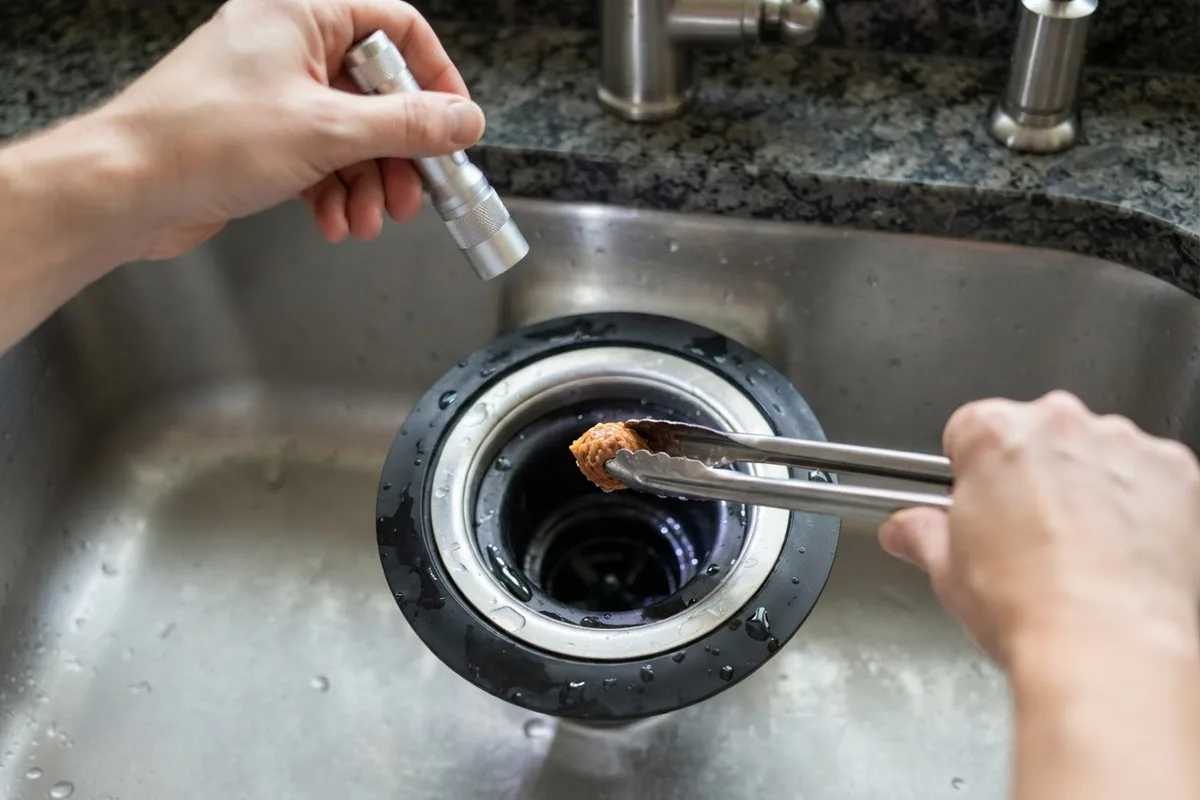
If the disposal runs at full speed but makes a fast, rhythmic clicking or clattering sound, a small foreign object is likely bouncing around inside the chamber. Even after you free a jam from below, the culprit stays inside the hopper until you remove it. If the noise sounds more like a harsh, metallic crunch, check out our guide on why a garbage disposal makes a grinding noise.
- Verify the power cord is unplugged and the wall switch is off.
- Lift the flexible rubber splash guard flaps and shine a bright flashlight straight down into the grinding chamber.
- Scan the outer perimeter of the turntable for fruit pits, poultry bones, popcorn kernels, screws, bottle caps, or broken glass.
- Use long-handled kitchen tongs or needle-nose pliers to grip and lift the debris out through the drain opening.
- For tiny metal shards like staples or paperclips caught near the shredder teeth, attach a small magnet to the end of a wooden spoon and sweep the outer edge of the chamber.
- Replace the splash guard, plug the unit in, and run cold water to test.
4. Unstick a Jammed Swivel Impeller Lug
Garbage disposals do not have sharp knife blades. Instead, they use two blunt metal lugs (called impellers) mounted on pins that swivel 360 degrees using centrifugal force. If a piece of fibrous food or bone wedges beneath one lug, it can click repeatedly against the side of the chamber as the turntable spins.
- Unplug the garbage disposal from the wall outlet beneath the sink.
- Shine your flashlight into the drain and locate the two raised metal lugs on opposite sides of the flat turntable.
- Use the handle of a heavy wooden spoon to press sideways against each lug.
- Both lugs should pivot smoothly on their mounting pins without sticking or wobbling loosely.
- If one lug feels frozen in place, trickle warm water and a few drops of dish soap directly onto the pivot pin, wait 5 minutes, and gently work the lug back and forth with the wooden spoon handle until the trapped grit washes free.
- Flush the chamber with cold water and test the unit.
5. Clear the Dishwasher Drain Knockout Plug
Did your clicking noise start right after installing a new disposal or connecting a dishwasher? Inside the upper nipple where the dishwasher drain hose attaches, manufacturers mold a hard plastic knockout plug. If a piece of that plastic plug fell into the chamber—or was only partially knocked loose—it will click loudly every time the impellers strike it.
- Unplug the disposal and place a shallow towel or bowl under the dishwasher inlet port near the top of the unit.
- Loosen the stainless steel hose clamp with a screwdriver and pull the black rubber dishwasher drain hose off the inlet nipple.
- Shine a flashlight into the inlet port to see if a jagged piece of plastic is hanging partially inside the chamber.
- Reach into the main sink drain with needle-nose pliers to pull any loose plastic disc fragments out of the grinding hopper.
- Reattach the dishwasher drain hose securely and tighten the clamp.
- If the unit has started dripping around the housing or seals during your inspection, see our troubleshooting guide for a garbage disposal leaking from the bottom.
6. Check the Wall Switch and Power Connection
Sometimes the clicking sound comes from the wall switch or an under-sink air switch relay rather than the motor itself. Standard wall toggle switches handle high starting amperage every time you turn the disposal on, and their internal contacts can wear out and arc over time.
- Stand quietly by the sink and listen closely to see whether the click comes from the wall switch box or the motor under the cabinet.
- Look under the sink and confirm the disposal power cord is plugged firmly into the electrical outlet.
- If that under-sink outlet is a GFCI receptacle (or wired downstream from a countertop GFCI), press the TEST button and then press RESET firmly to restore power.
- Unplug the disposal and plug a small lamp or hair dryer into the same under-sink outlet to confirm the receptacle is receiving steady household power.
- If the outlet works fine with a lamp, or if the wall switch feels mushy, crackles, or smells faintly like scorched plastic, stop using the switch immediately. Working inside live electrical boxes carries shock hazards and is best handled by a technician.
Garbage Disposal Clicking Sound Quick-Reference Guide
Use this table to match the exact clicking pattern you hear to the fastest DIY check:
| Clicking Sound Pattern | Most Likely Cause | First DIY Step to Try |
|---|---|---|
| Single click when flipping the wall switch, then dead silence | Tripped thermal overload switch or failed wall switch | Wait 10 minutes, unplug, and press the red bottom reset button |
| Single click followed by a low electrical hum | Jammed flywheel unable to rotate | Unplug and crank the bottom hex socket with a 1/4-inch Allen wrench |
| Rapid, metallic clicking while the motor spins | Loose coin, screw, bone, or pit bouncing on the turntable | Unplug, shine a flashlight in the drain, and remove object with tongs |
| Rhythmic click-clack once per rotation | Swivel impeller lug stuck on its pivot pin or loose | Unplug and test both impeller lugs with a wooden spoon handle |
| Repeated clicking from beneath the sink after running a load | Thermal overload tripping from a binding motor bearing | Let cool, check for jams, or plan for unit replacement |
When to Call a Pro
Most garbage disposal clicking noises come down to a stray fruit pit, a stuck impeller lug, or a tripped reset switch that you can resolve in minutes with an Allen wrench and a pair of tongs. However, you should stop DIY troubleshooting and call an expert if:
- The wall switch crackles, sparks, feels hot to the touch, or trips your main circuit breaker.
- One of the metal impeller lugs has a sheared-off pivot pin or wobbles violently against the shredder ring.
- The flywheel turns freely by hand, the reset button stays in, and the motor still only clicks and hums (a classic sign of a burned-out start winding or seized internal bearing).
- Water is dripping near the electrical cord plate or motor housing.
Depending on horsepower and local labor rates, a professional garbage disposal repair or replacement typically ranges from $150 to $400 (varies by area and model). When you need fast, reliable help in the kitchen, True Appliance Repair can connect you with an experienced local technician for professional appliance repair.
FAQ
Why does my garbage disposal click once and not turn on?
A single click followed by silence usually means the internal overload switch has tripped to protect the motor, or the flywheel is jammed tight against a hard object. Unplug the unit, use a 1/4-inch hex wrench in the bottom socket to make sure the flywheel turns freely, and then press the small red reset button on the underside of the housing.
Can I run my garbage disposal if it is making a clicking noise?
No, you should turn it off right away. Running a clicking disposal can wedge a hard fragment deeper between the flywheel and shredder ring, burn out the motor windings, or launch a small shard of bone or metal upward through the rubber splash guard.
How do I know if my garbage disposal blades are broken?
Garbage disposals actually use two blunt, swiveling metal lugs rather than sharp blades. With the unit unplugged, shine a flashlight down the drain and push each lug with a wooden spoon handle; if a lug is missing a chunk of metal or its mounting pin is loose and wobbly, the internal turntable assembly is worn out and the disposal should be replaced.
Why is my garbage disposal clicking and humming at the same time?
A click followed by a low humming sound means electricity is reaching the motor, but the turntable is physically locked up by wedged food or debris. Turn the switch off immediately before the motor overheats, unplug the cord under the sink, and free the jam using a hex wrench in the bottom socket.