
Turning on your kitchen sink switch shouldn't result in a dirty splash of water shooting up toward your face and countertops. When a garbage disposal spits water back into the sink basin, it usually points to a worn-out rubber splash guard, a partial drain clog, or a simple operating mistake. By following the six step-by-step checks below, you can stop the messy spray and get your sink draining smoothly again in under an hour.
Safety First: Before placing your hands or any tools near the drain opening, or before loosening any under-sink plumbing, always unplug the garbage disposal under the sink or shut off its circuit breaker at your main electrical panel. Never reach into the grinding chamber while the unit is connected to power.
1. Replace a Worn or Warped Rubber Splash Guard
The primary defense against flying water and food debris is the black rubber splash guard—also called a sink baffle—sitting right inside the drain opening. Over years of exposure to hot water, dish soap, and fibrous food scraps, the rubber flaps lose their flexibility, curl downward, or tear away completely. Once those flaps stop closing tightly in the center, spinning water shoots straight up out of the drain.
- Unplug the garbage disposal beneath the sink to ensure the unit cannot turn on.
- Inspect the rubber flaps inside the sink opening using a flashlight. If you see gaps in the center, stiff curled edges, or missing rubber pieces, the baffle needs replacement.
- For a drop-in style baffle, simply grab the top lip of the rubber ring and pull it straight up and out of the sink drain.
- For a twist-mount unit where the baffle is attached to the lower mounting collar, hold the heavy disposal body from underneath, twist the mounting ring counterclockwise to detach the unit, and swap the rubber gasket sitting on top of the rim.
- Scrub the metal sink flange with dish soap and an old toothbrush, press the new baffle firmly into the groove until it sits flush, and restore power.
2. Clear Trapped Debris Holding the Baffle Flaps Open
Sometimes the rubber splash guard is in great condition, but a hidden piece of bone, fruit pit, or hardened grease buildup wedged underneath is propping a flap open. Even a quarter-inch gap between the rubber triangles acts like a nozzle when the impeller plate spins at high speed. If your unit is making a racket at the same time, you can also check our guide on why a garbage disposal is rattling to clear hard objects from the grinding ring.
- Disconnect electrical power to the disposal by unplugging the power cord under the cabinet.
- Fold the rubber flaps upward toward the sink basin so you can see the underside of the rubber collar.
- Use a pair of long-handled kitchen tongs or needle-nose pliers to pull out any wedged utensils, plastic bottle caps, avocado pits, or fibrous celery strands.
- Pour two tablespoons of baking soda and a squirt of degreasing dish soap onto a stiff nylon dish brush, then scrub the underside of the rubber flaps to dissolve sticky grease that keeps the rubber from lying flat.
- Rinse with warm water and make sure every triangle flap drops back into a closed, level position.
3. Unclog the Dishwasher Drain Hose Air Gap
If you notice water spitting up from the disposal or out of the small cylinder mounted on the back corner of your sink counter while the dishwasher runs, your air gap or high-loop hose is likely restricted. Dishwashers pump wastewater directly into the top side inlet of the garbage disposal. When food sludge narrows that entry nipple, pressurized water hits the blockage and sprays violently into the sink.
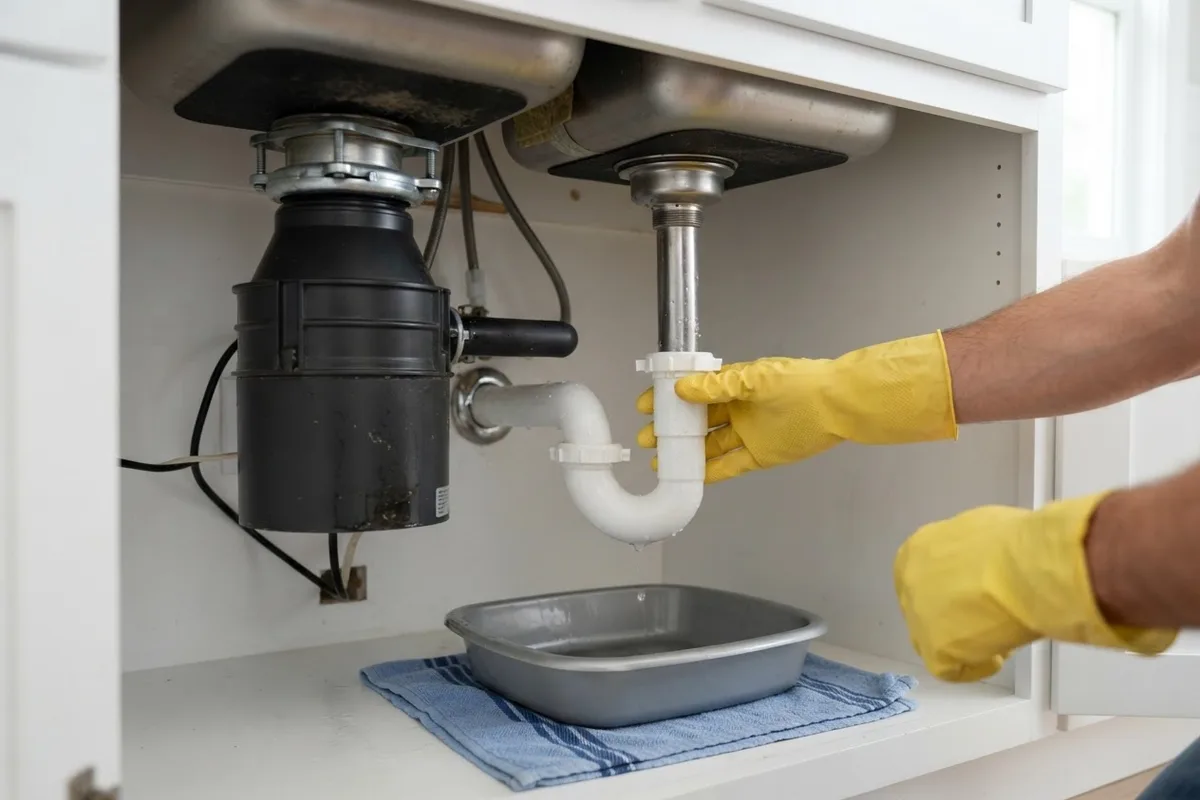
- Unplug the garbage disposal and place a shallow bucket and old towel on the cabinet floor beneath the unit.
- If your sink has a counter-mounted air gap cap, pull off the decorative metal cover, unscrew the plastic cap underneath, and clear out any food gunk with tweezers and a bottle brush.
- Look under the sink where the black rubber hose connects to the side inlet of the garbage disposal.
- Loosen the metal hose clamp with a screwdriver or pliers and pull the hose off the disposal inlet.
- Use a screwdriver or stiff wire brush to scrape out any calcified detergent or food buildup inside the plastic disposal inlet tube, then reattach the hose and tighten the clamp securely.
4. Flush Out a Partial P-Trap Drain Blockage
When water cannot exit the grinding chamber fast enough, the chamber fills up like a blender. Instead of swirling neatly down the waste pipe, the backed-up water gets whipped around by the spinning flywheel and splashes back through the sink opening. Clearing the P-trap directly underneath the disposal restores normal flow.
- Turn off power to the disposal and position a bucket directly underneath the curved plastic or metal U-shaped pipe (the P-trap) under the sink.
- Unscrew the two slip nuts at either end of the curved trap by hand or with channel-lock pliers.
- Wiggle the curved pipe free, dump any standing water into the bucket, and push a flexible brush through the bend to remove grease, coffee grounds, or potato peels.
- Shine a flashlight into the horizontal tailpiece coming out of the side of the disposal and wipe away any sludge sitting near the rubber discharge gasket.
- Reinstall the P-trap, hand-tighten the slip nuts plus a quarter turn with pliers, and run cold water to check for drips.
5. Run Cold Water Before Adding Food Scraps
User habits play a surprising role in sink splashing. If you pack the grinding chamber to the brim with food waste and turn on the motor dry—or turn the water on at a trickle after the motor is already spinning—the sudden rush of water hits a wall of spinning food and bounces right back out of the drain. Using the right water flow acts as a hydraulic seal that pushes waste down into the plumbing.
- Turn on a steady, medium-strong stream of cold tap water before flipping the disposal wall switch.
- Flip the switch to start the motor while the drain opening is still clear of heavy heaps of food.
- Feed food scraps in gradually through the rubber baffle rather than shoving a full plate of waste down at once.
- Avoid pouring hot water while grinding; hot water melts fats and oils, allowing them to coat the rubber splash guard and solidify inside the drain trap.
- Let the cold water and motor run for 10 to 15 seconds after the grinding sound stops so all pulverized particles flush completely past the P-trap.
6. Clear the Sink Divider Baffle on Double-Bowl Sinks
If you have a double-bowl kitchen sink, turning on the garbage disposal on one side can cause dirty water to spit or burp up out of the other sink drain. This happens because both drains meet at a central T-fitting before dropping into the P-trap. Inside that T-fitting sits a small directional baffle meant to direct disposal pressure downward. If that tee gets clogged or was replaced with a standard non-baffled tee, disposal water shoots straight across into the neighboring sink.
- Unplug the disposal and place your catch bucket underneath the center T-fitting that joins both sink bowls.
- Loosen the slip nuts connecting the horizontal crossbar pipe and the vertical T-fitting.
- Inspect the inside of the T-fitting to make sure it is a proper "baffled sanitary tee"—you should see an internal plastic curve inside the pipe that guides water down rather than straight across.
- Clean out any hair, fibrous food strings, or grease buildup clinging to that internal divider.
- If a previous repair used an open, hollow tee without an internal directional baffle, swap it out for an inexpensive baffled tee from your local hardware store and tighten all slip nuts.
Quick Diagnostic Table: Why Your Disposal Is Spitting Water
| What You See Happening | Most Likely Cause | DIY Fix & Typical Part Cost |
|---|---|---|
| Water sprays straight up from the disposal drain | Worn, torn, or stiff rubber splash guard | Replace rubber sink baffle ($8–$20; varies by model) |
| Water spits through one specific side of the drain | Food scrap or bone propping a rubber flap open | Unplug unit and pull debris from under flaps ($0) |
| Dirty water burps up into the second sink basin | Clogged or missing directional tee between sinks | Clean or install a baffled waste tee ($10–$18) |
| Water pools in the chamber and splashes loudly | Partial clog in the P-trap or discharge pipe | Remove and clean the under-sink P-trap ($0) |
| Water shoots out when the dishwasher drains | Clogged air gap or disposal dishwasher inlet | Clean air gap cap and flush inlet hose ($0–$15) |
When to Call a Pro
Most splashing garbage disposals can be fixed in 15 minutes with a new rubber baffle or a quick P-trap cleaning. However, you should stop DIY troubleshooting and call a professional if you find water leaking from the bottom motor housing, if the wall switch sparks or repeatedly trips the circuit breaker, or if the clog sits deep inside the main wall drain line beyond the P-trap. Additionally, if your disposal and dishwasher are both backing up and you suspect a faulty drain pump, scheduling professional dishwasher repair or general local appliance repair is the safest move. Typical professional service calls for disposal or drain repairs generally range from $120 to $275 depending on your location and whether the entire unit needs replacement. If you'd rather skip crawling under the sink, True Appliance Repair can match you with an experienced local appliance pro to handle the job cleanly and safely.
FAQ
Can I run my garbage disposal without the rubber splash guard?
No, you should never operate a garbage disposal without its rubber splash guard in place. Aside from letting dirty water spray all over your kitchen, the rubber baffle prevents metal silverware, glass shards, and hard food scraps from flying violently out of the grinding chamber while the impeller spins.
How often should a garbage disposal splash guard be replaced?
Under normal household use, a rubber sink baffle typically lasts 2 to 4 years before hot water, grease, and food acids cause the rubber to stiffen or warp. Because lift-out replacement baffles generally cost under $15 (varies by brand and model) and take seconds to pop in, swapping yours every couple of years is an easy way to keep your sink clean and quiet.
Why is water coming out of the small metal cylinder next to my faucet?
That small cylinder is your dishwasher air gap, which prevents sink wastewater from siphoning backward into your clean dishes. When water shoots out of the air gap holes, it almost always means the flexible black hose running from the air gap down into the side of your garbage disposal is clogged with food debris.
How do I know if I need a lift-out baffle or a collar-mounted baffle?
Unplug the disposal and look closely at the metal drain ring inside your sink. If the black rubber piece sits on top of the metal flange and pulls out easily by hand, you have a lift-out baffle (common on newer twist-lock units). If the rubber is tucked securely underneath the stainless steel sink flange, you have a collar-mounted gasket that requires unbolting the disposal from underneath to replace.