
Flipping the kitchen switch only to hear a violent clattering sound from the sink is enough to make any homeowner wince. When you are wondering why your garbage disposal is rattling, the culprit is almost always a hard foreign object bouncing around the grinding chamber or a loose mounting assembly vibrating against the sink basin. Before you pay for a service call, work through these six safe DIY checks to find the source of the rattle and restore quiet to your kitchen.
Safety First: Before inspecting or reaching near the grinding chamber, always unplug the garbage disposal under the sink or switch off its circuit breaker at your electrical panel. Never put your bare hands past the rubber splash guard, even when the power is disconnected.
1. Clear Foreign Objects From the Grinding Chamber
The number one reason a garbage disposal rattles like a blender full of rocks is that something metallic or hard fell past the splash guard. Coins, bottle caps, fruit pits, small bones, and stray silverware tips sit on top of the spinning flywheel and bounce off the metal walls without ever breaking down.
- Unplug the unit from the outlet beneath the sink and flip the wall switch to confirm it has no power.
- Lift the flaps of the black rubber splash guard and shine a bright flashlight straight down into the grinding chamber.
- Look around the outer edges of the metal turntable and behind the raised impeller lugs for shiny metal fragments, glass, or hard seeds.
- Use a pair of long needle-nose pliers, kitchen tongs, or a telescoping magnetic pickup tool to grab and lift out the debris.
- Plug the disposal back in, run a steady stream of cold water, and turn it on for five seconds to verify the clattering has stopped.
2. Check for Loose Impeller Blades on the Flywheel
Unlike a blender, a garbage disposal does not have sharp cutting blades. Instead, it uses two blunt metal lugs—often called impellers—mounted on swiveling rivets atop a spinning metal plate. These lugs are supposed to pivot freely by hand, using centrifugal force to fling food waste against the stationary shredder ring around the perimeter.
- Disconnect the power supply under the sink and shine your flashlight into the drain opening.
- Use a long wooden spoon handle to gently nudge each of the two impeller lugs on the turntable.
- If an impeller is stuck sideways because a piece of bone or gristle is wedged underneath it, the uneven weight will cause a rapid rattling sound as the plate spins. Prod the stuck lug with the wooden handle until the debris pops free and the lug swivels smoothly.
- Inspect the mounting rivets holding the lugs to the plate. If a rivet is severely worn down, cracked, or missing a washer, the metal lug will chatter loudly against the flywheel and the unit will likely need replacement.
3. Tighten the Sink Mounting Ring and Screws
If the grinding chamber is completely clean but the entire unit shudders and rattles against the underside of the sink, the mounting assembly has likely worked itself loose over months of daily vibration. Most disposals hang from a three-bolt collar that locks onto a metal mounting ring with a twisting ramp.
- Unplug the disposal and clear out any cleaning bottles stored under the kitchen sink so you have room to work.
- Grasp the body of the disposal with both hands and gently try to wiggle it side to side.
- If the entire collar shifts against the bottom of the sink basin, check the three vertical mounting screws. Turn each screw clockwise with a screwdriver until the flange sits snug and level against the sink.
- Check the lower mounting ring (the ring with three small metal tabs). Insert a screwdriver or your disposal wrench into one of the loops and push it counterclockwise (to the left when looking from below) to lock it tighter up the ramp.
- Inspect the ridge of plumber's putty around the top side of the sink drain; if the flange was loose for a long time and water is seeping through, you may need to drop the unit and apply fresh putty.
4. Secure the Discharge Elbow and Drain Trap Bolts
When water and ground food exit the disposal, they push through a curved plastic discharge tube bolted to the side of the housing. If the metal flange holding that tube loosens, or if the slip-joint nuts on your P-trap vibrate free, the rigid plastic pipes will rattle loudly against the disposal body and cabinet walls every time the motor spins.
- With the power off, locate the curved black or white discharge pipe attached to the upper side of the disposal.
- Wiggle the pipe gently where it meets the housing. If there is play, tighten the two hex-head bolts or Phillips screws securing the metal bracket—alternating a quarter-turn on each side so the rubber gasket inside compresses evenly.
- Hand-tighten all plastic slip-joint nuts along the P-trap and the dishwasher drain hose clamp.
- If your plumbing is clean and tight but water still backs up into the basin while the motor runs, review our guide on why your garbage disposal is not draining to clear a downstream clog.
5. Free a Partially Jammed Flywheel With an Allen Wrench
Sometimes a tiny piece of gravel, glass, or hard fruit pit wedges in the narrow gap between the spinning turntable and the outer stationary shredder ring. When this happens, the plate may still spin, but it scrapes and rattles violently every time the jammed spot passes the cutting teeth.
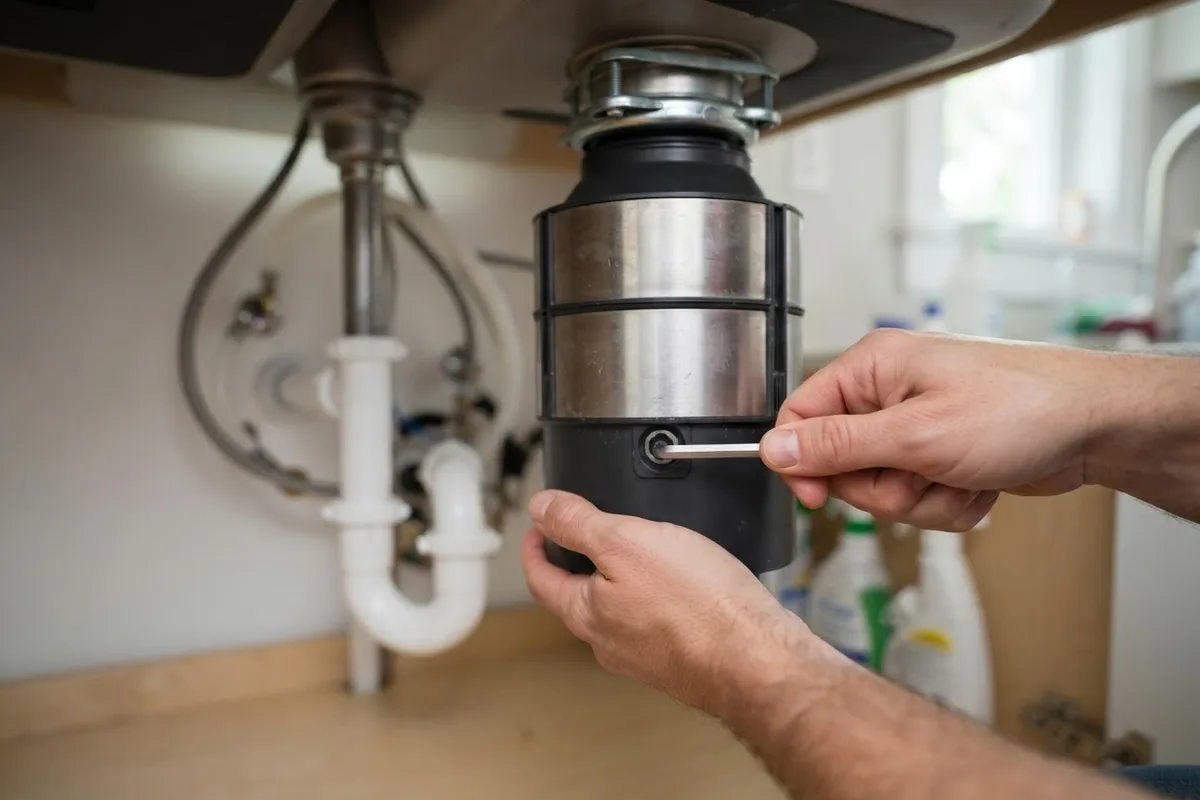
- Unplug the disposal and locate the small hexagonal hole centered on the very bottom of the exterior motor housing.
- Insert a 1/4-inch Allen wrench (hex key) into the bottom socket.
- Work the wrench back and forth clockwise and counterclockwise several times. You should feel the internal armature break free of any grit binding the shredder ring.
- Reach into the top chamber with long pliers or a wet/dry shop vacuum hose to pull out the dislodged grit.
- Press the red reset button on the bottom of the motor if it has popped out, plug the cord back in, and flush with cold water. If the motor clicks or trips instead of spinning smoothly, check these steps for why a garbage disposal is making a popping noise.
6. Inspect the Motor Bearings for Internal Wear
If you have removed every speck of debris, verified the impeller rivets are intact, and tightened the mounting hardware, the rattling sound may be coming from inside the sealed motor housing below the grinding chamber. Over eight to twelve years of service, moisture can slowly seep past the internal shaft seal and corrode the lower motor bearings.
- Unplug the unit and insert your 1/4-inch Allen wrench into the bottom hex hole.
- Slowly turn the wrench through a full 360-degree rotation while listening closely to the bottom of the unit.
- A healthy motor turns with smooth, silent resistance. If you feel a rough, crunchy, or hitching sensation through the wrench—or hear dry metal balls clicking inside the base—the internal bearings or motor magnets have failed.
- Because garbage disposal motors are factory-sealed and replacement bearings cost nearly as much as a brand-new unit, a failed bearing is a clear sign to replace the disposal rather than repair it.
Garbage Disposal Rattle Quick-Reference Guide
| Sound Description | Most Likely Cause | Typical DIY or Pro Fix | Estimated Cost Range* |
|---|---|---|---|
| High-pitched metallic clinking | Coin, screw, or bottle cap inside | Remove object with long pliers | $0 (DIY) |
| Rapid, uneven clicking on spin-down | Food wedged under one impeller lug | Free the swivel lug with a wooden spoon | $0 (DIY) |
| Heavy shuddering of the whole sink | Loose mounting ring or collar screws | Tighten 3 mounting bolts and lock ring | $0 (DIY) |
| Hollow plastic clattering under sink | Loose discharge tube or P-trap nuts | Tighten flange bolts and slip-joint nuts | $0 – $10 (New gasket) |
| Harsh scraping with every rotation | Grit wedged in outer shredder ring | Work bottom hex wrench back and forth | $0 – $8 (Hex wrench) |
| Deep, crunchy rumble from motor base | Worn-out internal motor bearings | Replace entire garbage disposal unit | $150 – $400 (Part & labor) |
Note: Typical US price ranges; actual costs vary by area, unit horsepower, and model.
When to Call a Pro
Most garbage disposal rattles take less than fifteen minutes to fix with a flashlight, a pair of tongs, and a screwdriver. However, you should stop DIY troubleshooting and call a professional if you notice water dripping from the bottom motor housing or over the electrical cord, if the unit repeatedly trips the circuit breaker at your main electrical panel, or if a broken impeller rivet or worn bearing requires a full unit swap on hardwired electrical lines.
Installing a replacement disposal involves supporting a heavy motor inside a cramped cabinet while aligning plumbing traps and wiring connections. If you would rather skip the under-sink headache, True Appliance Repair can connect you with an experienced local appliance pro to inspect your kitchen equipment or install a new unit safely.
FAQ
Can I run my garbage disposal if it is making a rattling noise?
No, you should turn it off immediately. Running a rattling disposal can launch sharp metal fragments or glass upward through the rubber splash guard, or drive a hard object deeper into the shredder ring where it can jam the motor and burn out the windings.
How do I get tiny glass shards or gravel out of a garbage disposal?
Unplug the disposal first, then use the crevice attachment on a wet/dry shop vacuum to suction out the bottom of the grinding chamber. Afterward, press half a raw potato or a damp wad of paper towels onto the turntable with tongs to pick up any remaining microscopic splinters before flushing with water.
Why does my garbage disposal only rattle when it is turning off?
A rattle that only happens as the motor slows to a stop is actually normal on many models. The two swivel impeller lugs are held outward by centrifugal force at full speed; as the turntable slows down, the lugs flop back and forth slightly on their rivets until the plate stops spinning.
How much does it cost to repair or replace a rattling garbage disposal?
Clearing a jammed object or tightening a loose mounting collar costs nothing if you do it yourself, or roughly $90 to $175 for a standard service call. If the motor bearings or flywheel are ruined, replacing the entire unit typically runs between $150 and $400 including the new disposal and labor, though prices vary by area and model.