
A sudden, sharp pop coming from under the kitchen sink can stop you in your tracks during dinner cleanup. Whether your unit is snapping against a hidden fruit pit, slapping a worn rubber baffle, or tripping its internal overload switch, a garbage disposal making a popping noise is warning you that something is out of place. By running through six safe, methodical checks, you can pinpoint the exact source of the sound and get your sink running quietly again.
Safety First: Before placing your hands, a flashlight, or any tools near the drain opening or under the sink cabinet, always unplug the garbage disposal from the wall outlet beneath the sink. If the unit is hardwired directly into your home's electrical system, go to your main breaker box and flip the corresponding circuit breaker to the "Off" position. Never put your fingers inside the grinding chamber, even when the power is disconnected.
1. Clear Small Hard Debris From the Impellers
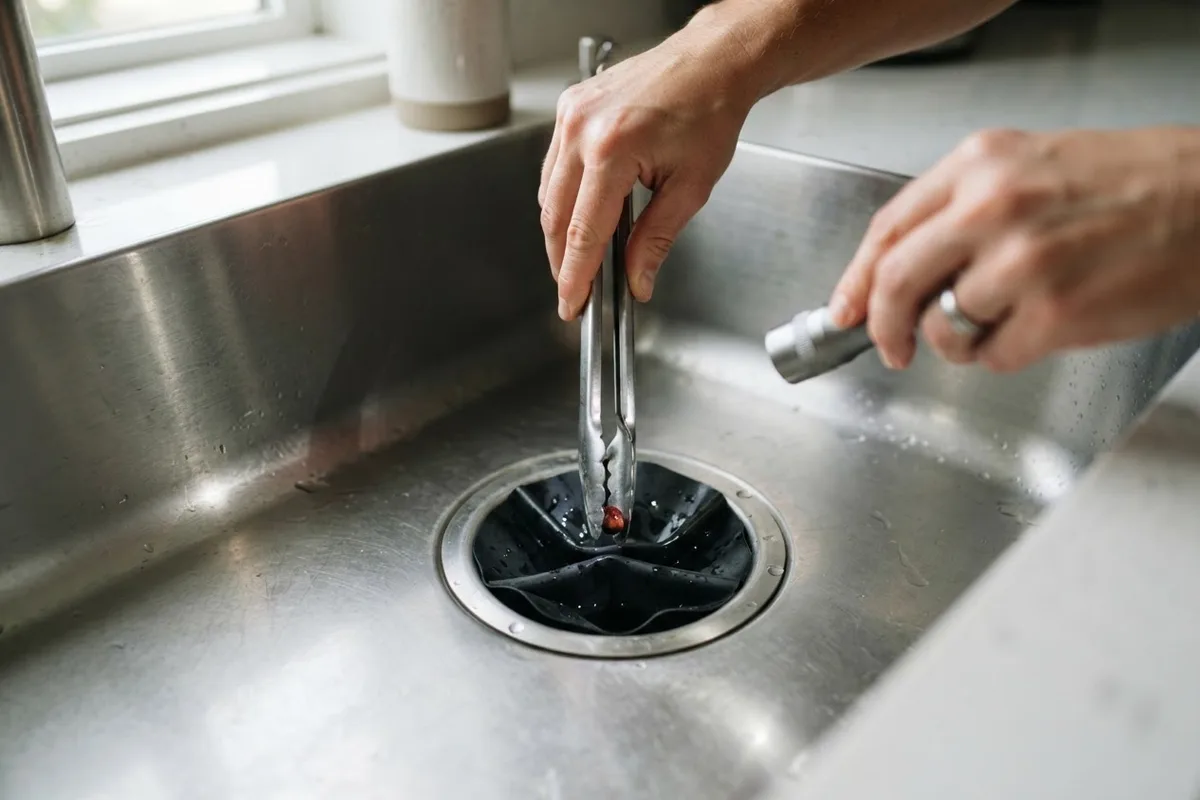
The most common culprit behind a rhythmic popping or snapping sound is a small, dense object ricocheting inside the grinding chamber. Unlike a large bone that jams the motor completely, a cherry pit, popcorn kernel, coffee bean, or small piece of gravel can bounce off the spinning impellers (the small metal lugs attached to the flywheel) and strike the metal shredder ring, creating a loud popping sound with every rotation.
- Unplug the garbage disposal under the sink or shut off its circuit breaker.
- Pull the removable rubber splash guard out of the sink opening (or fold the flaps back if it is a fixed mount) and shine a bright flashlight straight down into the chamber.
- Inspect the outer perimeter of the turntable and the small gaps around the impellers for pits, seeds, shells, or glass fragments.
- Use needle-nose pliers, long kitchen tongs, or a telescoping magnet (if the debris is a metal twist-tie or bottle cap) to extract every piece of foreign material.
- Swivel the two metal impellers gently with the tip of a wooden spoon to ensure no grit is wedged underneath them, so they can swing freely.
2. Free a Partially Jammed Flywheel With a Hex Wrench
Sometimes a tough, fibrous scrap or a wedged fragment catches the turntable at one specific point in its rotation, forcing the swiveling impellers to snap backward violently and make a loud pop before stalling. Using the manual breaker socket on the bottom of the unit lets you feel for hidden resistance and break the jam loose safely.
- Verify that the unit is unplugged and the wall switch is in the "Off" position.
- Clear items out from under the sink cabinet so you can clearly see the bottom center of the disposal housing.
- Insert a 1/4-inch Allen wrench (hex wrench) into the hexagonal hole located at the very center of the bottom plate.
- Work the wrench firmly back and forth—clockwise and counterclockwise—several times until the flywheel rotates a full 360 degrees with completely smooth, even resistance.
- Look down into the sink opening with your flashlight again and use tongs to grab whatever piece of debris was just dislodged from the shredder ring.
3. Reset a Popping Thermal Overload Button
If you hear a single, distinct "pop" or heavy click from beneath the sink cabinet followed immediately by dead silence, the sound may not be coming from inside the grinding chamber at all. Every disposal has a small red or black thermal overload protector on the bottom of the casing. When the motor overheats from a heavy food load or a bound flywheel, this switch springs outward with an audible pop to cut power and save the motor windings.
- Turn the wall switch off and unplug the power cord.
- Feel the outside of the disposal cylinder; if it is warm to the touch, let it cool down for 15 to 20 minutes before proceeding.
- After clearing the grinding chamber and turning the hex wrench as described in the steps above, locate the small square button on the bottom of the disposal.
- Press the reset button gently upward with your finger until it latches in place with a quiet click.
- If the button pops right back out the moment you plug the unit in and flip the switch—or if you notice a garbage disposal not draining alongside the tripping switch—stop immediately, as the motor may have an internal short.
4. Replace a Warped or Loose Sink Baffle
Not every popping noise is mechanical or electrical. Over years of exposure to hot water, dish soap, and food grease, the rubber splash guard (also called the sink baffle) softens, warps, and loses its elasticity. When water and pulverized food swirl upward during operation, a fatigued rubber flap can fold downward, get slapped by the spinning water stream or impellers, and snap back into place with a rapid, hollow popping sound.
- With the power disconnected, pull the rubber splash guard out of the drain throat (on collar-mounted units, you may need to twist the disposal slightly to access a fixed gasket, though most modern baffles pull right out from the top).
- Inspect the underside of the rubber flaps for missing chunks, tears, curled edges, or stiff, degraded rubber.
- Scrub a dirty but intact baffle in warm, soapy water to remove stiff grease deposits that make the flaps stick together and pop apart.
- Press the clean baffle firmly back into the sink drain groove until the outer lip is seated evenly all the way around.
- If the rubber is torn or warped out of shape, purchase an exact-fit replacement baffle for your sink model (typically $8 to $20 at hardware stores, though prices vary by model) and snap it into place.
5. Tighten a Loose Mounting Collar and Sink Flange
When a disposal isn't locked tightly against the underside of the sink basin, the sudden startup torque of the motor causes the entire heavy cylinder to jerk and twist. This movement makes the metal mounting tabs pop or snap against the lower mounting ring, especially when the unit first kicks on or shuts off.
- Unplug the disposal and look directly at the metal collar assembly where the top of the disposal meets the bottom of the sink.
- Grasp the body of the disposal with both hands and try to wiggle it gently; there should be zero play between the unit and the sink basin.
- Check the three mounting screws pressing against the flat metal backup ring. If any have vibrated loose, tighten them evenly with a screwdriver until snug.
- Insert a screwdriver tip or the disposal hex wrench into one of the curled metal ears on the lower mounting ring and pull it clockwise (to the right) to lock the collar higher up its ramps.
- If you notice water dripping around this collar while checking the bolts, check our guide on fixing a garbage disposal leaking from the side to reseal the plumber's putty properly.
6. Inspect the Wall Switch and Electrical Outlet
A sharp, single pop accompanied by a faint ozone smell or a tripped breaker points to an electrical fault rather than a mechanical jam. Kitchen sink switches endure heavy daily use and high humidity, which can wear out the internal spring contacts inside the wall toggle switch or cause loose wire connections to arc.
- Stand near the wall switch and listen closely when a helper flips it on—Wait first: if you ever heard a loud pop at the switch itself or saw a flash behind the faceplate, leave the circuit breaker off and do not flip the switch again.
- With the circuit breaker turned off at your home's main electrical panel, inspect the power cord under the sink for pinched insulation, animal chew marks, or water dripping onto the plug from the P-trap above.
- Check where the power cord enters the bottom plate of the disposal to make sure the metal strain-relief clamp is tight and hasn't allowed the cord to pull loose.
- Reset any tripped GFCI outlet buttons on the kitchen backsplash or under the sink once you have confirmed the area is completely dry.
- Leave any faulty wall switch replacement, burnt outlet repair, or breaker panel troubleshooting to a qualified professional.
Quick-Reference Guide: Decoding the Popping Sound
| What the Popping Sounds Like | When It Happens | Most Likely Cause | Typical Fix Cost (Parts Only) |
|---|---|---|---|
| Rapid, metallic snapping or clattering | Continuously while the motor runs | Fruit pit, seed, or pebble hitting the shredder ring | $0 (DIY extraction with tongs) |
| Hollow, wet slapping or flapping pop | Mostly when running water down the drain | Warped, greasy, or torn rubber splash guard | $8–$20 for a new baffle (varies by model) |
| Single loud clunk or pop under the sink | Right at startup or shutdown | Loose mounting ring tabs shifting under motor torque | $0 (Tighten mounting ring and screws) |
| Sharp single click/pop, then unit dies | After 5–10 seconds of straining | Thermal overload reset button tripping underneath | $0 (Clear jam with hex wrench and reset) |
| Sharp electrical snap near the wall or sink | Instant the wall switch is flipped | Worn wall switch, moisture in outlet, or shorted motor | $120–$275+ for pro repair (varies by area) |
When to Call a Pro
While clearing a rogue olive pit or pressing a reset button takes only a few minutes, some popping noises signal internal wear that isn't safe or practical to tackle on your own. If you have cleared the grinding chamber completely, verified that the flywheel spins smoothly with an Allen wrench, and yet the unit still makes a loud internal mechanical bang, one of the swivel impellers may have a broken mounting rivet or the lower motor bearings may be failing. Likewise, if the reset button or your home's circuit breaker pops immediately every time you restore power, stop right away—continuing to flip a tripping breaker creates a serious electrical hazard.
Professional local appliance repair or unit replacement typically ranges from $150 to $400 depending on your area, the horsepower of the disposal, and whether plumbing modifications are needed. If you want an experienced technician to inspect your setup safely, contact True Appliance Repair and we can match you with an independent local pro to get your kitchen back in working order.
FAQ
Is it safe to run my garbage disposal if it is making a popping noise?
No, you should turn the disposal off immediately if you hear any unusual popping, snapping, or banging sounds. Continuing to run the unit with a hard object inside can shatter the object, send shards flying upward, or permanently bend the metal impellers and burn out the motor.
Why did my garbage disposal pop and then stop working completely?
When a disposal pops once and goes completely dead, the internal thermal overload switch on the bottom of the unit has likely tripped to prevent the motor from overheating. Unplug the disposal, clear the jam using a 1/4-inch hex wrench in the bottom socket, let the motor cool for 15 minutes, and press the red reset button back in.
Can ice cubes cause a loud popping noise in a garbage disposal?
Yes, grinding a handful of ice cubes is a popular trick to scour grease off the shredder ring, and it naturally produces a very loud, sharp popping and crunching noise for 10 to 15 seconds. However, once the ice melts and flushes down the drain, the unit should return to a quiet, steady hum.
How long should a standard household garbage disposal last?
Most residential garbage disposals last between 8 and 12 years with normal kitchen use and proper care. If your unit is over 10 years old and starts making loud mechanical popping noises accompanied by leaks or frequent breaker trips, replacing the entire unit is usually more cost-effective than repairing internal motor parts.