
Standing murky water in your kitchen sink brings meal prep and cleanup to a sudden halt. When you have a garbage disposal not draining, the culprit is usually a ball of fibrous food waste, congealed grease in the P-trap, or a jammed impeller blade rather than a broken motor. With a few basic household tools and about 30 minutes, you can safely clear the blockage yourself and get your kitchen sink flowing freely again.
1. Cut Power and Check for a Hidden Impeller Jam
Before you put your hands or any tool near the sink drain, safety comes first. A disposal that hums or trips its breaker often has a jammed grinding plate, which blocks water from passing through the drain holes inside the chamber.
- Unplug the garbage disposal power cord under the sink, or flip the dedicated circuit breaker off at your home's main electrical panel.
- Shine a flashlight down through the rubber splash guard to look for utensils, fruit pits, or bone fragments.
- Use long-handled kitchen tongs or needle-nose pliers to pull out any visible debris—never reach your bare hand into the grinding chamber.
- Locate the quarter-inch hex hole on the very bottom center of the disposal unit.
- Insert an Allen wrench (most units come with an L-shaped disposer wrench) and work it back and forth clockwise and counterclockwise until the flywheel turns freely all the way around.
- Plug the unit back in, press the red reset button on the bottom of the motor housing if it popped out, and run cold water while flipping the switch for five seconds to see if the water drops.
2. Plunge the Sink Using a Drain Clamp on the Dishwasher Line
If the blades spin freely but water still sits in the basin, soft food waste is likely packed right below the grinding ring. Plunging works well, but you have to close off secondary openings first so your plunging pressure actually hits the clog instead of pushing dirty water backward.
- Look under the sink for the rubber dishwasher drain hose connected to the upper side inlet of the garbage disposal.
- Place a temporary hose clamp—or wrap a towel around the rubber tube and squeeze it gently with slip-joint pliers—to pinch the dishwasher line shut so murky sink water cannot backflow into your dishwasher.
- If you have a double-basin kitchen sink, stuff a wet dishcloth tightly into the other drain opening to create an airtight seal.
- Place a flat-bottomed sink plunger squarely over the garbage disposal opening and make sure there is at least two inches of standing water in the sink to cover the plunger lip.
- Pump up and down firmly six to eight times, then pull the plunger up sharply on the final stroke.
- Remove the clamp from the dishwasher hose and run a strong stream of cold tap water to flush the loosened food waste down the main pipe.
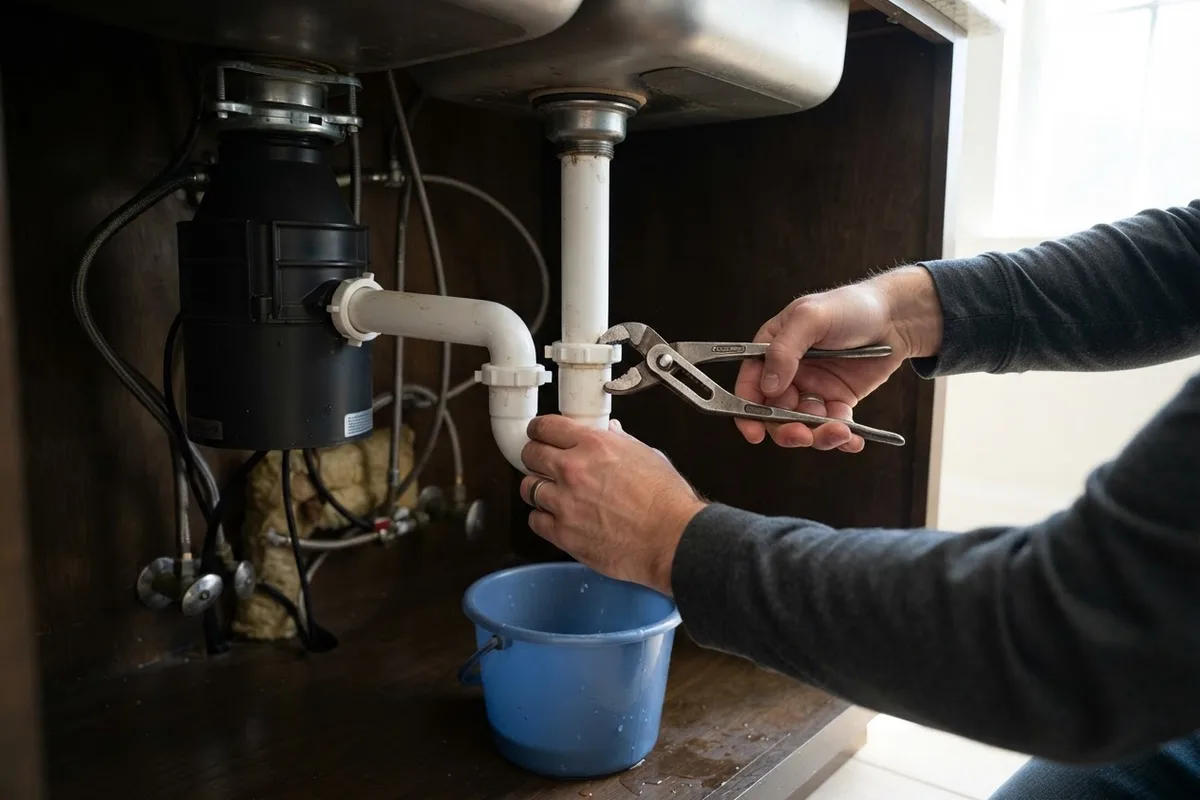
3. Clear the Discharge Elbow and Sink P-Trap
When plunging does not move the blockage, the clog is almost always sitting in the tight bend of the discharge tube or the U-shaped P-trap underneath the cabinet. Starchy foods like pasta, rice, and potato peels expand in water and pack tightly into these curved PVC pipes.
- Unplug the garbage disposal from the wall outlet to ensure it cannot turn on accidentally.
- Clear out the cabinet under the sink and place a deep plastic bucket or roasting pan directly beneath the U-shaped P-trap and the curved black discharge elbow exiting the side of the disposal.
- Unscrew the slip nuts at both ends of the P-trap by hand; if they are tight, use channel-lock pliers with gentle pressure so you do not crack the plastic threads.
- Let the trapped water and sludge empty into the bucket, then take the curved pipe outside or to a utility sink to push out the clog with a bottle brush.
- Undo the metal bracket or slip nut holding the horizontal discharge elbow directly to the side of the disposal and inspect the narrow opening—this spot catches fibrous celery strings and eggshell membranes.
- Reassemble the clean pipes, hand-tighten the slip nuts plus a quarter turn with pliers, and run cold water to check for drips. If you notice moisture seeping from the housing itself rather than the pipe joints, follow our guide on why your garbage disposal is leaking from the side.
4. Flush Out the Dishwasher Air Gap and Cross-Tee
Sometimes the restriction is not inside the disposal itself, but in the shared plumbing tee that links a double sink or an air gap vents system. When an air gap gets clogged with food particles, it can create an airlock or backup that slows drainage across the entire sink assembly.
- If you have a small cylindrical air gap cap mounted on the back corner of your sink deck next to the faucet, pull the decorative metal cover straight up to expose the plastic cap underneath.
- Twist or unclip the top plastic cap and check for wedged food scraps, grease buildup, or calcium scale.
- Use a long narrow bottle brush or a zip-tie drain tool to clear out the larger hose running down from the air gap to the disposal inlet.
- On a double-basin sink where both drains meet at a central T-fitting before dropping into a single P-trap, unscrew the baffle tee and inspect the internal divider wall.
- Rinse away any trapped food paste, reattach the fittings securely, and test the drain with hot running water.
5. Dissolve Grease Buildup with Baking Soda and Boiling Vinegar
Skip harsh chemical drain openers—caustic liquid cleaners corrode the rubber splash guard, pit the stainless steel grinding lugs, and eat away at the internal watertight seals of your disposal. Instead, use a hot vinegar and baking soda flush to break down congealed cooking fats and soap scum after you have removed standing water.
- Bail out any remaining standing water from the sink basin using a cup and sponge until the disposal chamber is empty.
- Pour one-half cup of dry baking soda directly down through the rubber sink baffle into the grinding chamber.
- Pour one cup of white distilled vinegar slowly over the baking soda; let the fizzing mixture sit undisturbed for 15 to 20 minutes to soften greasy sludge coated on the chamber walls.
- While waiting, bring a full kettle of water to a rolling boil on the stove.
- Carefully pour the boiling water straight down the disposal drain in a steady stream to melt and wash away the loosened grease.
- Plug the disposal back in, turn on the cold water tap full blast, and run the motor for 30 seconds to rinse the line clean.
6. Snake the Wall Drain Stub-Out Line
If the disposal chamber, discharge elbow, and P-trap are completely clear of debris, the blockage sits deeper inside the horizontal branch drain pipe behind your kitchen wall. You can reach clogs up to 15 or 25 feet down the line using an inexpensive manual drum auger.
- With the disposal unplugged and the P-trap removed (as outlined in Step 3), locate the open drain pipe stub-out coming out of the back wall of the cabinet.
- Loosen the thumbscrew on a manual hand auger and feed the coiled metal cable six inches into the wall pipe.
- Tighten the thumbscrew and turn the auger handle clockwise while gently pushing the cable forward until you feel resistance beyond the first wall elbow.
- Once the tip hits the clog, rotate the handle firmly while moving the cable slightly in and out to hook or break up the compacted mass.
- Slowly retract the cable, wiping it down with an old rag as it goes back into the drum so it does not fling dirty water inside your cabinet.
- Reinstall the P-trap, tighten all slip nuts, and run cold water for two full minutes to verify that the main branch line drains swiftly.
Garbage Disposal Drainage Troubleshooting Guide
| Symptom You Notice | Most Likely Cause | Best DIY Fix | Typical Pro Cost (US Range)* |
|---|---|---|---|
| Disposal hums, trips breaker, and holds water | Jammed flywheel / stuck impeller plate | Cut power, clear debris with tongs, use hex wrench under unit | $100 – $220 |
| Motor spins loudly, water drains very slowly | Clogged P-trap or side discharge elbow | Unplug unit, place bucket under pipe, remove and clean P-trap | $125 – $275 |
| Water backs up into both sides of double sink | Blockage in shared baffle tee or wall drain | Disassemble center tee and run a hand auger into wall stub-out | $150 – $350 |
| Dirty water shoots out of sink deck air gap | Blocked hose between air gap and disposal | Pop off air gap cap and brush out the large drain hose | $90 – $190 |
| Grinding chamber is dull and sluggish with food | Worn shredder ring or broken impeller blades | Replace aging garbage disposal unit | $250 – $550 (parts + labor) |
Note: Prices reflect broad typical US ranges and vary by local labor rates, plumbing accessibility, and appliance model.
When to Call a Pro
Most sink clogs can be cleared in under an hour with a plunger, a pair of pliers, and a bucket. However, you should stop DIY work and call a professional if your hand auger hits a solid obstruction deep inside the wall, if multiple drains in your home are backing up at the same time, or if the disposal motor is tripping your main electrical panel breaker repeatedly.
Additionally, if your unit is over 8 to 10 years old and the grinding lugs are worn down so flat that food slips past unshredded—or if it is making a harsh metallic screech like the ones covered in our guide on why your garbage disposal is making a squealing noise—replacing the disposal is often more cost-effective than constantly clearing clogs. If you need help diagnosing a stubborn drain problem or installing a replacement unit, True Appliance Repair can match you with a local pro for dependable home appliance repair.
FAQ
Can I use Drano or Liquid-Plumr in a garbage disposal that is not draining?
No, you should never pour chemical drain cleaners into a garbage disposal. Harsh caustic chemicals sit inside the grinding chamber where they corrode metal blades, weaken plastic housing components, and ruin rubber seals. Worse yet, if the chemical fails to clear the clog, you risk chemical burns on your hands when you open the P-trap underneath.
Should I use hot or cold water when running the garbage disposal?
Always use a strong stream of cold water whenever you grind food waste. Cold water keeps any fats or cooking oils solid so the disposal blades can chop them into tiny pellets that wash easily through the P-trap. Hot water melts grease temporarily, allowing it to coat the deeper drain pipes where it cools, hardens, and causes severe blockages.
Why is water backing up into my garbage disposal when the dishwasher runs?
The dishwasher drain hose connects directly into the top side inlet of your garbage disposal. If your disposal's discharge elbow or P-trap is partially clogged—or if someone recently installed a new disposal and forgot to knock out the plastic dishwasher inlet plug inside the chamber—wastewater pumped out by the dishwasher has nowhere to go and will rise up into the kitchen sink.
Which foods are most likely to clog a garbage disposal?
Fibrous vegetables (celery stalks, corn husks, onion skins, and artichoke leaves) wrap tightly around the spinning impeller plate, while starchy foods (cooked pasta, white rice, and potato peels) turn into a thick, glue-like paste in the P-trap. Coffee grounds and eggshells also settle like wet sand in horizontal pipe bends and should always go into the trash or compost bin instead.