
Hearing a sudden pop, thump, or mini-boom coming from your kitchen range right as you preheat dinner is enough to make any homeowner jump. While normal thermal expansion can cause harmless metallic clicks, a louder bang usually means gas is building up for a few extra seconds before catching a spark. Below, you will learn how to tell harmless expansion sounds apart from delayed ignition and walk through six practical checks to keep your oven running quietly before holiday baking season kicks into high gear.
Safety First: Before inspecting or cleaning any internal oven components, turn the oven controls completely off, unplug the power cord from the wall outlet (or flip the dedicated circuit breaker), and shut off the gas supply valve behind the range. Make sure the oven cavity is completely cool to the touch. If you ever smell strong raw gas that does not dissipate, or hear a continuous hissing sound when the oven is off, leave the house immediately and call your gas utility company.
1. Clear Clogged Bake Burner Ports
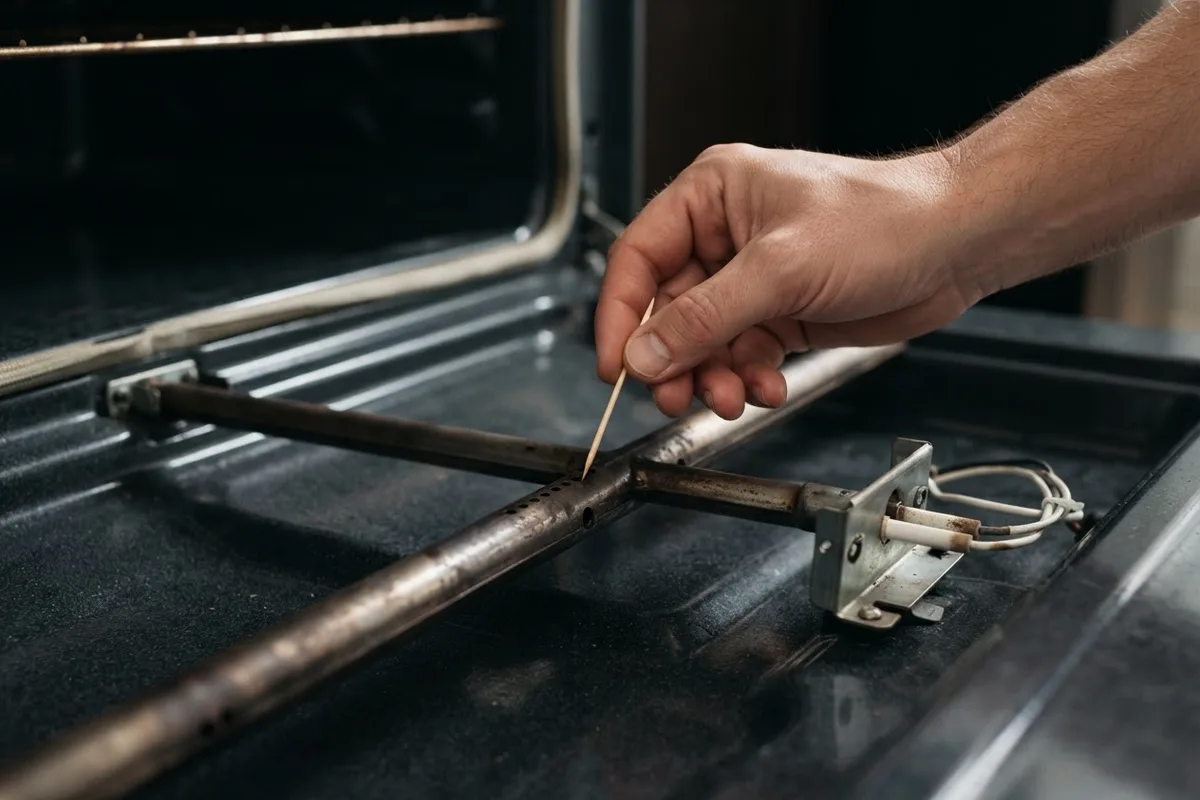
When baked-on grease, carbon buildup, or boil-over crumbs block the tiny holes along the side of your oven's bake burner tube, gas cannot flow smoothly toward the igniter. Instead, gas accumulates inside the bottom of the oven until it finally reaches the heat source, igniting all at once with a loud pop or whoosh. Cleaning those tiny ports is one of the easiest ways to restore smooth, quiet ignition.
- Unplug the range, shut off the gas valve, and remove the oven racks.
- Unscrew and lift out the flat metal oven floor panel (bottom baffle) and the flame spreader plate beneath it to expose the burner tube.
- Wipe away loose soot and food debris around the burner with a dry microfiber cloth.
- Gently poke a wooden toothpick, a stiff nylon brush, or a sewing needle into each individual port hole along the burner tube to clear out stubborn carbon.
- Avoid using metal wire brushes that can scratch or widen the factory-drilled holes, and never use soapy water that could trap moisture inside the gas tube.
- Vacuum up any fallen crumbs, reinstall the flame spreader and floor panel, and test the bake cycle.
2. Replace a Weakening Glow Bar Igniter
Most modern gas ovens rely on a silicon carbide or silicon nitride glow bar igniter that heats up to open the gas safety valve and light the burner. As an igniter ages, it takes longer to reach the required amperage, sometimes allowing small pockets of unburned gas to collect and pop when they finally catch. This is also the number one culprit if you have noticed your gas oven taking forever to preheat over the past few weeks.
- Turn the oven on to Bake at 350°F and watch the glow bar through the bottom vents (or with the floor panel temporarily removed).
- Time how long it takes from the moment the igniter starts glowing until the gas burner lights.
- If it takes more than 60 to 90 seconds to ignite, or if the bar glows a dim orange instead of bright yellow-white, the igniter is wearing out.
- Shut off the power and gas supply, then let the igniter cool completely.
- Unscrew the two mounting bolts holding the igniter bracket to the burner tube and disconnect the quick-release wire harness.
- Install an exact-match replacement igniter without touching the fragile gray carbide tip with your bare fingers, as skin oils create hot spots that shorten its life.
3. Reseat the Oven Floor and Flame Baffle
Not every popping sound comes from gas or flames. The heavy sheet-metal floor panel and the steel flame baffle underneath it expand rapidly as the burner heats them from room temperature to 400°F, and they contract just as quickly when the oven cools down. If those panels are slightly warped, wedged too tightly, or missing a mounting screw, the metal will buckle and snap with a sharp pop during preheating and cooling.
- With the oven cool, press down gently on the four corners and the center of the bottom oven panel to see if it rocks oroil-cans.
- Remove the rear thumbscrews or sliding clips that hold the floor panel in place.
- Lift the panel out and inspect it against a flat countertop to check for twisting or warping caused by heavy roasting pans.
- Check the metal flame baffle directly below it to ensure its mounting tabs sit flat inside their slots.
- Reinstall the floor panel and tighten the retaining screws until they are just snug—overtightening prevents the metal from sliding micro-fractions of an inch as it expands.
- Never line the bottom floor of a gas oven with aluminum foil, which traps intense heat and warps steel panels permanently.
4. Adjust the Burner Air Shutter
A gas burner needs a precise mix of fuel and oxygen to light cleanly and burn at a steady temperature. At the very back of the bake burner tube—right where it slides over the brass gas orifice— sits an adjustable metal collar called the air shutter. If cleaning vibrations or a bumped pan knock this collar out of position, the air-to-gas ratio goes out of balance, causing noisy lighting, fluttering flames, and distinct popping when the burner cycles off.
- Remove the oven racks, floor panel, and flame spreader so you have a clear view of the entire bake burner tube.
- Turn the oven on briefly to inspect the flame color along the tube, then turn the oven off and disconnect power.
- Healthy gas flames should be steady blue with tiny light-blue tips; lazy yellow flames mean too little air, while noisy flames that lift off the burner ports mean too much air.
- Locate the small locking screw on the collar at the back end of the burner tube and loosen it a half-turn with a screwdriver.
- Rotate the metal shutter open slightly to fix yellow flames, or close it slightly to quiet down lifting, popping flames.
- Tighten the locking screw, reassemble the oven floor, and test the bake cycle.
5. Level Oven Racks and Heavy Cookware
Sometimes the simplest explanation is the right one. If your oven racks are bowed in the middle or coated in burnt-on grease along the side rails, they can bind against the porcelain cavity walls as the metal expands. As the temperature climbs, the rack suddenly slips free of the friction spot, making a loud metallic pop that sounds surprisingly like an ignition issue.
- Pull each cool oven rack completely out and check the side rails for baked-on food or rough rust spots.
- Place a small spirit level across the front and side of the range to verify the appliance itself sits level on the kitchen floor.
- If the range rocks, adjust the front leveling legs at the base of the cabinet with channel-lock pliers until all four feet sit firmly.
- Wipe a tiny drop of high-heat vegetable oil onto a paper towel and rub it along the outer edges of the metal racks so they glide smoothly against the porcelain guides.
- Avoid placing thin, bargain-aisle aluminum cookie sheets directly on the bottom rack, as thin bakeware warps and pops loudly around 375°F.
- While you have the racks out for a tune-up, it is also a great time to clean your oven door glass between the panes so you can clearly monitor your bake burner and food without opening the door.
6. Inspect the Gas Safety Valve Connections
Inside the bottom rear compartment of your range sits the dual gas safety valve, which regulates gas flow to both the bake and broil burners. Inside this valve, a bi-metal switch opens and closes as electrical current passes through the glow bar igniter. When the internal diaphragm or mechanical seats inside the safety valve begin to stick or wear out, the valve may snap open abruptly or leak tiny puffs of gas that pop when extinguishing.
- Unplug the range from the wall and shut off the main gas supply valve.
- Slide the range forward carefully on furniture sliders so you do not tear your kitchen flooring or kink the flexible gas connector line.
- Unscrew and remove the lower rear access panel to locate the gas safety valve where the main burner tubes connect.
- Inspect the wire spade terminals attached to the valve for signs of scorching, corrosion, or loose connections.
- Gently push any loose electrical spade connectors firmly back onto their tabs.
- Do not attempt to disassemble or adjust the gas safety valve body itself; if the valve is buzzing loudly, sticking, or failing to close cleanly, stop right there and bring in a qualified technician.
Quick-Reference Guide: Gas Oven Popping Sounds
| When You Hear the Pop | What It Sounds Like | Most Likely Cause | Typical Part or Repair Cost* |
|---|---|---|---|
| 60–90 seconds after turning on | Loud boom or whoosh accompanied by a flash | Clogged burner ports or weak glow bar igniter | $0 (cleaning) to $150–$300 (pro igniter replacement) |
| Every 5–10 minutes while baking | Soft thump as the burner cycles back on | Air shutter out of adjustment or aging igniter | $0 (DIY shutter tweak) to $150–$280 |
| Right as the burner shuts off | Quick pop or puff at flame extinction | Too much primary air at the burner shutter | $0–$120 (service adjustment) |
| During preheat and cooldown | Sharp metallic snap or ping | Warped oven floor panel, baffle, or tight racks | $0 (reseating) to $80–$160 (new floor panel) |
| Continuous clicking + loud pop | Rapid spark ticking followed by a bang | Dirty spark electrode or faulty safety valve | $180–$400 (valve replacement) |
Note: Typical US price ranges; actual costs vary by area, range brand, and model.
When to Call a Pro
Cleaning clogged burner ports, leveling racks, and reseating a warped oven floor panel are safe, rewarding weekend projects for any handy homeowner. Replacing a plug-and-play glow bar igniter is also very manageable if you take your time and disconnect both power and gas first.
However, you should always stop and call a professional if the popping turns into a heavy boom that shakes the oven door, if you smell unburned gas around the kitchen, or if the problem points to the internal gas safety valve, pressure regulator, or main gas manifold. Working directly on pressurized gas components requires specialized leak-detection equipment and model-specific calibration. If your troubleshooting points beyond a simple cleaning, True Appliance Repair can connect you with an independent local technician for professional oven and stove repair so you can get back to baking safely.
FAQ
Is it dangerous if my gas oven makes a popping noise?
It depends on the cause of the sound. A sharp metallic ping or snap as the oven heats up and cools down is just sheet metal expanding and is completely harmless. However, a muffled boom or whoosh right as the burner lights is called delayed ignition—meaning unburned gas is pooling for a few seconds before igniting—which should be fixed right away by cleaning the burner ports or replacing a weak igniter so the buildup does not get worse.
Why does my gas oven pop after I turn it off?
There are two common reasons a gas oven pops after you shut it off. First, as the flame extinguishes, the remaining gas inside the burner tube mixes with air and can make a single soft "pop" if the air shutter is open a bit too wide. Second, over the 20 to 30 minutes after baking, the heavy steel floor panel and internal frame contract as they cool, creating intermittent metallic popping sounds.
How much does it cost to fix delayed ignition in a gas oven?
If the delayed ignition is caused by dirty burner ports or a misaligned air shutter, you can clean and adjust the burner yourself for free in under 30 minutes. If the glow bar igniter or gas safety valve needs to be replaced by a technician, typical US repair costs range from $150 to $350 including parts and labor, though exact pricing varies by area and oven model.
Can a dirty oven cause a popping noise?
Yes, a dirty oven is one of the leading causes of popping noises. Spillover grease, pie filling, and carbon flakes often drop through the floor vents onto the bake burner tube, plugging the tiny gas ports around the igniter. When those ports are blocked, gas cannot reach the igniter until it travels further down the tube, causing a mini flare-up and a loud pop when it finally catches.