
You set your oven to preheat, come back fifteen minutes later, and find the cavity stone cold. When an oven fails to reach temperature, dinner plans grind to a sudden halt. Fortunately, standard gas and electric ranges rely on a few specific components to generate and regulate heat, making troubleshooting straightforward.
Before performing any hands-on inspection, prioritize safety. Always unplug your range from the wall outlet or switch off the dedicated circuit breaker at your main electrical panel. For gas models, turn off the manual gas shutoff valve behind the appliance before attempting repairs. If you ever smell gas or suspect a leak, stop immediately, ventilate the room, and contact your local utility company.
Here are six common reasons your oven is not heating up and how to fix them.
Inspect the Bake Element for Visible Burn Damage
On electric ranges, the bake element sits at the bottom of the oven cavity and supplies the primary heat for baking and roasting. Over time, high electrical current and thermal expansion can cause the metal coil to blistering, crack, or burn out completely.
To inspect the element, open the oven door and look closely at the bottom heating rod. If you notice localized melting, white blistering spots, or a physical break in the rod, the element has failed. If no visual damage is present, you can test it for continuity using a digital multimeter set to ohms (Ω).
- Disconnect power to the range by unplugging it or tripping the breaker.
- Remove the oven racks and unfasten the screws securing the bake element to the back wall.
- Pull the element forward slightly to reveal the wire terminals, and carefully disconnect the spade connectors.
- Touch the multimeter probes to the two metal terminals. A healthy element typically reads between 15 and 40 ohms. A reading of infinity (open circuit) means the element must be replaced.
Replacement bake elements generally cost between $30 and $90, depending on the brand and model, making this one of the most affordable DIY repairs.
Test or Replace a Weak Gas Oven Igniter
A gas oven igniter serves two vital purposes: it glows intensely hot to ignite the gas burner and draws electrical current to keep the gas safety valve open. Even if the igniter glows visible orange, it may lack the amperage required to open the gas valve, preventing the burner from lighting.
If your gas range broiler works but the bake burner fails, or if the oven takes more than 15 minutes to preheat, a worn igniter is almost always the cause.
- Shut off electrical power and close the gas supply valve to the range.
- Remove the bottom oven panel and flame spreader shield to expose the igniter assembly near the burner tube.
- Inspect the igniter for cracks, gray ash deposits, or broken filaments.
- Reconnect power temporarily to observe the ignition sequence: the igniter should glow bright yellow-white within 30 to 60 seconds before releasing gas. A dull orange glow indicates a weak igniter.
- Disconnect power again, unplug the wiring harness, unbolt the old igniter, and install a matching replacement assembly.
Replacement igniters typically run between $40 and $110. Avoid touching the ceramic element of the new igniter with bare hands, as skin oils can cause premature failure.
Check and Recalibrate the Oven Temperature Sensor
The temperature sensor (or thermistor) is a thin metal probe protruding from the upper rear corner of the oven cavity. It monitors internal heat levels and signals the control board to cycle the heating elements or gas valve on and off. A faulty or miscalibrated sensor can cause the oven to underheat dramatically or bake unevenly.
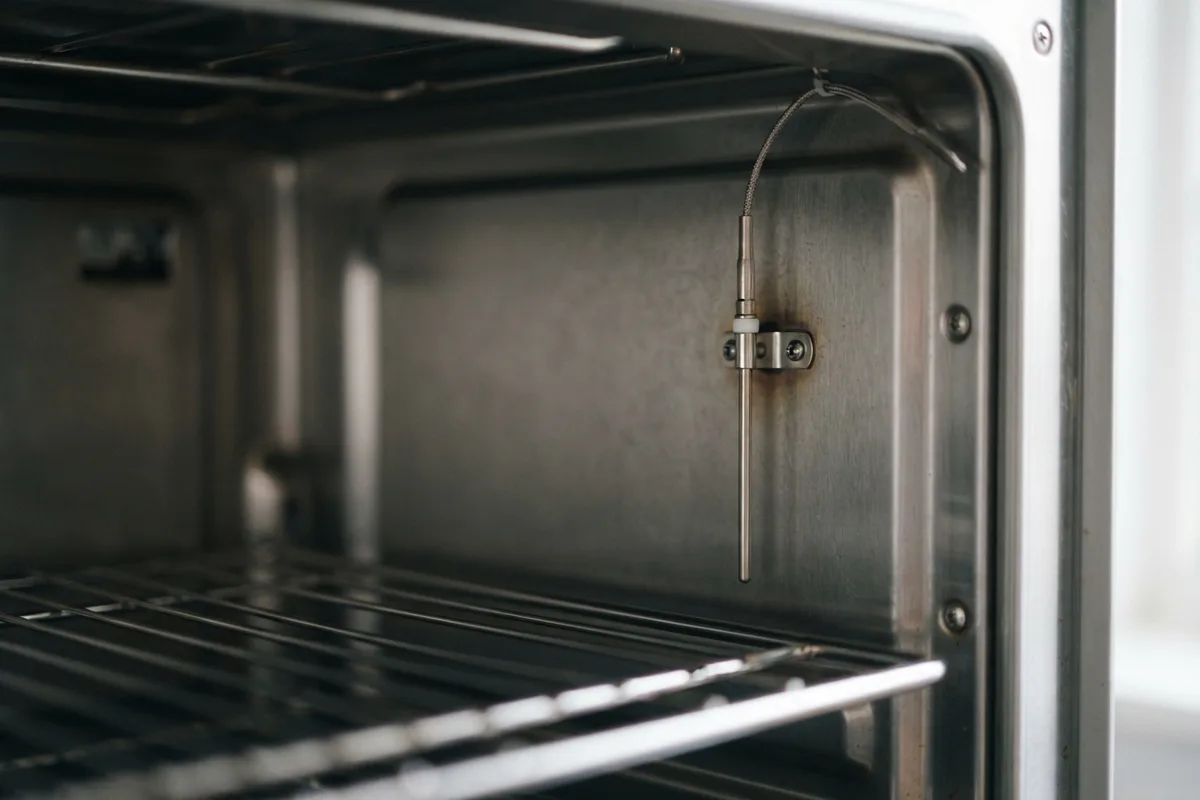 If your oven runs consistently 25 to 50 degrees cooler than the display temperature, the sensor may simply need recalibration or cleaning. If you are learning how to clean an oven properly, make sure not to knock or bend this delicate probe.
To test the sensor:
- Ensure the oven is completely cool and unplugged from electrical power.
- Remove the mounting screws holding the sensor probe to the back wall.
- Pull the wire harness out gently and disconnect the plastic connector.
- Measure resistance across the sensor terminals with a multimeter set to ohms. At room temperature (70°F), a standard RTD sensor should read approximately 1,050 to 1,100 ohms.
If the resistance strays significantly outside this range, replace the probe. If resistance is accurate, you can adjust the temperature offset through your oven control panel settings menu—consult your owner's manual for specific button sequences.
Reset a Tripped Breaker or Replace a Blown Thermal Fuse
Electric ranges require 240 volts of alternating current to power the heating elements. They operate on a double-pole circuit breaker in your home's breaker box. If one leg of the circuit trips while the other stays engaged, the clock and display lights will turn on, but the bake and broil elements will not heat up.
- Locate your home electrical panel and inspect the dual breaker for the range.
- Flip the dual switch fully to the "OFF" position, then firmly back to "ON" to reset both electrical legs.
- Try preheating the oven again.
Additionally, many modern electric and gas ovens feature an internal thermal fuse designed to cut power if the appliance overheats during a self-cleaning cycle. Located behind the back access panel or under the main cooktop, a blown thermal fuse cuts off heat permanently until replaced. Unplug the range, remove the back panel, and test the thermal fuse for continuity with a multimeter. A replacement fuse usually costs under $25.
Inspect the Door Switch and Self-Clean Latch Assembly
Your range uses a door switch to detect whether the oven door is fully closed. For safety reasons, many models disable heating operations or self-cleaning cycles if the control board senses an open door latch. Furthermore, if the motorized door latch mechanism becomes jammed or damaged during a previous cleaning cycle, the control board will lock out the heating elements.
- Disconnect power to the range.
- Inspect the plunger door switch along the front frame for cracks, sticky residue, or physical damage.
- Press the switch button manually; it should click cleanly without sticking.
- Test continuity across the switch terminals while depressing the actuator pin.
- If the door latch motor is stuck in the locked position, perform a hard reset by unplugging the range for 15 minutes to reset the logic board.
Sticky switches can often be cleaned with electrical contact cleaner, while broken door latches require full assembly replacement.
Verify High-Voltage Power and Main Control Board Outputs
When heating elements, igniters, and sensors test normal, the root issue likely stems from the main electronic control board or relay board. The control board uses mechanical relays to send 240V power to the bake element or 120V power to the gas valve circuit. Loose wire connections, burned relay contacts, or blown solder joints on the control board prevent voltage output.
- Ensure the main power is disconnected.
- Remove the upper back cover panel behind the control display.
- Visually inspect the circuit board for scorched components, swollen capacitors, or loose terminal wiring.
- Inspect the wiring harness connecting the main board to the heating components for signs of melting or pinching.
Replacing a control board is a moderate DIY task that costs between $150 and $350 for parts. However, electrical diagnostics on live circuits require extreme caution.
Quick Oven Heating Troubleshooting Guide
| Symptom | Primary Cause | Diagnostic Test | Typical DIY Repair Cost |
|---|---|---|---|
| Electric oven won't heat, display works | Burnt Bake Element | Visual inspection / Continuity test | $30 – $90 |
| Gas oven won't ignite, broiler works | Weak Gas Igniter | Amperage check / Visual glow test | $40 – $110 |
| Oven takes hours to preheat | Failing Sensor or Element | Multimeter resistance test | $20 – $70 |
| Display lit, no heat at all | Half-Tripped 240V Breaker | Reset dual circuit breaker | $0 |
| Heat stopped after self-clean | Blown Thermal Fuse | Continuity test behind back panel | $15 – $35 |
| Error code displayed | Faulty Control Board | Visual check for burn marks | $150 – $350 |
When to Call a Pro
While swapping out an accessible bake element or temperature sensor is well within the capability of most homeowners, certain repairs demand professional technical skill. You should stop and contact a technician if:
- You smell gas around your range or suspect a supply line issue.
- You need live voltage measurements across 240-volt electrical circuits.
- The main electronic control panel requires complex wiring transfers.
- Your wall oven requires total removal from cabinetry to reach rear access panels.
If you prefer to avoid handling electrical wiring or specialized diagnostic tools, True Appliance Repair can match you with a local appliance pro. Navigating oven and stove repair services quickly ensures your kitchen remains safe and fully functional without risking further component damage.
When you need broader assistance with household systems, expert local appliance repair technicians can diagnose complex electrical issues, save you time, and safely handle specialized tools.
Frequently Asked Questions
Why does my gas oven igniter glow orange but the burner won't ignite?
An igniter must glow bright yellow-white to draw sufficient amperage (typically 3.2 to 3.6 amps) to open the gas safety valve. Over time, ceramic igniters age and lose electrical resistance, causing them to glow dull orange without generating enough current to release gas. Replacing the igniter solves this issue in most gas ovens.
How much does it cost to fix an oven that won't heat up?
DIY replacement parts like bake elements, thermal fuses, and temperature sensors generally cost between $20 and $100. If you hire a service technician, total repair costs typically range from $150 to $400 depending on your location, oven model, and the specific component being replaced.
Why did my oven stop heating after running the self-clean cycle?
The high temperatures generated during a self-cleaning cycle (often exceeding 800°F) place extreme stress on internal electrical parts. This thermal stress frequently trips or blows the safety thermal fuse, damaging thermostat sensors or wire insulation. If your oven is dead after self-cleaning, check the thermal fuse first.
Can I use my stove cooktop if the oven is not heating up?
Yes, in most gas and electric ranges, the surface burners operate on separate electrical circuits or gas lines from the internal oven cavity components. You can safely cook on the stovetop while troubleshooting or waiting for oven repair parts, provided there are no gas leaks or main power failures.