
Few kitchen frustrations compare to checking on a holiday roast or batch of cookies only to find a cold cavity and a blank display. When your oven shuts off mid-bake, the culprit is often a simple setting, blocked airflow, or a minor sensor issue you can diagnose yourself. Before you begin any hands-on inspection below, let the oven cool completely, switch off the dedicated circuit breaker or unplug the range, and turn off the gas shutoff valve on gas models.
1. Check Cook Time and Auto-Shutoff Settings
Many modern ranges shut down automatically if an accidental timer or safety feature is active. It is surprisingly easy to brush a touchpad while wiping the control panel or to set a timed bake instead of a standard kitchen timer.
- Look at the display for indicators like Cook Time, Delay Start, or Auto Off while the oven is running.
- Cancel any active timed-bake setting and restart a standard Bake cycle without entering a duration.
- Check your owner's manual for the built-in 12-hour safety shutoff feature, which turns the heating elements off automatically during long overnight roasts unless Sabbath mode is enabled.
- Test the oven at 350°F for 30 minutes with an empty rack to confirm the shutoff was just a programming quirk.
If the oven still powers down with no timer set, move on to a full control reset.
2. Reset the Control Board at the Breaker
A brief power flicker or static shock can freeze an oven's electronic control board, causing the heating relay to drop out halfway through baking. A hard reset clears temporary glitches without needing any tools.
- Turn all oven knobs and digital controls to the Off position.
- Locate your home's breaker box and switch the labeled oven or range circuit breaker fully to Off (or unplug the range if the cord is easily reachable).
- Wait at least five full minutes so the internal capacitors discharge completely.
- Flip the breaker firmly back to On, reset the clock, and run a 20-minute bake test.
Never remove the electrical panel cover or force a breaker that trips again right away. A breaker that keeps tripping signals an electrical fault that requires a professional technician.
3. Clear Blocked Vents and Cooling Airflow
Ovens rely on vents and a small cooling fan to keep heat away from the electronic control board. If airflow is restricted, an internal high-limit thermal switch shuts the oven off to prevent heat damage—especially during long winter baking sessions.
- Wait until the oven is completely cool, then disconnect power at the breaker and shut off the gas valve on gas ranges.
- Remove any aluminum foil, silicone mats, or baking stones blocking the bottom vents or resting directly on the oven floor.
- Locate the rear exhaust vent (often under a rear burner or beneath the control console) and gently wipe away grease buildup using a damp cloth.
- Confirm the back of the range is not pushed tightly against the wall, blocking rear airflow slots.
Keeping vents clear as part of a regular oven maintenance checklist prevents repeat overheat shutdowns and improves baking consistency.
4. Inspect the Door Seal and Latch Switch
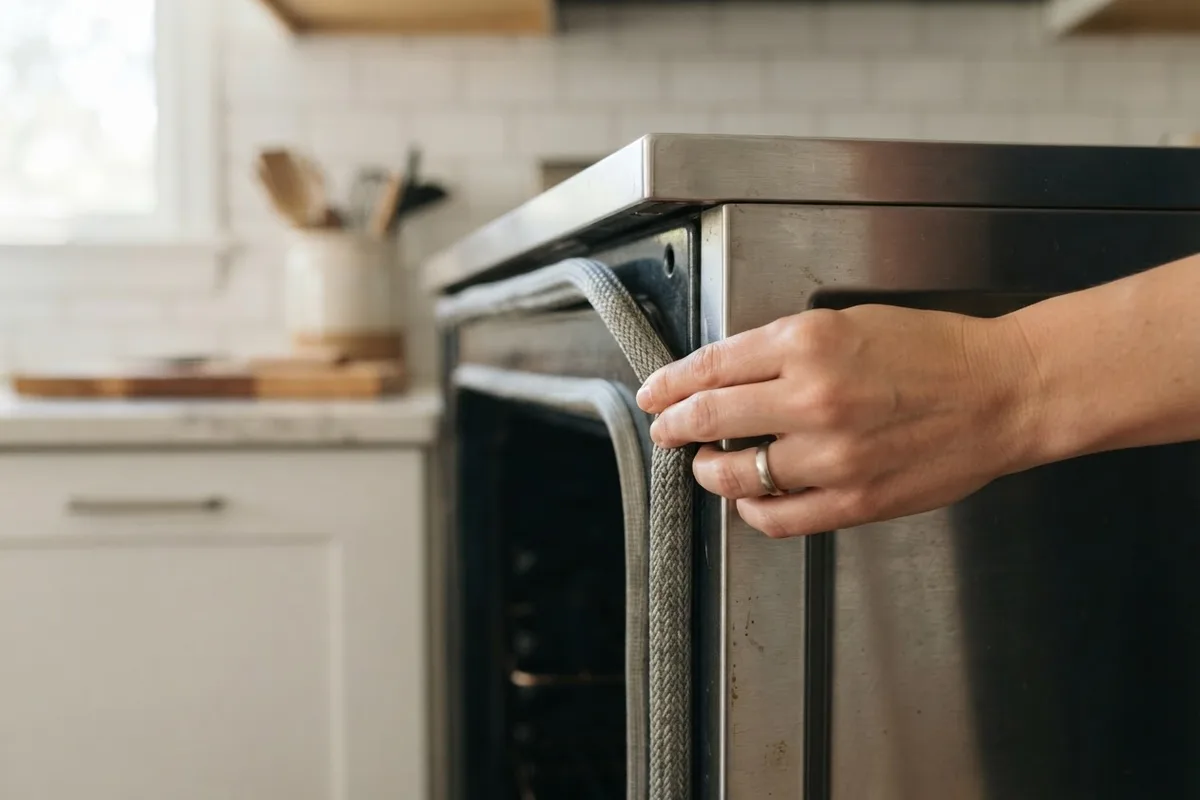
A worn door gasket or misaligned hinge lets blasts of hot air escape upward directly onto the control panel and thermal switches. On some ranges, a loose door also releases the door-ajar switch, signaling the oven to pause heating mid-cycle.
- With the oven cool and power disconnected, run your fingers around the entire perimeter of the braided fiberglass or rubber door gasket.
- Look for flattened sections, tears, hard grease crusts, or corners pulled out of their mounting clips.
- Check the door switch plunger along the front frame and gently wipe away sticky grease so it depresses smoothly.
- Close the door and verify it sits flush against the frame on both sides without sagging.
A damaged gasket is usually an easy snap-in replacement, while bent hinges or a faulty internal door-latch assembly call for service.
5. Clean and Check the Temperature Sensor
Inside the upper back corner of most ovens sits a thin metal rod called the temperature sensor. If heavy grease coats the probe—or if the sensor shifts and touches the cavity wall—the control board receives false overheat readings and shuts the oven down early.
- Shut off the breaker (and the gas valve on gas ovens) and confirm the interior is completely cool.
- Inspect the metal probe for baked-on spills, rust, or visible bends.
- Wipe the sensor gently with a damp microfiber cloth and mild dish soap, then dry it thoroughly without twisting the rod.
- Check that the small mounting bracket screws are snug and the probe sits clear of the metal wall.
If the sensor looks clean and straight but your oven still cuts off at random temperatures, the sensor's internal resistance may be drifting and needs multimeter testing by a technician.
6. Watch for Weak Gas Igniter Cycling
Gas ovens cycle their burner off once they hit the set temperature, then re-ignite periodically to maintain heat. A weak igniter often has just enough strength to light the oven during preheat, but fails to draw enough electrical current to open the gas safety valve on the second or third cycle—leaving your oven stone cold mid-bake.
- Start a normal bake cycle and listen closely after the oven reaches temperature.
- Look through the bottom vent slots (without opening the door repeatedly) when the oven should be re-heating to see if the igniter glows dimly orange without a flame lighting within 60 to 90 seconds.
- Review these signs your oven igniter is failing to see if slow preheating or clicking accompanies the shutoffs.
Never dismantle gas valves, manifolds, or supply lines yourself. If you ever smell rotten eggs or raw gas, turn the oven off immediately, open a window, leave the house, and contact your gas utility.
Quick Symptom-to-Cause Reference
Use this table to match what your oven does right before shutting off with the most likely cause and next step.
| What Happens Mid-Bake | Most Likely Cause | Safe Next Step |
|---|---|---|
| Display counts down, then turns off cleanly | Active Cook Time or 12-hour auto-shutoff | Cancel timed bake and test standard Bake |
| Entire display goes blank until oven cools | Tripped high-limit thermal switch or clogged vent | Clear foil and grease from vents; check cooling fan |
| Oven stays on, but cavity turns cold after preheat | Weak gas igniter or failing bake relay | Watch for dim glow; book a pro diagnosis |
| Shutoff happens after a power flicker | Frozen electronic control board | Reset at the circuit breaker for 5 minutes |
| Door feels hot at the top before shutoff | Torn door gasket or sagging hinge | Inspect seal and frame alignment |
When to Call a Pro
Stop DIY troubleshooting and bring in a technician if your oven still shuts off after checking settings, vents, the door seal, and the sensor probe. Always call a pro for anything involving gas safety valves, gas supply lines, high-voltage wiring, breaker trips, or replacing internal control boards, cooling fans, or thermal fuses. Working inside live 240-volt range cabinets or pressurized gas components carries serious shock and fire risks.
Typical US oven repair costs generally run around $150 to $400 for common fixes like a temperature sensor, igniter, or thermal fuse, while control board replacements can reach $300 to $600 or more, though final pricing varies by area, brand, and model. If you need dependable local help, True Appliance Repair can match you with a nearby technician for oven and stove repair so you can get back to baking safely.
FAQ
Why does my oven shut off right after preheating?
An oven that shuts off right after preheating usually points to a weak gas igniter, a failing bake relay on the control board, or a drifting temperature sensor. On gas ranges, the igniter may manage one initial lighting cycle but lack the electrical current needed to re-open the safety valve when heat drops.
Can using aluminum foil on the oven floor make it shut off?
Yes. Lining the bottom of the oven with aluminum foil traps radiant heat and blocks hidden airflow vents. That excess heat builds up around the control console and trips the oven's high-limit thermal safety switch, cutting power mid-bake.
How do I know if my oven cooling fan is failing?
On most modern ranges, you should hear a gentle hum and feel warm air venting near the top of the door or control panel during baking and cool-down. If the oven runs silently, the control panel feels unusually hot, and the unit shuts down during long bakes, the cooling fan motor may be failing.
Is it safe to keep restarting an oven that keeps turning off?
Restarting it once after a breaker reset or timer check is fine, but repeatedly forcing an oven back on after mystery shutdowns is not recommended. Repeated thermal trips can permanently damage the control board, and in gas ovens, unburned gas accumulation creates a safety hazard.