
It is incredibly frustrating when your freezer is working perfectly, but your fresh food compartment is warm. When your freezer is freezing cold but your refrigerator is not cooling, it usually points to an airflow or defrost issue rather than a broken compressor. Fortunately, this common issue can often be resolved with basic tools and a bit of troubleshooting. Here are 6 easy DIY fixes to get your refrigerator cooling properly again and prevent your groceries from spoiling.
Before you begin any hands-on inspection or repair, always prioritize safety. Unplug your refrigerator from the wall outlet and shut off its water supply line to prevent any risk of electrical shock or water damage. If you ever feel uncomfortable with a step, or if your diagnosis points to a gas, sealed-system, or electrical panel issue, stop immediately and call a professional.
1. Inspect the Evaporator Fan Motor
The evaporator fan is responsible for drawing cold air over the evaporator coils and circulating it throughout both the freezer and refrigerator compartments. If the evaporator fan motor fails, the cold air stays trapped in the freezer, leaving your refrigerator compartment warm.
To inspect the fan, unplug the appliance and remove the freezer's rear interior panel. Locate the fan, which is usually positioned near the top of the freezer compartment. Visually inspect the fan blades for any damage or debris, and try to spin the blades gently with your hand. If the fan blades do not spin freely or if the motor was making squeaking, grinding, or chirping noises before you unplugged it, the evaporator fan motor likely needs to be replaced. If the blades spin freely and look undamaged, use a multimeter to test the motor for continuity. If there is no continuity, the motor is dead and needs replacement.
2. Check for a Blocked Damper Control
The damper control is a small, flap-like device located between your freezer and refrigerator compartments. Its job is to open and close to allow a specific amount of cold air from the freezer to flow into the fresh food section based on the thermostat's reading. If the damper control is stuck closed, damaged, or blocked by ice, cold air cannot reach your refrigerator, even if your freezer is freezing.
To check the damper, locate it at the top rear or side of your refrigerator compartment, where it connects to the freezer. Visually inspect the damper vent to see if it is stuck shut or clogged with frost. Sometimes, a simple ice jam is the culprit. If you see ice, gently defrost it using a hairdryer on a low, warm setting—being careful not to melt any surrounding plastic parts. If the damper is controlled by a motorized flap and does not open when the refrigerator thermostat calls for cooling, the damper assembly may be broken and require replacement. For a broader look at temperature-related issues, consult our guide on refrigerator temperature fluctuating.
3. Clear the Return Air Vents
For a refrigerator to cool efficiently, air must continuously cycle between the compartments. Cold air enters the fresh food compartment via the damper and returns to the freezer through return air vents, typically located near the bottom or sides of the refrigerator compartment. If these return air vents are blocked by bulky food items, grocery bags, or frost, the air circulation stops. This causes the refrigerator compartment to warm up while the freezer becomes excessively cold.
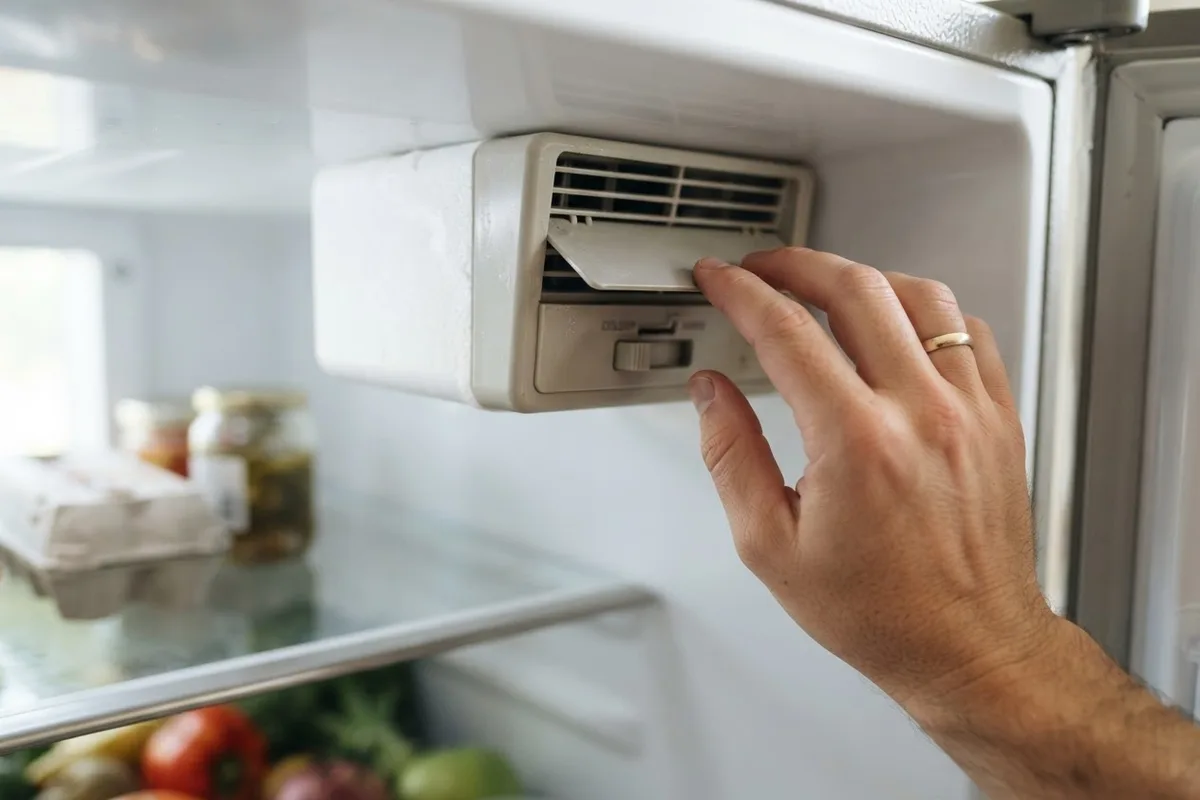 Open your refrigerator and locate the return vents. Ensure there is at least an inch or two of space around them. Rearrange your groceries so that nothing is pushed directly against the vents. Additionally, check for any frost or ice buildup inside or over the vents. If you find ice, safely melt it away with a hairdryer on a low setting or by manually defrosting the refrigerator. Ensuring clear airflow through both the supply and return vents is one of the easiest ways to fix a warm refrigerator compartment. Aim to keep your refrigerator about three-quarters full; an overly packed fridge blocks airflow, while an empty fridge struggles to retain cold.
4. Test the Defrost System Components
Your refrigerator’s defrost system consists of a defrost timer, a defrost thermostat, and a defrost heater. Together, they periodically melt away frost that accumulates on the evaporator coils. If any component of this system fails, frost will continue to build up on the coils. Eventually, the frost turns into a solid block of ice that completely blocks airflow through the evaporator coils, preventing cold air from reaching the refrigerator compartment.
To test this, look at the back wall of your freezer compartment. If you see a thick layer of frost or ice on the back wall, your defrost system is likely failing. With the fridge unplugged, remove the freezer's rear panel to access the evaporator coils. If they are caked in ice, use a hairdryer on a low setting or leave the fridge doors open for 24 to 48 hours to manually defrost it (be sure to place towels down to catch melting water). Once the ice is melted, use a multimeter to test the defrost heater and defrost thermostat for continuity. If either part lacks continuity, it must be replaced. If they test fine, the defrost timer or control board may be the issue.
5. Clean the Condenser Coils
While dirty condenser coils typically cause both the refrigerator and freezer to struggle with cooling, in some scenarios, they can cause the compressor to run constantly, leading to severe frost buildup in the freezer and a warm refrigerator. The condenser coils, usually located at the bottom front or rear of the appliance, release heat from inside the fridge into the room. When they are coated in dust, pet hair, and debris, the refrigerator cannot dissipate heat effectively, leading to inefficient cooling and airflow imbalances.
To fix this, first unplug the appliance. Locate the condenser coils and remove the base grille or rear access panel. Use a specialized coil brush and a vacuum cleaner with a narrow nozzle attachment to gently remove all dust and debris from the coils. For a more detailed, step-by-step walkthrough, follow our comprehensive guide on how to clean refrigerator coils. Once the coils are clean, restore power to the appliance. You should notice improved cooling efficiency within a few hours.
6. Evaluate the Thermistor
The thermistor is a temperature sensor that monitors the internal temperature of your refrigerator and sends resistance readings to the main control board. The control board uses this data to turn on the compressor, fan, and damper control. If the thermistor is faulty, it may inaccurately report that the refrigerator is already cold enough, causing the control board to keep the damper closed and the fan off, leaving your refrigerator warm while the freezer remains cold.
To test the thermistor, you will need to locate it (usually mounted to the side of the fresh food compartment or near the evaporator coils) and remove it. With the refrigerator unplugged, use a multimeter set to the ohms (resistance) setting to test the thermistor. To test it accurately, place the thermistor in a glass of ice water and check its resistance against your refrigerator model's specific temperature-to-resistance chart. If the thermistor's resistance doesn't change with the temperature or differs significantly from the manufacturer's specifications, it is faulty and needs to be replaced.
Quick-Reference Troubleshooting Table
| Failed Component | What It Does | Symptoms of Failure | DIY Fix |
|---|---|---|---|
| Evaporator Fan Motor | Circulates cold air to fridge | No airflow, noisy freezer | Test continuity; replace motor |
| Damper Control | Allows cold air into fridge | Stuck closed, warm fridge | Clear ice jam or replace damper |
| Return Air Vents | Returns air to freezer | Blocked by food/ice, warm fridge | Rearrange food; clear vents |
| Defrost System | Melts coil frost/ice | Heavy frost on freezer back wall | Defrost coils; replace bad part |
| Condenser Coils | Dissipates ambient heat | Fridge runs constantly, warm | Vacuum and brush coils clean |
| Thermistor | Senses compartment temp | False temp readings, warm fridge | Test with multimeter; replace |
When to Call a Pro
While many causes of a refrigerator not cooling are easy to fix with basic maintenance and parts replacement, some issues require advanced expertise. If you have completed all 6 steps above and your refrigerator compartment still will not cool despite a cold freezer, you may be dealing with a failed main control board, a refrigerant leak, or a complex sealed system blockage.
Repairing sealed refrigerant systems, replacing compressors, or diagnosing complex internal electrical wiring are tasks that must be handled by an expert. Attempting to fix sealed systems or complex electrical components yourself can be dangerous and may permanently damage your appliance. If your diagnostic efforts point to these advanced issues, True Appliance Repair can match you with a local appliance pro who can safely diagnose and repair your refrigerator. Relying on professional refrigerator repair services ensures the job is done safely and correctly. Typical refrigerator repairs in the US can range from $100 to $400 for standard part replacements, though complex compressor or sealed system work can cost more, varying by area and model.
FAQ
Why is my freezer cold but my fridge is warm?
This specific issue is usually caused by a failure in the airflow or defrost system rather than the compressor. The most common culprits include a failed evaporator fan motor, a stuck or blocked damper control flap, obstructed return air vents, or a failing defrost system that has allowed ice to completely clog the cooling coils and block airflow to the fridge compartment.
Can I manually defrost my refrigerator to fix this?
Yes, if frost has blocked the airflow between your freezer and refrigerator, you can manually defrost the appliance. Unplug the refrigerator, store your food safely in coolers, and leave the doors open for 24 to 48 hours. Be sure to place towels down to catch melting water. Once fully defrosted and dry, plug it back in. If the refrigerator cools properly again, but the problem returns in a week or two, you likely have a faulty defrost component, such as a bad defrost thermostat, heater, or timer.
How do I know if my evaporator fan is bad?
If your evaporator fan is failing, you may hear unusual squeaking, grinding, or chirping noises coming from the freezer compartment. Alternatively, you might not hear any fan noise at all when the refrigerator is running. To verify, unplug the fridge, remove the freezer's rear panel, and try to spin the fan blade gently by hand. If it feels stiff, does not spin freely, or has visible physical damage, the motor likely needs to be replaced.
Is a refrigerator not cooling a fire hazard?
Generally, a refrigerator not cooling is not an immediate fire hazard, but it can be if the issue is caused by a short-circuited control board, damaged electrical wiring, or a severely overheating compressor motor. Additionally, a warm refrigerator is a significant food safety hazard, as perishable items can quickly develop harmful bacteria. If you smell burning, see smoke, or notice sparks, immediately unplug the appliance and call a professional.