
Is your kitchen soundtrack dominated by the relentless hum of your fridge? A refrigerator running constantly is noisy, spikes your electric bill, and puts unnecessary wear and tear on your appliance's compressor. While modern refrigerators are designed to run a significant portion of the day, they should still cycle off periodically.
Fortunately, you do not always need to call for service when your fridge won't stop running. Many of the most common causes are simple maintenance issues you can address yourself. Here are 6 easy DIY fixes to get your constant refrigerator noise under control, restore its efficiency, and prevent food spoilage.
Check the Temperature and Thermostat Settings
The first step in diagnosing a refrigerator running constantly is to verify that the temperature settings are correct. If your thermostat is set too low, your refrigerator will work overtime to reach an unattainable level of coldness, especially if the ambient air in your kitchen is warm. Conversely, if the temperature is set too high, the fridge may struggle to stay cool, causing it to run continuously.
How to fix it:
- Use a separate appliance thermometer to check the actual temperature inside your fridge and freezer. Internal digital displays on some appliances can sometimes be inaccurate.
- Aim for the ideal temperature range: 37°F to 40°F (3°C to 4°C) for the fresh food compartment and exactly 0°F (-18°C) for the freezer.
- Adjust your refrigerator's thermostat dials or digital controls to these recommended settings.
- Wait 24 hours after making an adjustment to allow the internal temperature to stabilize before checking it again.
Clean the Condenser Coils for Better Airflow
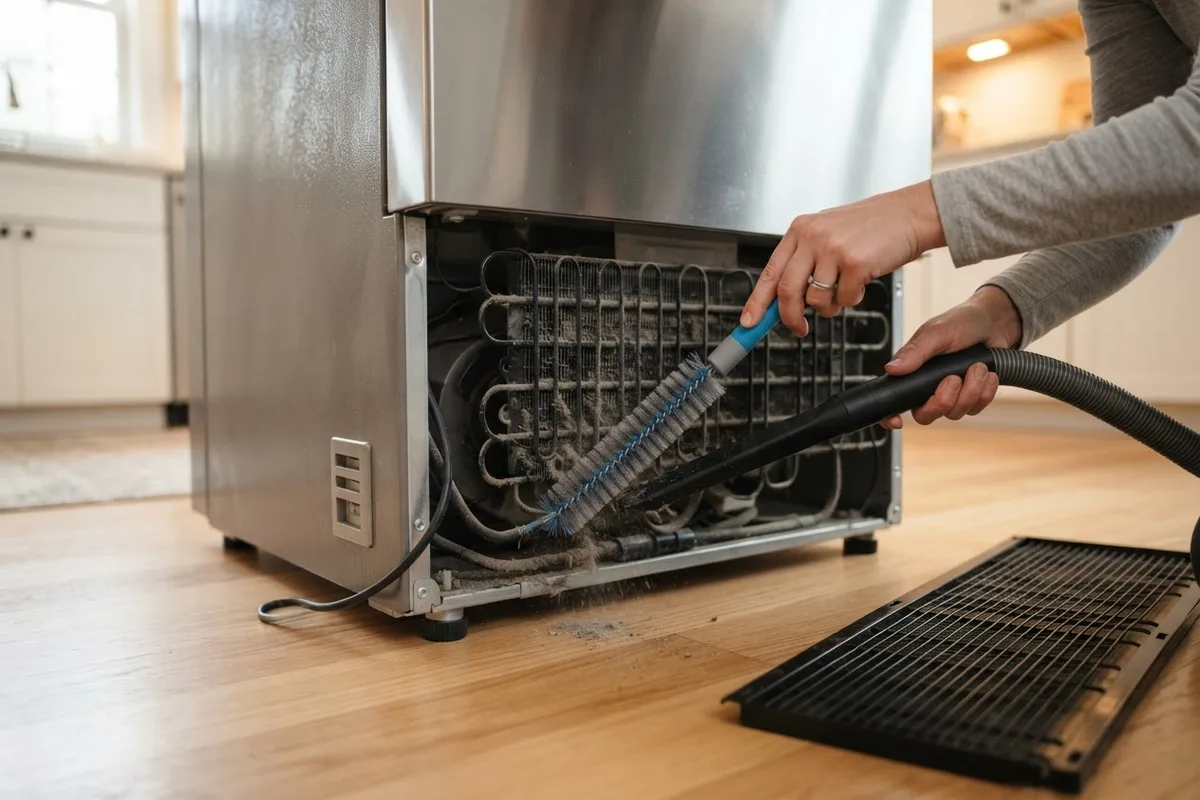
Dirty condenser coils are one of the most frequent reasons a refrigerator runs constantly. The condenser coils, typically located at the bottom behind a base grille or on the back of the appliance, are responsible for dissipating the heat removed from inside the fridge. When these coils are caked in dust, pet hair, and kitchen grease, they cannot release heat efficiently. As a result, the compressor has to work much harder and run much longer to keep your food cold.
Safety First: Always unplug your refrigerator from the electrical outlet and shut off the water valve (if applicable) before performing any hands-on maintenance or cleaning on the coils.
How to fix it:
- Unplug the refrigerator.
- Locate the condenser coils. If they are at the bottom front, gently snap off the base grille. If they are on the back, carefully pull the refrigerator away from the wall.
- Use a vacuum cleaner equipped with a brush attachment to gently remove the loose dust and cobwebs from the coils.
- For stubborn debris between the coils, use a specialized, flexible coil brush to gently scrape the dust free, vacuuming as you go. Be careful not to bend or damage the coils.
- Vacuum the floor beneath the coils to prevent dust from immediately being sucked back up.
- Reattach the grille or push the fridge back into place (leaving at least an inch of space from the wall), plug it back in, and listen for improved performance. For a more detailed guide, check out our article on how to clean refrigerator coils.
Inspect and Test the Door Gaskets and Seals
Your refrigerator rely on an airtight seal to keep cold air in and warm air out. The rubber gaskets along the edges of your refrigerator and freezer doors create this seal. Over time, these gaskets can become dirty, brittle, cracked, or warped. When a door seal fails, warm kitchen air constantly leaks into the appliance. This constant influx of heat forces your refrigerator's cooling system to run continuously to maintain its internal temperature.
How to fix it:
- Inspect the rubber door gaskets on both the fridge and freezer doors for any visible tears, cracks, or gaps.
- Perform the "dollar bill test." Place a crisp dollar bill halfway across the door gasket, close the door, and try to pull the bill out. If it slides out easily with no resistance, your seal is weak. Test several spots along the top, bottom, and sides of both doors.
- If the gasket is just dirty, clean it thoroughly with warm water, mild dish soap, and a microfiber cloth. Avoid harsh chemicals, which can degrade the rubber. Dry it completely.
- If the gasket is damaged or fails the dollar bill test after cleaning, you will need to order a replacement gasket specific to your refrigerator's model number. Installing a new gasket is a straightforward DIY task that involves pressing the new rubber seal into the door's track.
Clean and Clear the Vents and Airflow Paths
Proper airflow is essential for a refrigerator's cooling system to function correctly. Inside your refrigerator and freezer, there are small vents that allow cold air to circulate between the compartments. If these vents are blocked by large food items, ice buildup, or overstuffed shelves, the cold air cannot circulate evenly. This causes temperature imbalances, forcing the refrigerator to run constantly as it tries to cool down areas that are not receiving enough airflow.
How to fix it:
- Open both the refrigerator and freezer compartments and locate the internal air vents. They are usually located on the back or side walls.
- Ensure that no large items, such as milk jugs, cereal boxes, or large bags of frozen food, are placed directly against these vents.
- Maintain a healthy amount of space between your groceries. As a general rule, your refrigerator should be comfortably full to help retain coldness, but not so packed that air cannot circulate. Aim for a 1-to-2-inch gap around the walls and between items.
- Regularly check for and remove any small food debris or ice that may have accumulated near or inside the vent openings.
Assess the Ambient Room Temperature and Location
The environment surrounding your refrigerator has a major impact on how often it needs to run. Refrigerators are designed to operate within specific ambient temperature ranges. If your kitchen is excessively hot, or if the refrigerator is placed directly next to a heat source, it will struggle to dissipate heat. This causes the compressor to work continuously to keep the interior cold.
How to fix it:
- Check the location of your refrigerator. Is it positioned next to a heat-producing appliance like an oven, range, dishwasher, or radiator? Is it in the path of direct afternoon sunlight from a nearby window?
- If possible, consider rearranging your kitchen layout to give your refrigerator some distance from heat sources. If that is not an option, you can install a heat shield between the appliances.
- Ensure there is adequate ventilation around the exterior of the refrigerator. Most manufacturers recommend at least 1 to 2 inches of clearance on the top, back, and sides of the unit so heat can escape.
- If your refrigerator is located in a garage or unheated porch, check its operating climate rating. In the summer, a hot garage makes the fridge run constantly. In the winter, an unheated garage can cause the fridge to stop cycling correctly altogether. You may need to relocate a garage fridge during extreme weather or add insulation to the space. If your garage unit is struggling, read our guide on why is my garage refrigerator not cooling.
Defrost the Freezer and Check the Evaporator Fan
Frost buildup inside your freezer acts as an insulator, preventing the cooling system from efficiently absorbing heat from the freezer compartment. If your freezer is caked in thick frost and ice, your refrigerator will run constantly to compensate. Additionally, beneath the frost is the evaporator fan, which blows cold air throughout the appliance. If the evaporator fan is iced over, dirty, or failing, cold air cannot move, leading to constant running and a warm refrigerator.
How to fix it:
- Look for excessive frost buildup on the walls of your freezer. If you see more than a quarter-inch of frost, it is time to defrost.
- To safely defrost your freezer, first remove all food and store it in coolers with ice. Unplug the refrigerator and leave the freezer doors open. Place towels on the floor to catch melting water. Never use sharp metal objects or knives to scrape away ice, as you can easily puncture the evaporator coils and destroy the appliance. For detailed steps, see our guide on how to defrost a freezer fast.
- Once the freezer is defrosted, clean and dry the interior.
- While the unit is empty and unplugged, listen to or check the evaporator fan (usually located behind a panel at the back of the freezer). If the fan was making a loud squeaking, screeching, or grinding noise before you unplugged it, or if it doesn't spin freely when pushed manually, it may need to be replaced. If the fan blades are simply dirty, gently wipe them clean before restoring power.
Quick Reference: Refrigerator Constant Running Troubleshooting
| Potential Cause | What to Check | DIY Fix | Difficulty Level |
|---|---|---|---|
| Thermostat Set Too Low | Internal temperature below 37°F | Adjust settings to 37°F - 40°F | Very Easy |
| Dirty Condenser Coils | Dust/debris on bottom or back coils | Vacuum and brush coils thoroughly | Easy |
| Defective Door Gasket | Dollar bill test fails / visible tears | Clean or replace the gasket | Easy to Medium |
| Blocked Air Vents | Food items stacked against internal vents | Rearrange food for better airflow | Easy |
| High Ambient Temperature | Proximity to oven or direct sunlight | Move appliance or provide clearance | Easy to Medium |
| Frost / Evaporator Fan Issue | Heavy ice buildup / strange fan noises | Defrost freezer / clean fan | Medium |
When to Call a Pro
While the 6 fixes above solve the majority of cases where a refrigerator is running constantly, some issues require advanced diagnostic tools and technical expertise. If you have thoroughly completed the maintenance steps above and your refrigerator continues to run without cycling off, the issue may be more complex.
You should stop and call a professional appliance repair technician if you encounter any of the following symptoms:
- Sealed System Issues: If you suspect a refrigerant leak or a problem with the sealed cooling system, this must be handled by a professional. Signs include the fridge running constantly while the temperature inside continues to rise, or one section being freezing while the other is warm.
- Compressor Failure: The compressor is the heart of the cooling system. If it is running constantly but making a loud, abnormal clicking or knocking noise, or if it is extremely hot to the touch, it may be failing. Read more about this in our guide on why is my refrigerator compressor clicking.
- Defrost System Failure: If your freezer continues to frost over rapidly even after you have defrosted it, you may have a failed defrost timer, defrost thermostat, or defrost heater. A technician can test these components with a multimeter.
- Electrical or Control Board Issues: If the digital display is malfunctioning or the main control board is sending incorrect signals to the compressor, a pro will need to diagnose the electronics.
Safety Warning: Never attempt to work on exposed electrical wiring, sealed refrigerant lines, or the internal components of a gas appliance yourself. Always leave sealed system work and electrical panel diagnostics to the experts.
When DIY troubleshooting isn't enough, True Appliance Repair can match you with a local appliance pro. Don't let a failing compressor ruin your groceries; find reliable refrigerator repair services in your area to get your kitchen back on track. Typical professional refrigerator repair costs generally range from $200 to $600, though this varies by your location, the parts needed, and your specific refrigerator model.
FAQ
How many hours a day should a refrigerator run?
It is normal for modern, energy-efficient refrigerators to run for about 80% to 90% of the day (roughly 19 to 21 hours total). Modern compressors are designed to run at lower, more efficient speeds for longer periods to maintain a steady temperature, rather than constantly cycling on and off at full power like older models. However, your refrigerator should still cycle off periodically. If it is running 100% of the time at full power without ever shutting down, that indicates a problem.
Does a dirty condenser coil make a fridge run constantly?
Yes, dirty condenser coils are one of the most common reasons a refrigerator runs constantly. The coils are responsible for releasing the heat collected from inside the fridge into the surrounding room. When they are covered in dust, dirt, or pet hair, they act like an insulated blanket, trapping the heat. The refrigerator cannot cool efficiently, causing the compressor to work continuously to keep the interior temperatures at the set level.
Can a bad door seal cause a refrigerator to run all the time?
Yes, a damaged, warped, or dirty door seal (gasket) is a major cause of a constant-running refrigerator. When the door seal does not form an airtight barrier, warm, humid air from your kitchen constantly leaks into the fridge and freezer. Your refrigerator's cooling system must work continuous overtime to cool down this influx of warm air, leading to higher energy bills, frost buildup, and constant running.
Why is my new refrigerator running constantly?
If your refrigerator was just installed, it is completely normal for it to run constantly for the first 24 to 48 hours. The appliance needs time to cool down from ambient room temperature to its ideal operating temperature (37°F - 40°F for the fridge and 0°F for the freezer). Additionally, if you have just filled a new or existing fridge with a large amount of warm groceries, or if the doors have been left open during stocking, it will run continuously until it lowers the temperature of the new items.