
Standing over a simmering stockpot during busy fall and winter meal prep only to watch your stove burner shut off mid-boil is deeply frustrating. Before you assume your range needs an expensive repair, know that electric burners are designed to cycle—though sudden heat loss points to a real fault. Use these six safe DIY checks to tell normal cycling from a worn pan, loose coil, or failing switch and get steady cooking heat back fast.
1. Confirm Whether Your Burner Is Cycling Normally
Electric coil and radiant glass cooktops do not run at constant full power the way a gas flame does. Instead, they pulse full voltage on and off to maintain your chosen dial setting. On medium or low heat, watching the glow fade to black for 15 to 30 seconds before lighting back up is completely normal.
Follow these quick checks to see if your burner is working as designed:
- Test on high with a small pot of water. Turn the dial all the way up and time how quickly two cups of water reach a rolling boil.
- Listen for a light click. A soft clicking sound from the control knob or beneath a glass cooktop is the internal thermostat switching power on and off.
- Compare against a matching burner. Test the same pan on another burner of equal size at the same setting.
If water never boils on high, or the burner stays cold for several minutes while the dial sits above medium, move to the next check.
2. Check Cookware for Warped or Oversized Bottoms
On smooth glass-ceramic cooktops, trapped heat is the single most common reason a healthy burner cuts out early. Radiant elements contain a built-in safety limiter that shuts power off whenever glass temperatures climb too high, protecting the surface from cracking.
Heavy holiday cookware—like wide canning pots, warped skillets, or oversized cast-iron Dutch ovens—traps heat right against the glass and triggers repeated shutoffs. Check your pans with these steps:
- Do the straight-edge test. Set a metal ruler across the bottom of your cool pan. Any noticeable gap or wobble means heat cannot transfer evenly into the pot.
- Match pan width to the burner ring. Keep cookware within about one inch of the painted burner outline so heat does not radiate back down onto the glass.
- Skip reflective or textured bases. Thin aluminum, copper-clad bottoms with heavy ridges, and recessed canning pots bounce heat back toward the element.
Swap in a flat-bottomed stainless steel pot sized to the ring and retest before blaming the stove.
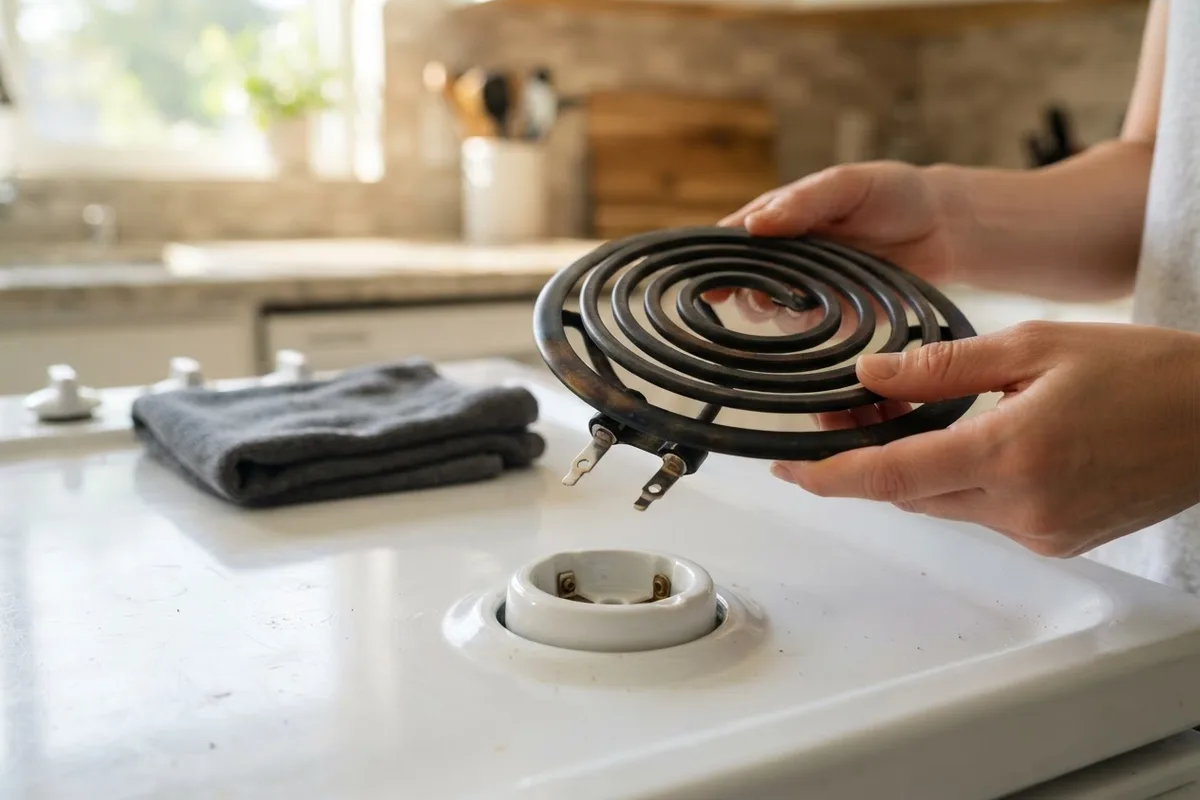
3. Clean and Reseat Coil Burner Plugs and Sockets
If you cook on a traditional electric coil range, erratic heating often comes from poor electrical contact where the burner prongs meet the porcelain terminal socket. Over time, boil-overs leave baked-on grease and carbon buildup that interrupt current flow and cause the coil to drop out mid-cook.
Always cut power before touching burner hardware:
- Turn off power and let it cool. Switch all knobs off, wait until every coil is room temperature, and flip off the range's circuit breaker (or unplug the stove if accessible).
- Pull the coil straight out. Lift the side opposite the socket slightly and slide the two metal prongs out gently without bending them.
- Inspect for heat damage. Check the prongs and receptacle for dark scorch marks, pitting, or melted edges.
- Clean and reseat firmly. Wipe cool prongs with a mild soapy cloth, dry completely, and push them snugly back into the socket.
Stop using any burner with a burned or loose socket until a technician replaces the terminal block.
4. Power-Cycle the Range at the Circuit Breaker
Modern electric and induction ranges rely on electronic relay boards to manage burner power levels. A brief utility brownout, storm surge, or internal glitch can leave a control relay confused, causing burners to shut off randomly or refuse to hold temperature.
A clean power reset clears temporary logic faults safely:
- Turn every knob and oven setting off. Confirm all indicator lights are dark.
- Locate your home's electrical panel. Find the double-pole breaker labeled "Range" or "Stove."
- Flip it off for five minutes. Wait a full five minutes so internal capacitors discharge completely, then switch it firmly back on.
- Retest the burner. Reset the clock and test the problem burner with a flat-bottomed pot of water.
If your control panel also freezes or ignores touches alongside burner shutoffs, review our guide to troubleshooting unresponsive oven buttons. Pair this reset with our home appliance safety checklist to keep breakers and cords in safe shape.
5. Test for a Failing Infinite Heat Control Switch
Behind each stovetop knob sits an infinite switch that times how long the burner stays powered during each cycle. Its tiny internal contacts open and close thousands of times over the years. Once those contacts wear down or pit, the burner may heat briefly, shut off early, and stay cold until you twist the knob again.
Spot a failing switch without opening the control panel:
- Check knob feel and temperature. Notice whether the dial feels loose, gritty, or unusually warm compared to neighboring knobs.
- Swap matching coils (coil ranges only). With the breaker off and coils cool, swap the problem coil with an identical working coil, restore power, and test. If the issue stays on the original burner position, the switch or socket is the culprit.
- Track heat consistency. A burner that cuts off on high and fails to return to a boil points strongly to a worn switch.
Leave switch replacement to a technician, as opening the console exposes 240-volt wiring.
6. Watch for a Tripping High-Limit Thermal Switch
Beneath every radiant glass cooktop element sits a high-limit thermal switch—often a thin metal rod spanning the burner coil—designed to cut power if temperatures exceed safe glass limits. While warped pans trigger it legitimately, an aging thermal limiter can grow overly sensitive and trip far too early, shutting off your burner even with a flat pan and moderate heat.
Look for these telltale signs:
- Short, uneven heat bursts. The burner glows bright red for 20 to 40 seconds, shuts off completely, and stays dark much longer than neighboring burners.
- No recovery on high. Even with a properly sized flat stainless pan, water barely simmers before the element cuts out again.
- Visible element gaps. Through the glass on high heat, notice if half the radiant ring stays dark—a failing dual-ring element can trigger abnormal cycling.
On most glass cooktops, the thermal limiter is built directly into the radiant element assembly, so replacing the full element restores accurate cycling.
| Burner Symptom | Most Likely Cause | Safe Next Step |
|---|---|---|
| Fades on and off every 15–30 seconds on medium | Normal temperature regulation | No repair needed; cook normally |
| Cuts out under a wide or wobbly pan | Overheated glass triggering limiter | Switch to flat, burner-sized cookware |
| Flickers or drops heat on a coil stove | Dirty prongs or worn socket | Cut breaker, clean cool prongs, inspect block |
| Won't boil on high; knob feels loose or hot | Failing infinite control switch | Stop using burner and schedule repair |
| Shuts off early with any flat pan on glass | Weak high-limit thermal switch or element | Have a pro test and replace the element |
When to Call a Pro
Simple checks—like swapping warped cookware, resetting the breaker, or cleaning cool coil prongs—are completely safe DIY steps for most homeowners. Stop and bring in a technician the moment troubleshooting requires lifting a glass cooktop, unscrewing the back panel, or testing live circuits. Electric ranges run on heavy 240-volt power that poses serious shock and fire hazards, and dual-fuel models also carry gas supply lines that should never be disturbed without proper tools and training.
Call a pro right away if you smell burning plastic, see sparks near a coil socket, notice a melted knob, or have a breaker that trips repeatedly—a recurring breaker trip can also signal an electrical panel issue needing an electrician. In the US, typical professional repairs for an infinite switch, terminal block, or radiant burner element generally fall around $150 to $375 for parts and labor combined, though actual costs vary widely by area, cooktop style, and range model.
When you need safe electrical diagnostics, True Appliance Repair can connect you with local oven and stove repair specialists who work on your brand.
FAQ
Is it normal for an electric glass stove burner to turn on and off?
Yes. Electric glass-ceramic and coil burners regulate heat by pulsing full power on and off rather than dimming gradually. As long as your pan holds a steady simmer or reaches a full boil on high, brief glowing and darkening cycles are normal operation.
Why does my stove burner turn off before water boils?
On a glass cooktop, an oversized, warped, or reflective pot traps excess heat against the surface and trips the safety limiter early. If switching to a flat, properly sized pot does not fix it, a failing radiant element thermal limiter or worn infinite switch is likely cutting power too soon.
Can a bad stove burner switch be a safety hazard?
Yes. A failing infinite switch can overheat internally, melt wire connectors, or stick permanently on high heat even when the dial is turned down. Stop using any burner whose knob feels unusually hot, smells burned, or refuses to shut off cleanly, and flip off the breaker if needed.
Why does my induction cooktop turn off and beep mid-cook?
Induction burners rely on magnetic contact with cookware and will shut off automatically if a pan is not magnetic, sits slightly off-center, or has a base smaller than the burner's minimum sensor size. Overheating from a blocked underside cooling vent can also trigger an automatic safety shutoff.