
A sudden, violent thumping sound in your walls whenever your cycle fills can rattle your nerves and shake your plumbing. If your dishwasher banging pipes is waking the household or causing visible pipe vibration under the sink, hydraulic shock is the likely culprit. Fortunately, you can silence the racket and protect your home's water lines with a few straightforward mechanical adjustments.
Before tackling any hands-on maintenance, always turn off the dedicated circuit breaker in your electrical service panel and unplug the appliance power cord. Turn the hot water shutoff valve under the kitchen sink fully clockwise until tight. If you ever encounter complex electrical wiring, high-voltage panel work, or stubborn main plumbing lines, pause immediately and call a professional technician.
Install an Inline Water Hammer Arrestor
The most common reason for pipe banging is hydraulic shock, also known as water hammer. Modern dishwashers utilize fast-acting electric solenoid valves that shut off the incoming hot water in milliseconds. When that rushing water abruptly slams to a halt, the kinetic energy creates a high-pressure shockwave that ripples backward through the copper or PEX tubing, making loose pipes whip against wall studs.
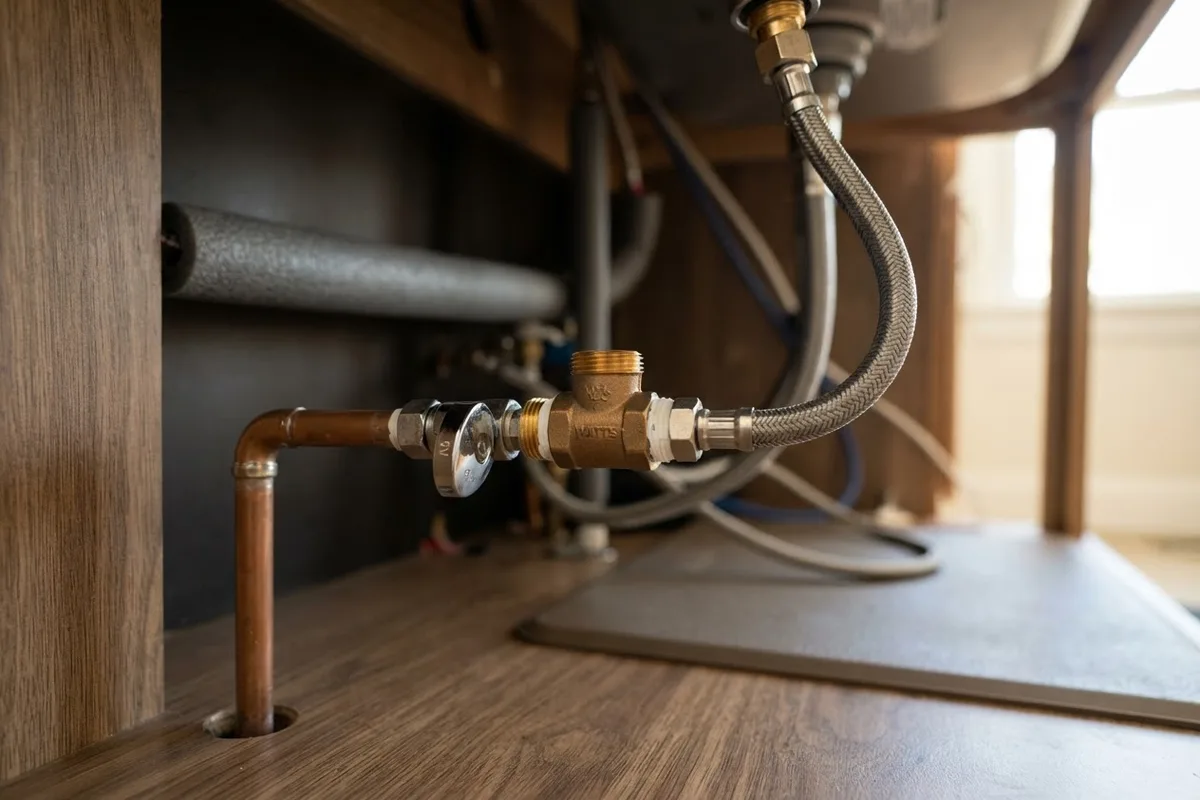
Adding an inline mini water hammer arrestor directly between your kitchen shutoff valve and the dishwasher supply line provides an immediate cushion. These compact brass fittings contain a sealed air chamber separated by a sliding piston. When the valve closes, the pressurized water compresses the air chamber instead of banging into your home's framing.
- Shut off the under-sink hot water supply valve and place a small towel underneath the connection.
- Disconnect the flexible braided dishwasher hose using an adjustable wrench.
- Thread a 3/8-inch compression water hammer arrestor onto the shutoff valve outlet.
- Reattach the flexible braided hose to the top of the arrestor.
- Snug the brass fittings down by hand, then apply a quarter-turn with a wrench to avoid over-tightening.
- Slowly restore water pressure and inspect carefully for drips.
Secure Loose Water Supply Lines Under the Sink
Even minor water velocity shifts will cause noticeable thumping if your plumbing lines lack adequate physical support. Over years of thermal expansion and normal kitchen cabinet vibration, plastic pipe clips and metal brackets often loosen, crack, or pull free from cabinet backs and wall studs. When the appliance draws hot water, an unsecured pipe will sway and strike surrounding wood, drywall, or the cabinet floor.
Crawl under the sink with a bright flashlight and trace the supply line from the shutoff valve toward the appliance inlet. If you can wiggle the copper pipe or PEX line more than a quarter-inch with your fingers, it needs reinforcement.
- Inspect every anchor bracket along the cabinet back wall and floor.
- Fasten loose copper or PEX lines using rubber-cushioned pipe clamps (avoid bare metal hangers on copper to prevent friction wear).
- Slip pre-slit foam pipe insulation over any tubing sections that rest within two inches of wood framing, drain lines, or cabinet walls.
- Check the entry hole where the supply line passes through the cabinet sidewall into the appliance opening. If the pipe rattles against the raw cut wood, wrap closed-cell foam insulation around the tubing to create a snug acoustic barrier.
Test and Replace a Faulty Water Inlet Valve
A worn or mechanically defective water inlet valve can generate extreme pipe vibration during fill sequences. Inside the valve assembly behind the appliance lower toe kick, a tiny internal spring and rubber diaphragm regulate the flow. Over time, mineral scale buildup or metal fatigue can cause the internal plunger to chatter rapidly rather than opening and closing cleanly.
This rapid mechanical flutter sends repetitive shuddering pulses through the supply line. If your appliance is also struggling with other electrical cycle errors, such as seeing the dishwasher clean light blinking, the inlet solenoid coils may be deteriorating.
- Confirm the appliance is unplugged and the water supply is turned completely off.
- Remove the lower access kickplate screws using a Phillips screwdriver or nut driver.
- Locate the brass or plastic inlet valve where the hot water hose connects.
- Unthread the water supply line and place a shallow pan underneath to catch residual drainage.
- Disconnect the wire harness terminals by gently depressing the locking tabs.
- Test electrical continuity across the solenoid terminals using a digital multimeter set to ohms; normal resistance ranges between 500 and 1,500 ohms depending on the brand. An open reading (infinite resistance) signals complete coil failure.
- If the valve exhibits corrosion, physical calcification, or abnormal multimeter readings, replace the assembly with the exact manufacturer part.
Check and Lower High Household Water Pressure
Excessive water pressure coming into your house dramatically intensifies pipe banging. Residential water systems perform best between 40 and 60 pounds per square inch (PSI). If your neighborhood municipal supply pushes water through your main service line at 75 to 90 PSI, every valve closure in the kitchen will sound like a thunderclap.
High pressure places immense stress on flexible appliance lines, internal fittings, and shutoff valves, elevating the risk of sudden leaks. Testing your home water pressure takes less than five minutes and requires an inexpensive mechanical pressure gauge available at any hardware store.
- Screw the pressure gauge onto an outdoor hose bib or laundry utility sink faucet that connects directly to the incoming cold supply line.
- Ensure all other water fixtures, including the washing machine and ice maker, are completely off.
- Open the faucet fully and read the gauge needle.
- If the dial exceeds 65 PSI, locate your main pressure-reducing valve (PRV), usually installed near the main indoor water shutoff where the utility pipe enters the foundation.
- Loosen the locknut on the PRV adjusting bolt with an open-end wrench.
- Turn the adjustment screw counterclockwise a half-turn to lower the incoming pressure, then retest at the faucet until the gauge rests comfortably at 50 to 55 PSI. Tighten the locknut to secure the setting.
Recharge Waterlogged Plumbing Air Chambers
Older homes built before modern inline arrestors became standard often rely on vertical copper riser pipes hidden inside the wall cavities. These vertical pipe stubs, called air chambers, sit upright directly above faucet and appliance shutoffs. In theory, the column of trapped air inside the vertical pipe compresses when water stops suddenly, absorbing mechanical shock.
Over months and years, that trapped air pocket slowly dissolves into the moving water stream, leaving the vertical riser completely filled with liquid. Because water cannot compress, the cushioning effect vanishes, resulting in loud, violent pipe banging during every fill cycle. Fortunately, you can recharge these wall chambers by draining and resetting your home's water lines.
- Turn off the main water supply valve to the entire house.
- Open the highest hot and cold faucets in your home (such as a second-floor bathroom sink or tub).
- Open the lowest hot and cold faucets in the structure, such as a basement utility sink or an exterior drain spigot.
- Let all water drain completely until the lines are empty, which introduces fresh atmospheric air back into the vertical chamber tubes.
- Close all indoor and outdoor faucets.
- Slowly open the main water shutoff valve halfway to allow lines to refill gently without blasting air through fixtures.
- Bleed any remaining air splutters from kitchen and bathroom aerators until the stream flows smooth and quiet.
| Issue Cause | Typical Sound | Primary Fix | Difficulty Level | Estimated DIY Cost |
|---|---|---|---|---|
| Missing Arrestor | Single sharp bang when water cuts off | Install inline mini arrestor at valve | Beginner | $15 – $30 |
| Loose Supply Lines | Rattling, flapping wood contact | Add rubberized clamps and foam wrap | Beginner | $10 – $20 |
| Faulty Inlet Valve | Fast fluttering or rapid buzzing clunk | Swap out appliance water inlet valve | Intermediate | $40 – $95 |
| Excess Water Pressure | Loud thuds, vibrating pipes throughout | Adjust pressure-reducing valve (PRV) | Intermediate | Free – $25 |
| Flooded Air Chambers | Resonant metallic shudder in wall | Drain household plumbing lines | Beginner | Free |
When to Call a Pro
Most homeowners can silence water hammer by adding a compact threaded arrestor or clamping down loose lines under the kitchen counter. However, if pipe banging persists after these adjustments, the problem may involve failing internal check valves, extensive copper piping running unsecured inside finished drywall, or an aging PRV that no longer regulates pressure accurately.
Furthermore, if you notice continuous dripping from the appliance tub floor, slow fills, or an unexpected cycle shutoff where the dishwasher won't turn off, the internal hydraulic controls require diagnostic testing. A typical service call to diagnose appliance valve issues and mechanical flow problems generally ranges from $120 to $260, depending on your geographic region and specific equipment brand. If tracking down the noise requires opening walls or testing complex components, True Appliance Repair can match you with an independent local appliance specialist to inspect your setup safely.
FAQ
Can water hammer damage my kitchen plumbing or dishwasher?
Yes, severe water hammer generates transient pressure spikes that can exceed 150 to 200 PSI inside residential pipes. Over time, these violent pressure waves can rupture flexible braided hoses, blow out internal solenoid valve seals, crack soldered copper fittings, and cause expensive hidden water leaks inside walls.
Why does my dishwasher only bang pipes during certain parts of the cycle?
A standard wash cycle opens and closes the water inlet valve three to five times between the pre-rinse, main wash, intermediate rinse, and final rinse sequences. The loud banging only occurs at the exact millisecond the electric valve snaps shut to stop the incoming water flow, which happens briefly at the end of each fill period.
Will turning down the under-sink shutoff valve stop the banging?
Partially closing the hot water shutoff valve reduces water flow rate, but it does not lower static water pressure or eliminate hydraulic shock. In fact, constricting the shutoff valve can cause internal turbulence, increase water velocity through the valve seat, and starve the appliance pump. It is always better to install a proper water hammer arrestor than to restrict supply valves.
How do I know if the noise is coming from inside the dishwasher or the pipes?
Listen closely to the timing of the noise. If the sound is a single, hard metallic clunk that coincides precisely with the water stream stopping, it is water hammer in the plumbing lines. If the noise is an ongoing rhythmic tapping or scraping while water is actively circulating, an interior spray arm may be hitting oversized plates or a broken rack roller, which can be evaluated with professional dishwasher repair services.