
You flip your kitchen sink switch expecting the familiar hum of the waste disposer, but instead you get an abrupt click and total silence. A garbage disposal tripping its red thermal reset button or shutting off your kitchen breaker is one of the most frustrating sink problems a homeowner can encounter. Fortunately, this built-in safety feature exists specifically to save the motor from burning out, and most causes can be resolved with a few simple household tools.
Before performing any hands-on troubleshooting, always unplug the disposal from its under-sink wall outlet or switch off the dedicated circuit breaker in your electrical service panel. Never place your bare hands or fingers inside the disposal chamber—always use wooden handles, tongs, or pliers to retrieve foreign objects.
1. Clear an Impeller Jam With an Allen Wrench
The most frequent reason a disposal trips its thermal overload button is a mechanical jam. Hard food scraps like fruit pits, chicken bones, popcorn kernels, or accidentally dropped silverware can wedge firmly between the rotating shredder plate and the stationary grinding ring. When the motor tries to spin against this immovable obstruction, electrical resistance spikes instantly, tripping the red overload button on the bottom of the canister to prevent motor burnout.
- Disconnect power by unplugging the unit under the sink or turning off the circuit breaker at the main electrical panel.
- Look at the absolute center of the bottom underside of the disposal unit for a small hex-shaped socket (typically 1/4-inch).
- Insert a standard 1/4-inch Allen wrench (hex key) into the socket.
- Work the wrench back and forth in both directions. You may encounter strong resistance at first. Apply steady, firm pressure until the flywheel spins freely through a complete 360-degree rotation.
- Peer into the drain from above using a flashlight. Use long needle-nose pliers or kitchen tongs to extract the dislodged item.
2. Cool Down the Motor and Reset the Overload Switch
If you recently processed a massive batch of vegetable peelings or ran the disposal continuously for several minutes without sufficient cold water, the motor likely overheated. Disposals rely on cold tap water to cool the internal bearings and solidify fats so the blades can chop them. When running dry or overtaxed, internal temperatures climb until the thermal sensor pops open.
- Leave the disposal powered off and let the motor cool down completely for at least 15 to 20 minutes.
- Feel the under-sink housing. If the canister feels warm to the touch, give it an additional 10 minutes.
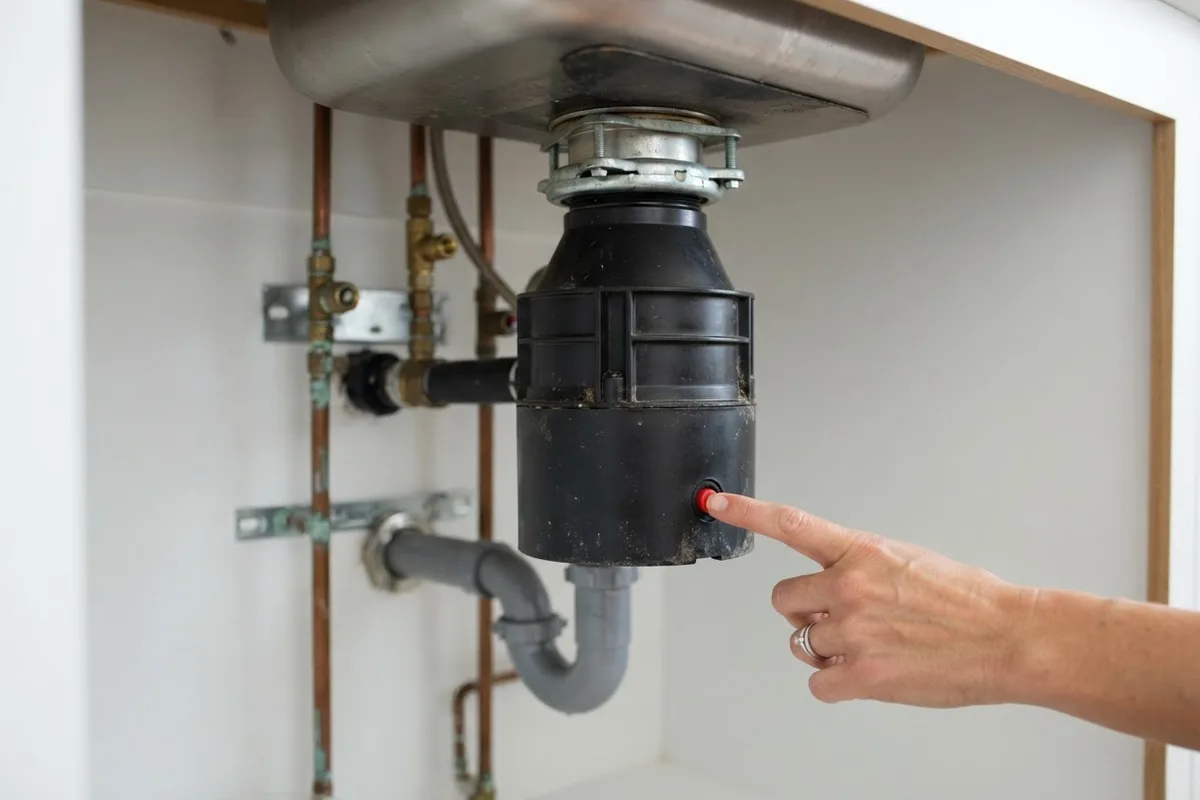
- Reach under the disposal canister and locate the small red button near the bottom edge or underside center.
- Press the red button firmly upward until you feel or hear a crisp mechanical snap. If it pops right back out, the internal motor windings are still too hot.
- Once the button stays depressed, plug the unit back in, turn on a strong stream of cold water, and flip the wall switch to verify normal operation.
3. Dislodge Fibrous Sludge and Bone Fragments
Not every jam is caused by a single large bone or spoon. Stringy, fibrous materials like corn husks, celery stalks, artichoke leaves, onion skins, and potato peelings can wrap tightly around the rotating impeller lugs. Over time, these fibers create a sticky, dense sludge that acts like a brake shoe against the motor shaft, forcing the motor to draw excess amperage until the circuit breaker trips.
- Unplug the unit and confirm the wall switch is firmly in the off position.
- Shine a bright flashlight straight down through the rubber sink splash baffle.
- Inspect the perimeter of the turntable where the movable lugs swivel. Use tongs or needle-nose pliers to peel away tangled vegetable strands and compacted food waste.
- Pour two cups of ice cubes followed by a half-cup of coarse rock salt or baking soda directly into the grind chamber.
- Reconnect power, turn on cold water at medium pressure, and switch the disposal on. The hard ice chips will scour accumulated residue off the shredder ring without dulling the impellers. If your sink backs up during cleaning, inspect your plumbing lines or review how to fix a garbage disposal backing up.
4. Inspect Under-Canister Seals for Moisture Leaks
When a disposal trips an electrical GFCI outlet or the home breaker rather than its own red reset button, moisture could be shorting out the internal wiring. As garbage disposals age, the internal rubber shaft seal separating the wet grinding chamber from the lower electrical motor compartment can degrade. Water containing dissolved dish soaps and food salts conducts electricity rapidly, triggering an instantaneous ground fault.
- Shut off power at the main breaker before inspecting any damp electrical components.
- Place dry paper towels directly underneath the disposal unit and run water through the sink.
- Inspect the bottom metal plate and the lower housing seams with a flashlight to see if water droplets emerge from the motor vents or the electrical reset area.
- Check the top sink flange and the dishwasher inlet connection. Sometimes an external leak runs down the outside casing and enters the lower wiring plate. If the drain pipe itself is leaking, check our guide on fixing a slow draining disposal to clear blockages that force water through gasket seals.
- If water is dripping directly through the bottom motor housing, the internal seal has failed, requiring unit replacement.
5. Check the GFCI Outlet and Circuit Load
In many modern kitchens, the garbage disposal shares an electrical circuit with the dishwasher or countertop convenience outlets. If your disposal switch instantly trips the wall breaker or the test button on a GFCI receptacle, the issue may stem from an overloaded circuit or a weakened electrical outlet rather than a damaged appliance motor.
- Inspect the wall outlet located inside your sink cabinet. If it features a GFCI test and reset button, press the reset button until it clicks.
- Ensure high-draw appliances on the same kitchen circuit—such as a dishwasher, air fryer, or microwave—are not running simultaneously.
- Plug a small table lamp or nightlight into the disposal outlet to verify whether the receptacle delivers steady power without tripping.
- Examine the disposal power cord where it enters the base of the machine. Make sure the wire clamp is snug and that the insulation has not rubbed against vibrating metal edges.
- If the GFCI outlet trips even when the disposal is disconnected, the wall receptacle itself may be worn out and require replacement by a qualified electrician.
| Tripping Symptom | Primary Cause | Primary DIY Solution |
|---|---|---|
| Red reset button pops out; unit hums softly | Mechanical impeller jam | Free flywheel with Allen wrench under unit |
| Red reset button pops out; no humming sound | Motor thermal overload | Allow 20 minutes to cool, then depress red switch |
| Wall GFCI outlet trips immediately | Internal water leak in motor | Check bottom housing for leaks; replace failed unit |
| Main electrical breaker trips on startup | Circuit overload or wire short | Test on isolated circuit; check electrical cord |
| Trips after 10–15 seconds of grinding | Heavy sludge or fibrous drag | Clear chamber with ice cubes and needle-nose pliers |
When to Call a Pro
Most garbage disposal tripping issues can be resolved in under thirty minutes with an Allen key, some ice cubes, and a quick reset. However, there are clear signs that indicate it is time to stop DIY efforts and consult a specialist:
- The internal motor emits an acrid burning electrical smell or visible smoke.
- Water actively drips from the electrical access cover on the underside of the canister.
- The unit trips the main breaker instantly even when the flywheel spins completely free with no obstructions.
- You suspect complex electrical panel issues, damaged branch wiring, or a failing motor winding.
Replacing a disposal or correcting under-sink electrical wiring involves tight spaces, plumbing traps, and high-voltage connections. When DIY fixes do not solve the problem, True Appliance Repair can match you with an independent local appliance pro to inspect the machine or install a new unit quickly. Replacing a standard residential garbage disposal typically costs between $150 and $350 for labor and parts, though costs vary based on your local area and the disposal brand.
FAQ
Where is the garbage disposal reset button located?
The reset button is a small, bright red or black push-button located on the bottom underside of the disposal canister or along the lower exterior rim near the power cord. It pops out roughly a quarter-inch when the motor overloads.
Why does my disposal trip the breaker instantly when turned on?
If the main breaker or GFCI trips instantaneously without any motor hum, you likely have a dead electrical short caused by water leaking into the internal motor compartment, a pinched supply wire, or a failed motor winding. Never attempt to bypass a breaker that trips on demand.
Can I use drain cleaners like Drano in my garbage disposal?
Never pour caustic chemical drain openers into a garbage disposal. These chemicals can melt rubber splash baffles, degrade internal shaft seals, and splash caustic liquids back up into your eyes when the disposal runs. Instead, use baking soda, vinegar, or ice cubes to clean the chamber.
How long should a home garbage disposal last?
Most residential garbage disposals provide dependable service for 8 to 12 years with basic care. If your unit is over a decade old and repeatedly trips its reset button despite clearing all jams, the internal motor bearings are likely worn down and the unit should be replaced.