
A gas stove burner that continues to click even after the flame has successfully lit is one of the most frustrating kitchen nuisances. That relentless tick-tick-tick usually indicates that your stove's spark igniter still senses an incomplete ignition circuit or is reacting to trapped moisture. Fortunately, you can safely troubleshoot and resolve most causes of continuous clicking at home without calling for emergency service right away.
Before performing any hands-on inspection or maintenance, safety must come first. Always turn off all stove knobs, shut off the gas supply line behind the appliance or at the shutoff valve, and unplug the stove from its electrical outlet. If you ever smell gas continuously, leave the home immediately and contact your gas utility provider or emergency services.
Clean Moisture and Food Debris From Burner Caps
Spilled pasta water, sauce splatters, and moisture from liquid cleaners are the single most common reasons a gas stove igniter clicks continuously after lighting. When liquid or grease bridges the gap between the spark igniter electrode and the metallic burner cap, the spark module continuously fires because it senses a ground fault.
To clean the assembly, wait until the cooktop is completely cool to the touch. Lift off the removable cast-iron grate and carefully lift the metal burner cap off the burner head. Inspect the underside of the cap for carbon buildup or moisture droplets. Scrub the cap thoroughly using warm water, mild dish soap, and a soft nylon brush or sponge. Avoid soaking igniter components directly in liquid.
Use a dry microfiber cloth or paper towel to dry every surface completely. Pay close attention to the small metal rim on the underside of the cap where it sits on the burner head. Reinstall the cap only when it is 100 percent dry. Restoring a clean, dry contact point between the cap and burner head stops the spark module from sending continuous current.
Realign Misplaced Burner Caps and Heads
Even if your burner cap is spotlessly clean, sitting slightly off-center will prevent the spark igniter from grounding correctly. If the igniter pin cannot complete its circuit cleanly through the metal burner head, the system acts as though the flame never ignited, keeping the spark module running.
Begin by checking alignment visually across all cooktop burners. A properly seated burner cap lies completely flat and parallel with the stovetop surface. If a cap tilts even slightly, it disrupts gas distribution and electrical grounding.
To fix alignment:
- Unplug the range and ensure all burners are completely cool.
- Remove the burner cap and check for any debris sitting in the alignment notches on top of the burner head.
- Lower the burner cap straight down onto the burner head, ensuring the alignment pins or grooves lock into place.
- Gently wiggle the cap with your fingers. It should sit firmly without rocking or sliding.
- If your range features removable burner heads (the metal base under the cap), verify that the entire base is flush against the range deck.
Once aligned, plug the range back in, restore the gas supply, and test the burner. Proper alignment usually silences the extra clicking instantly while ensuring an even, blue flame.
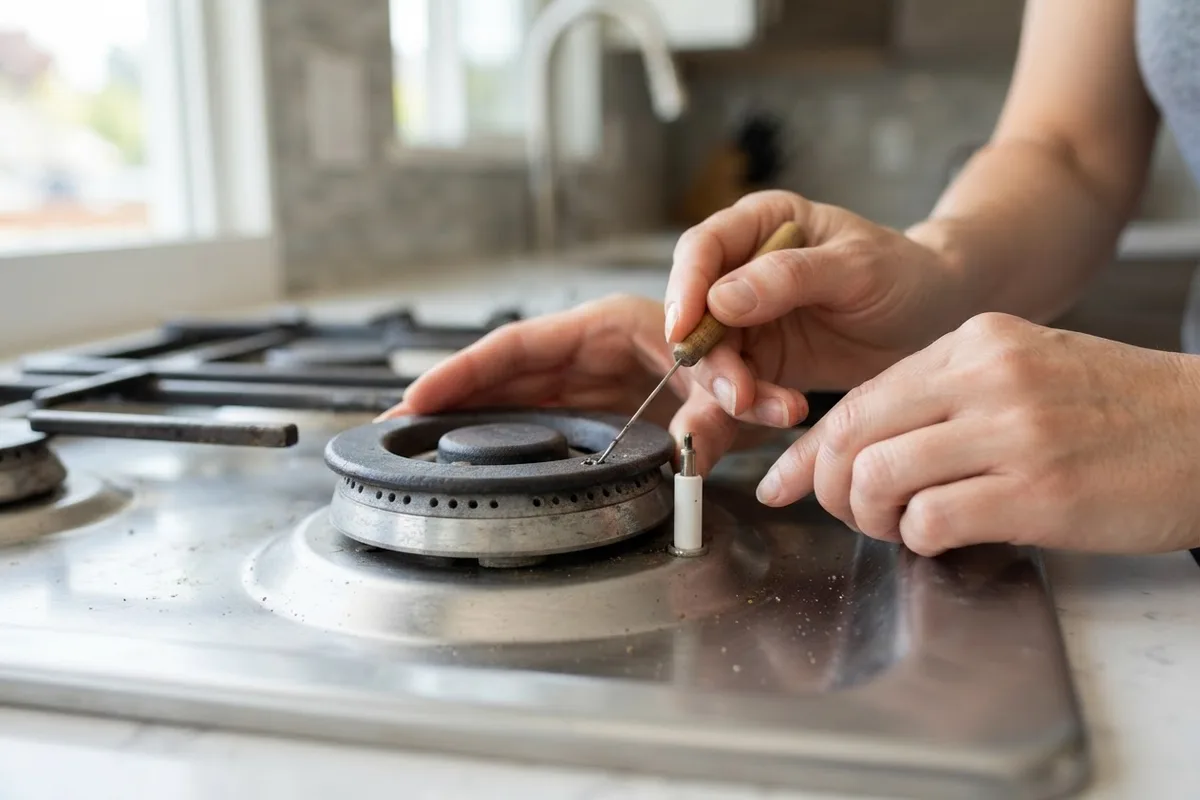
Dry Out Saturated Spark Igniters Completely
If you recently deep-cleaned your range top or had a major pot boil-over, water may have seeped inside the ceramic igniter post itself. Ceramic is porous, and trapped internal moisture causes electrical current to short out against the range chassis rather than jumping cleanly across the spark gap.
When dealing with a soaked igniter, aggressive scrubbing won't help; the component needs time and gentle heat to dry out thoroughly. Start by wiping down the exterior white ceramic igniter electrode with a dry cotton swab or paper towel.
To dry internal moisture, try these safe methods:
- Patience and Air Flow: Leave the affected burner disassembled for 24 to 48 hours to allow natural evaporation.
- Low Heat Aid: Use a handheld hairdryer on a low, warm setting held 6 to 8 inches away from the igniter base for 5 to 10 minutes.
- Bake Method: If other oven burners or the oven itself operate independently without clicking, running the oven at 350°F for 30 minutes can help warm the cooktop deck and evaporate hidden moisture.
Never attempt to dry ceramic igniters using open flame torches or harsh heat guns, as extreme heat shocks can crack the ceramic insulation permanently. If your range shows other operational issues, checking general household appliance warning signs can help identify broader electrical concerns early.
Unclog Small Igniter Ports and Gas Openings
Gas must flow freely past the igniter tip to maintain a steady flame shield around the sensor electrode. Burner heads feature small gas ports—tiny slots or holes drilled around the perimeter—along with a specific ignition port right next to the igniter pin. If boiled-over grease or mineral deposits clog this port, gas cannot reach the igniter electrode consistently, triggering persistent clicking.
Unclogging burner ports requires delicate precision to avoid widening the metal openings or snapping off igniter tips:
- Ensure power and gas to the range are shut off.
- Remove the grate, burner cap, and burner head.
- Locate the tiny ignition port notch directly adjacent to the white ceramic igniter pin.
- Take a straightened metal paperclip, thin sewing needle, or fine wire brush and carefully clear debris out of each tiny gas slot.
- Avoid using wooden toothpicks, which can snap off inside the narrow port.
- Vacuum away loose food crumbs or dust using a hose attachment.
Reassemble the burner head and cap, plug in the power cord, turn on the gas, and test the stove. Freeing restricted gas flow allows the flame to envelope the igniter tip immediately, signaling the ignition module to stop sparking.
| Common Cause | DIY Difficulty Level | Primary Symptom | Best Fix Action |
|---|---|---|---|
| Wet Ceramic Igniter | Easy | Clicks after liquid boil-over | Air dry or low-heat hairdryer |
| Misaligned Burner Cap | Very Easy | Flame lights, cap sits tilted | Realign cap flush in grooves |
| Food Grease in Ports | Moderate | Flame is patchy near igniter | Clear ports with needle/paperclip |
| Damaged Igniter Wire | Advanced | Clicks continuously when off | Inspect wiring under cooktop |
| Faulty Spark Switch | Advanced | Knobs feel sticky or shorted | Replace internal harness switch |
Inspect and Replace Faulty Spark Ignition Switches
If cleaning, drying, and realigning components fail to stop the clicking, the issue may lie inside the control switch harness located behind your burner control knobs. Behind each knob sits a spark switch. When you turn a knob to the "Lite" position, the switch closes an electrical circuit, telling the spark module to fire. Over time, liquid spills can trickle down control shafts, causing the internal switch contacts to short-circuit permanently in the "on" position.
To test if a switch is shorted:
- Unplug the range from the power outlet.
- Slowly turn each control knob back and forth. You should feel a distinct, firm mechanical click when passing in and out of the "Lite" position.
- If a knob feels loose, spongy, or sticky, liquid may have entered the switch housing.
While replacing an internal spark switch harness is a common fix, it requires removing the control panel or lifting the cooktop deck to access electrical wiring. If you are uncomfortable working with internal wiring harnesses, this is an ideal time to seek technical support. You can also review tips on why is my oven making noise to distinguish normal operational sounds from electrical shorting noises.
When to Call a Pro
Most gas stove clicking issues stem from simple moisture or food residue and take less than half an hour to resolve on your own. However, certain situations require expert hands to protect your home from gas leaks or electrical hazards. Stop troubleshooting and contact a technician if:
- You smell persistent gas odors even when all burner knobs are set firmly to Off.
- You observe cracked or broken ceramic insulators on the igniter electrodes.
- The continuous clicking continues even after the stove has been completely dry and unused for 48 hours.
- You need internal gas valve servicing or spark module replacement.
When electrical or gas component replacements go beyond basic DIY comfort, True Appliance Repair can match you with a local appliance pro to diagnose and repair your range quickly and safely. Professional technicians can inspect internal wiring harnesses, test switch continuity, and replace failing ignition modules using proper manufacturer components.
FAQ
Is a gas stove clicking continuously dangerous?
Continuous clicking is generally an electrical nuisance rather than an immediate emergency, provided there is no unburned gas escaping into your kitchen. However, if the clicking is accompanied by a strong gas smell, immediately turn off the gas supply line, open windows for ventilation, and contact a professional before using the appliance again.
Why does my stove click even when all knobs are turned off?
When a stove clicks while turned completely off, liquid or grease has likely leaked down behind one of the burner knobs into the spark switch harness, creating an unintended short circuit. Unplugging the unit and letting the control area dry for 24 hours often resolves the short.
Can I use my oven if the stovetop igniter keeps clicking?
While the oven may function independently on many modern ranges, running the cooktop while an igniter continuously sparks is not recommended. Unplug the range to stop the irritating sparking noise until you can dry out or clean the affected cooktop burner components.
How long does it take for a wet igniter to dry out?
Depending on humidity levels and how much liquid entered the ceramic base, a wet stove igniter typically takes between 12 and 48 hours to air dry completely. You can speed up the process by using a hairdryer on a low, warm setting for several minutes.