
A warm fridge or puddles under the freezer can turn an ordinary week into a race against spoiled groceries. Knowing your expected refrigerator repair cost ahead of time helps you spot simple DIY fixes, avoid surprise bills, and decide when calling a technician makes sense. Below are six common fridge repairs with typical US price ranges—which always vary by area, brand, and model—plus safe checks to run first.
1. Door Gasket Replacement ($150–$350)
A torn, brittle, or warped rubber door seal lets humid room air leak inside, forcing your fridge to run nonstop, building up freezer frost, and spoiling milk early. Having a technician install a new door gasket typically runs $150 to $350 in the US, though costs vary by area, door style, and model—French-door and built-in units sit toward the higher end.
Before scheduling a visit, run these safe checks:
- Unplug the refrigerator before inspecting hinges or wiping around electrical mullion heaters.
- Close the door on a crisp dollar bill at several spots around the perimeter; if it slides out with zero resistance, the seal is loose.
- Wash the gasket and cabinet frame with warm, soapy water to clear sticky spills that break contact.
- Check door alignment using our guide to fixing a refrigerator door that won't close.
If the rubber is cracked or split, ordering an exact model-number gasket is often a manageable DIY job.
2. Ice Maker Assembly Repair ($200–$450)
When your ice maker stops producing cubes, makes tiny hollow ice, or leaks into the bin, the culprit is usually a worn ice maker module, a faulty water inlet valve, or a frozen fill tube. Typical US repair bills fall between $200 and $450 for parts and labor, depending on your area and whether your fridge uses a standard freezer unit or an in-door dispenser assembly.
Try these safe checks before paying for a service call:
- Unplug the refrigerator and shut off the cold-water supply valve behind the unit or under the sink.
- Inspect the supply line for kinks and make sure the shutoff valve is fully open once you restore water.
- Replace an overdue water filter—a clogged cartridge starves the inlet valve of pressure.
- Verify the freezer sits near 0°F, since most ice makers pause cycling if temperatures climb above 10°F.
If water valves hum without filling or the module stays dead, plan on a pro swap.
3. Evaporator or Condenser Fan ($200–$450)
Two small motors move air across your refrigerator's coils: the condenser fan cools the bottom coils, while the evaporator fan blows cold freezer air into the fresh-food shelves. A failing fan often causes squealing or rattling noises, warm fridge temperatures while the freezer stays frozen, or overheating cabinets. Expect typical US repair costs of $200 to $450, varying by area, brand, and how much disassembly your model requires.
Check for simple airflow blockages first:
- Unplug the refrigerator before touching any rear access panels or coils.
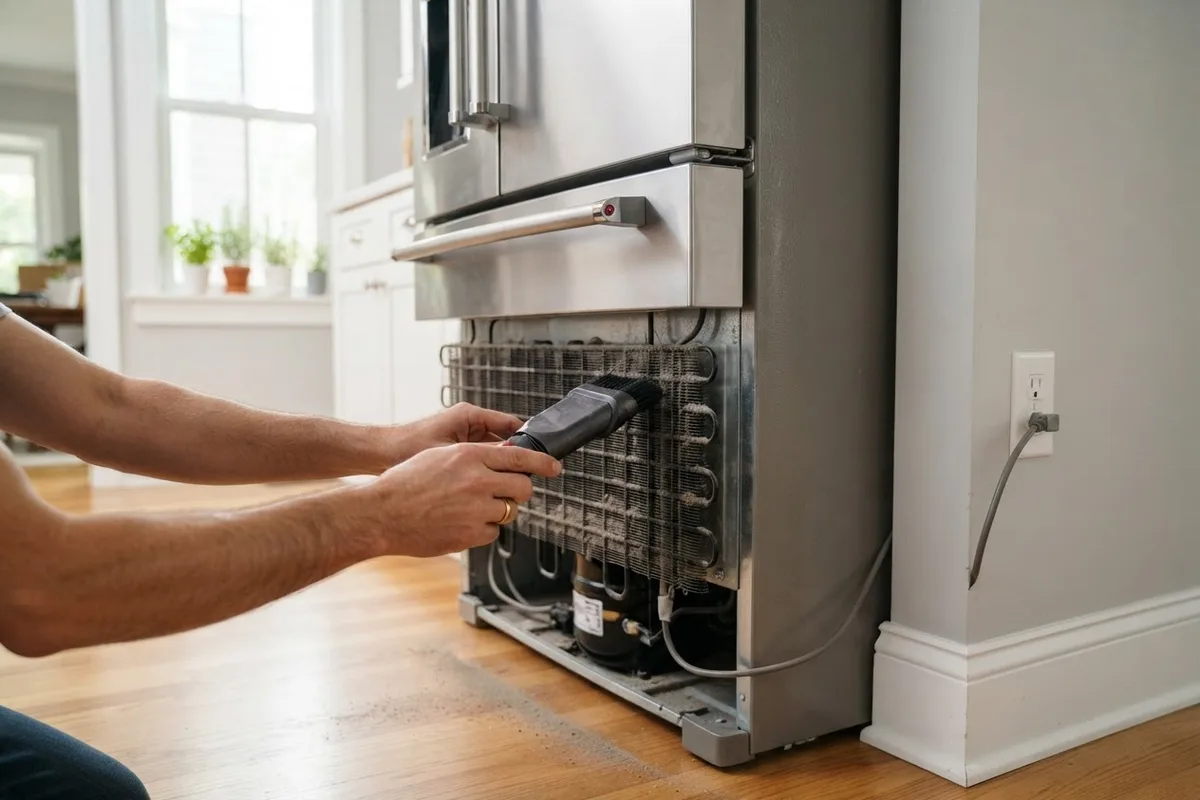
- Pull the fridge gently from the wall and vacuum pet hair and dust from the condenser coils and fan blades—a habit worth keeping on your refrigerator maintenance checklist.
- Clear packed boxes away from interior freezer vents so cold air can circulate freely.
- Listen for grinding after plugging the unit back in; a noisy motor bearing means the fan needs replacement.
4. Defrost Heater or Thermostat ($200–$450)
Modern frost-free freezers automatically melt ice off the hidden evaporator coils several times a day. When the defrost heater, bimetal thermostat, or defrost timer fails, heavy frost chokes the coils, airflow stops, and the refrigerator compartment warms up while the back freezer wall cakes with snow. Professional repairs typically cost $200 to $450 in the US, varying by region and model design.
Follow these safe steps to confirm a defrost issue:
- Unplug the refrigerator and move perishable food into coolers with ice packs.
- Remove the freezer drawers and look for thick frost coating the rear interior wall—never chip ice with a knife or use a heat gun, which can puncture refrigerant lines.
- Leave the doors propped open with towels at the base for 24 hours to let the hidden coils thaw completely.
- Restart the unit; if cooling returns for a week and then fades again, a failed defrost component needs testing and replacement.
5. Main Control Board Fix ($300–$700)
Your refrigerator's main control board directs power to the fans, defrost cycle, compressor, and display panel. Power surges, moisture, or aging relays can cause erratic temperatures, blank screens, constant clicking, or a fridge that stops cooling altogether. Because electronic boards are pricey and require diagnostic testing, typical US repairs run $300 to $700—and even higher on luxury or built-in models, depending on area and brand.
Rule out simple power issues before assuming the board is dead:
- Check your home breaker box to make sure the dedicated circuit has not tripped; if a breaker trips repeatedly, stop and call a pro rather than forcing it back on.
- Unplug the refrigerator for five full minutes to perform a hard reset on the electronics.
- Plug the cord directly into the wall outlet—never use an extension cord or power strip.
- Verify your control panel is not stuck in Showroom or Demo mode by checking your owner's manual.
6. Sealed-System and Compressor ($500–$1,200+)
The compressor and sealed refrigerant tubing form the cooling engine of your refrigerator. When a compressor seizes or a pinhole refrigerant leak drains the system, the fridge runs constantly without getting cold, or you may hear loud clicking every few minutes as the overload switch trips. In the US, replacing a start relay is modest ($150 to $300), but true compressor or sealed-system work typically runs $500 to $1,200 or more, varying widely by area, refrigerant type, and built-in versus freestanding design.
Handle only exterior checks yourself:
- Unplug the refrigerator and shut off the water line before moving it away from the wall.
- Vacuum heavy dust off the back grille and underneath the cabinet so the compressor can shed heat.
- Leave at least two inches of breathing room behind the unit when sliding it back.
- Stop there—never cut, puncture, or attempt to recharge refrigerant lines yourself.
Here is a quick-reference breakdown to help you budget before calling a technician (all US ranges vary by area, brand, and model):
| Repair Type | Common Warning Sign | Typical US Cost Range | Safe DIY Check First |
|---|---|---|---|
| Door Gasket | Frost buildup, warm air leaks | $150–$350 | Dollar-bill seal test and warm soapy wash |
| Ice Maker Assembly | No ice, hollow cubes, bin leaks | $200–$450 | Check water valve, filter, and 0°F temp |
| Fan Motor | Squealing noise, warm fridge | $200–$450 | Vacuum condenser coils and clear vents |
| Defrost System | Thick frost on back freezer wall | $200–$450 | Unplug and thaw for 24 hours with towels |
| Main Control Board | Blank screen, erratic cooling | $300–$700 | 5-minute power reset and outlet check |
| Compressor / Sealed System | Runs nonstop, clicking, no cooling | $500–$1,200+ | Vacuum coils and check wall clearance |
When to Call a Pro
Basic maintenance—like cleaning condenser coils, swapping a water filter, adjusting door hinges, or resetting a control panel—is safe for most homeowners once the appliance is unplugged and the water supply is shut off. However, stop immediately and call a technician for any sealed-system refrigerant leak, compressor swap, live electrical testing, or recurring breaker trips at your electrical panel.
Before approving a major repair, compare the written estimate against the age and replacement cost of your unit. On a freestanding fridge past the 10-year mark, a $900 sealed-system repair rarely makes financial sense, whereas a $250 fan motor or defrost thermostat on a five-year-old fridge can easily buy years of reliable cooling. Built-in and panel-ready models cost far more to replace, so higher repair budgets often remain worthwhile. When you are ready for an accurate diagnosis, True Appliance Repair can match you with a local pro for refrigerator repair in your area.
FAQ
How much is a refrigerator diagnostic or service call fee?
Most US appliance repair companies charge between $75 and $150 for a diagnostic visit, though rates vary by area and whether your fridge is a built-in model. Many technicians credit part or all of that diagnostic fee toward the final bill if you approve the repair. Always ask upfront how the service fee is applied before booking an appointment.
Why do built-in refrigerator repairs cost more than freestanding models?
Built-in and counter-depth luxury refrigerators often require two technicians to pull from tight cabinetry, use proprietary electronic boards, and rely on dual-compressor sealed systems. Replacement parts alone can cost two to three times as much as standard models, and extra labor time raises the total estimate.
Is it worth repairing a 10-year-old refrigerator?
It depends on the problem and the overall condition of the fridge. A $200 to $350 fix—like a door gasket, defrost thermostat, or evaporator fan—is usually worth paying if the cabinet and seals are in good shape. Once estimates pass roughly half the cost of a comparable new refrigerator, especially for compressor or control-board failures, replacing the unit is often the smarter budget move.
Can dirty refrigerator coils really cause expensive repairs?
Yes. Dust-choked condenser coils trap heat, forcing the compressor and condenser fan to run longer and hotter every single day. Vacuuming the coils once or twice a year—after unplugging the fridge—takes ten minutes and helps prevent premature compressor wear.