
Nothing derails a busy weeknight—or upcoming holiday hosting—faster than a dishwasher that quits mid-cycle with a tub full of dirty dishes. When your machine breaks down, deciding whether to repair or replace a dishwasher comes down to a clear math equation between its age, the failed component, and hidden wear. Use these seven practical rules and safe DIY checks to figure out whether a quick fix or a brand-new unit makes the most financial sense.
Safety First: Before inspecting any internal components, removing the lower kickplate, or reaching beneath the tub, always unplug the dishwasher or switch off its dedicated circuit breaker at your home's electrical panel, and shut off the hot water supply valve under the sink. Never attempt to bypass door latches or work on live household wiring.
1. Apply the 50% Cost and 8-Year Lifespan Rule
Most modern dishwashers last between 8 and 12 years with normal household use. Appliance pros rely on the "50% Rule" to keep homeowners from pouring money into a money pit: if your dishwasher is more than halfway through its expected lifespan (over 5 to 6 years old) AND the repair quote exceeds 50% of the cost of a comparable new dishwasher, replacement is the smarter move.
Here is how to run the numbers on your specific machine:
- Open the dishwasher door and locate the model and serial number tag along the inner left or right edge of the tub frame.
- Look up the manufacturing date using an online serial number decoder for your brand, or check your original purchase receipt.
- Compare the estimated repair bill against the price of a similar new model (including delivery and installation fees).
- If your machine is under 6 years old and the repair is under $250, fixing it almost always wins.
2. Check Whether Water Leaks Come From Seals or the Tub
Finding a puddle in front of the kickplate feels catastrophic, but the source of the leak determines whether you need a $35 part or a whole new appliance. Leaks from a worn rubber door gasket or a loose water inlet valve are straightforward, budget-friendly repairs. However, if the plastic outer tub has cracked or a stainless steel floor pan has developed corrosion pinholes, the machine must be replaced.
To safely pinpoint where the moisture is coming from:
- Shut off the circuit breaker to the dishwasher and turn off the hot water supply valve under the sink.
- Lay down a dry towel and unscrew the lower access panel (kickplate) at the base of the unit.
- Shine a bright flashlight underneath the center of the tub and look for white mineral trails, rust streaks, or active dripping.
- Run your dry hand along the rubber door gasket and the water inlet valve connection at the front corner.
- Inspect the interior floor of the tub closely for hairline cracks in the plastic or deep rust pits in the metal.
3. Separate Simple Pump Debris From a Seizing Wash Motor
Every dishwasher makes gentle swishing sounds, and an occasional knocking sound might just mean a spray arm is bumping a tall platter (if you hear rhythmic knocking, check out our guide on why your dishwasher is making a thumping noise). However, a loud, continuous grinding or high-pitched howling usually points to either hard debris stuck in the sump or failing bearings inside the main circulation motor. Clearing debris is free, while replacing a main wash motor assembly is one of the priciest dishwasher repairs.
Check whether the noise is a free DIY fix or a costly motor failure:
- Turn off power to the appliance and slide out the bottom dish rack.
- Twist and lift out the lower cylindrical filter and remove the flat mesh screen at the bottom of the tub.
- Shine a flashlight into the sump pit and carefully clear out any hard objects—like fruit pits, toothpicks, or broken glass—using needle-nose pliers.
- Spin the lower spray arm by hand to verify it rotates freely without scraping the heating element.
- If the sump is completely clear and the loud howling returns on the next run, the main circulation motor bearings are wearing out.
4. Test Door Latches Before Blaming a Warped Frame
A door that refuses to click shut or pops open mid-wash prevents the safety switch from starting the cycle. Often, this is just a misaligned strike plate or a worn latch assembly—a very affordable repair. On the other hand, if years of heavy leaning have bent the chassis or torn the hinge mounts through the frame, fixing the structure rarely holds up long-term.
Here is how to check if the issue is a simple latch or a bent frame:
- Open the door and inspect the rubber gasket around the perimeter for flattening or brittle spots that push the door outward.
- Check the top latch mechanism to see if the metal strike plate is loose; if so, tighten the mounting screws with a Phillips screwdriver.
- Gently lift up and down on the open door to test the side hinges for excessive sagging.
- Close the door slowly and watch whether it meets the tub evenly on both sides. If the tub frame itself is twisted out of square, replacement is your best bet.
5. Weigh Heating Element Fixes Against Control Relay Failure
Water temperature is essential for dissolving detergent pods and sanitizing plates. If you open the door right after a cycle and everything is stone cold, or if the interior gets so blistering hot that top-rack items warp—see our troubleshooting steps for why your dishwasher is melting plastic—you have a heating malfunction. A burned-out heating element or high-limit thermostat is a moderate repair, whereas a shorted electronic control board on an older unit often tips the scale toward replacement.
Perform these safe checks before making your call:
- Run your kitchen sink hot water faucet for 60 seconds before starting a cycle, then test the water with a kitchen thermometer; it should reach at least 120°F.
- With the dishwasher power switched off at the breaker, inspect the curved heating element at the bottom of the tub for visible blisters, cracks, or breaks.
- Check your cycle settings on the keypad to confirm options like "Heated Dry" or "Hi-Temp Wash" are turned on.
- If your home's hot water supply is hot and the element looks intact, a technician will need to test the thermostat and control board relay.
6. Price Out Crumbling Dish Racks Before Buying Parts
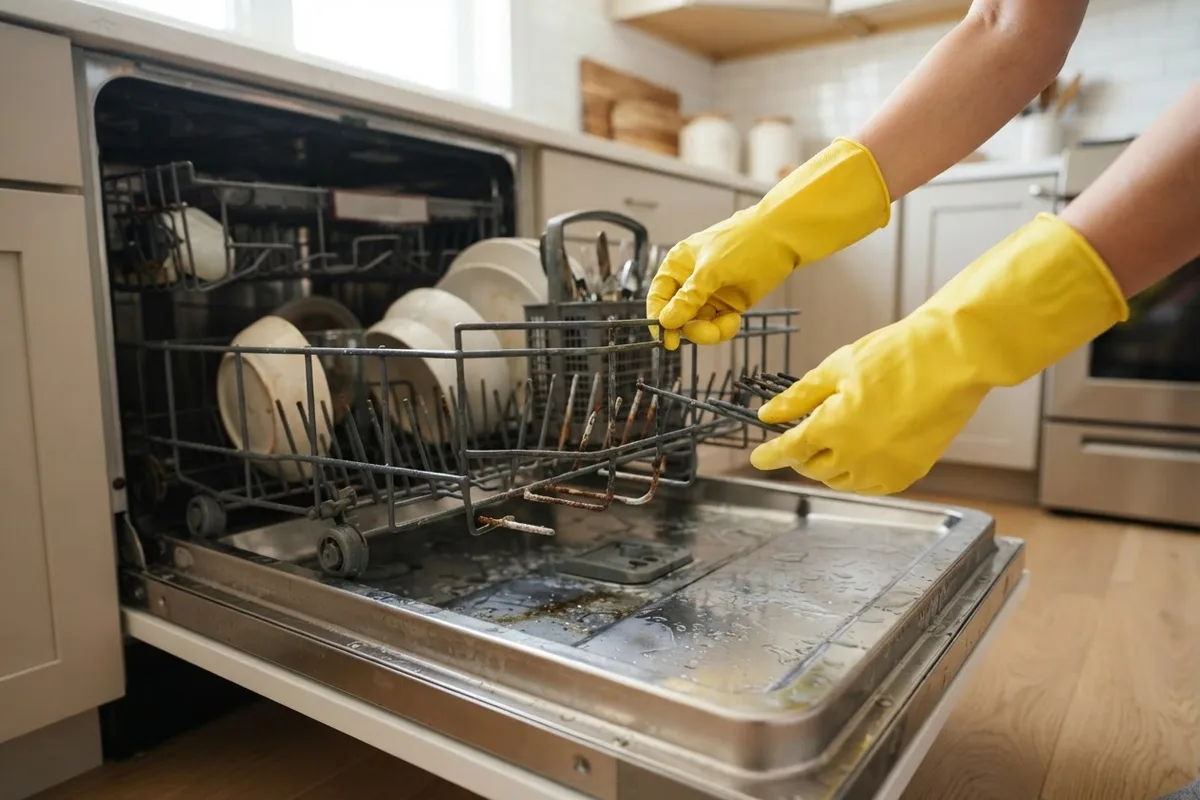
At first glance, rusty dish racks seem like a minor cosmetic flaw. However, once the vinyl coating peels away from the metal tines, the exposed steel rusts rapidly and drops brittle metal flakes into the sump, which can shred the rubber impellers inside your drain and wash pumps. Surprisingly, replacing both the upper and lower OEM dish racks can cost $250 to $400 in parts alone.
Inspect your racks to see if they can be saved on a budget:
- Pull out both the upper and lower racks completely and examine the tine tips and bottom rollers.
- If you only find a few small nicked spots, sand off the surface rust and seal the tips with a food-safe vinyl rack repair liquid.
- Press gently on rusted crossbars; if the metal crumbles or snaps, the rack must be replaced.
- Look up the price of replacement racks for your model number. If your dishwasher needs two new racks plus a mechanical repair, buying a brand-new dishwasher is almost always cheaper.
7. Compare Typical Repair Costs Against Replacement
Before scheduling a service visit or heading to the appliance showroom, compare your symptom against typical US repair ranges. Remember that stacking two moderate repairs together—such as a control board plus a new set of racks—quickly surpasses the price of a new machine.
Use this quick-reference table to guide your decision (prices vary by area, brand, and model):
| Dishwasher Problem | Likely Failed Component | Typical US Repair Range* | Repair or Replace? (Under 7 Yrs Old) | Repair or Replace? (8+ Yrs Old) |
|---|---|---|---|---|
| Won't latch (frame straight) | Door latch / strike assembly | $100 – $220 | Repair | Repair |
| Won't fill with water | Water inlet valve or float switch | $120 – $240 | Repair | Repair if racks & tub are solid |
| Water stays cold mid-cycle | Heating element or thermostat | $150 – $300 | Repair | Repair if no other issues exist |
| Loud howling or grinding | Circulation pump & wash motor | $250 – $450 | Repair | Replace |
| Dead keypad / erratic cycles | Main electronic control board | $250 – $500 | Weigh against 50% rule | Replace |
| Both racks rusting & crumbling | Upper and lower dish racks | $200 – $400 (parts alone) | Replace racks only | Replace unit if other parts age |
| Puddle from cracked floor pan | Outer tub / structural chassis | $500+ (exceeds unit value) | Replace | Replace immediately |
Note: Ranges reflect typical national averages for parts and labor; actual costs vary by region and model.
When to Call a Pro
While clearing glass from the filter sump, tightening a loose door strike, and checking incoming water temperature are safe DIY tasks, electrical diagnostics and under-tub pump replacements require specialized tools. Stop your DIY troubleshooting and call a professional if you smell burning plastic, see water dripping near electrical wiring, or need to test a circulation motor, heating relay, or control board.
Still on the fence about whether your machine is worth saving? A quick diagnostic visit can save you hundreds of dollars over buying a new unit unnecessarily. True Appliance Repair can connect you with an independent local pro for dishwasher repair who can inspect your unit and give you a clear repair quote. If you are tackling a full kitchen refresh before guests arrive, you can also explore our appliance repair services for every major household unit.
FAQ
Is it worth fixing a 7-year-old dishwasher?
If the dishwasher is in good cosmetic condition with rust-free racks and only needs a single common component—such as a water inlet valve, drain pump, or door latch costing under $220—repairing a 7-year-old unit is usually well worth it. However, if it requires a costly circulation motor or electronic control board, putting that money toward a new machine is typically the wiser choice.
What is the most expensive part to replace on a dishwasher?
Aside from a cracked outer tub (which generally cannot be economically repaired), the main circulation pump and motor assembly and the main electronic control board are the two most expensive components. Depending on the brand and local labor rates, replacing either part typically ranges from $250 to $500 (varies by area and model).
Do newer dishwashers last as long as older ones?
Most modern dishwashers last 8 to 12 years, which is similar to older models, though today's machines rely on sensitive electronic sensors and control boards that are vulnerable to power surges and moisture. You can maximize the lifespan of any dishwasher by cleaning the lower filter monthly, scraping heavy food scraps before loading, and using a whole-home or point-of-use surge protector.
Should I replace my dishwasher before it completely breaks?
If your dishwasher is over 9 years old and starts showing multiple wear signs at once—such as peeling racks, a noisy wash motor, and intermittent keypad glitches—replacing it proactively is smart. Shopping ahead of a total failure lets you compare models, wait for seasonal sales, and avoid an emergency kitchen flood.