
A failing under-sink unit rarely quits without warning; instead, it drops subtle clues like frequent clogs, tripping breakers, or a mystery puddle in your cabinet. Catching the early signs your garbage disposal is dying helps you avoid a backed-up kitchen sink right before a big family dinner. Below are the seven clearest indicators that your unit is reaching the end of its lifespan, along with safe DIY checks to confirm whether you need a quick tune-up or a full replacement.
1. It Constantly Trips the Reset Button
Every disposal has a small red overload protector button on the bottom casing. While it is normal for this button to pop out once in a while if a peach pit or bone jams the flywheel, a unit that trips every few days is struggling with deeper internal wear. Over time, the internal motor windings degrade and overheat under normal kitchen loads, or the internal breaker switch itself wears out and becomes hypersensitive.
Before assuming the motor is toast, run a safe check to make sure a hidden jam isn't drawing excess amperage:
- Turn the wall switch off and unplug the power cord from the under-sink outlet (or flip the dedicated circuit breaker off at your main panel).
- Shine a flashlight down the sink drain to inspect for stray silverware, fruit pits, or fibrous peels wrapped around the impellers.
- Insert a quarter-inch Allen wrench into the hex socket at the very bottom center of the unit and crank it back and forth until the flywheel turns freely.
- Plug the unit back in, wait ten minutes for the motor to cool, and press the red reset button firmly.
If the flywheel turns effortlessly by hand but the reset button still pops out during basic food grinding, the motor is nearing failure.
2. Water Leaks from the Bottom Casing
Not all under-sink leaks mean your disposal is dead, so pinpointing the exact drip source is crucial. A leak at the top sink flange usually just needs fresh plumber's putty, and a drip at the black rubber discharge elbow often requires a new metal clamp or a five-dollar rubber gasket. However, water dripping directly from the bottom housing, the reset button, or the seams in the outer shell is a terminal symptom.
Inside the disposal, a watertight internal seal separates the wet grinding chamber from the electrical motor below. Years of vibration, food acids, and corrosion eventually crack this internal seal, allowing dishwater to seep straight down through the motor bearings and out the bottom vents.
To trace the leak accurately:
- Unplug the unit from the wall outlet for safety.
- Wipe the entire exterior of the canister bone-dry with paper towels.
- Place a dry sheet of cardboard or a baking sheet directly underneath the unit.
- Plug the sink stopper, fill the basin with three inches of water mixed with a few drops of food coloring, and pull the stopper.
- Watch with a flashlight to see whether colored water appears at the top collar, the side drain pipe, or the bottom motor housing.
If water drips from the bottom housing or around the reset button, internal rust has breached the motor seal and the entire unit must be replaced immediately to prevent electrical hazards.
3. Food Takes Twice as Long to Grind
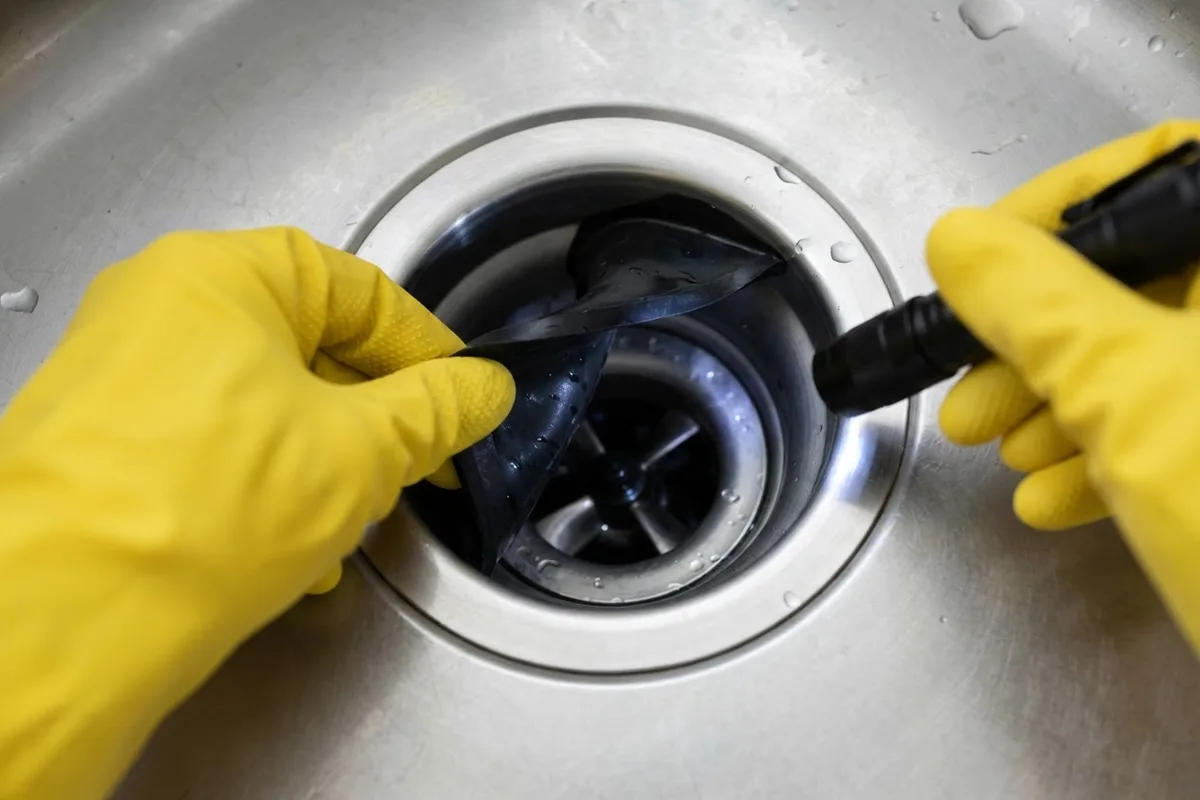
If soft vegetable scraps and cooked pasta used to disappear in five seconds flat but now swirl endlessly in murky water, the grinding assembly is worn down. Contrary to popular belief, garbage disposals do not have sharp spinning knife blades. Instead, they use blunt metal lugs (impellers) mounted on a spinning turntable that use centrifugal force to fling food waste against a stationary metal shredder ring lined with small cutting grooves.
After eight to twelve years of daily use, both the swivel lugs and the teeth on the stationary shredder ring wear smooth. Sometimes the swivel lugs also corrode and rust stuck against the turntable so they can no longer swing outward. When this happens, food gets mashed rather than finely pulverized.
You can test and clean the grinding teeth safely:
- Turn off power at the breaker or unplug the cord under the sink.
- Pull out the removable rubber splash guard (or peer past a fixed baffle with a flashlight) and look at the two metal lugs on the spinning plate.
- Use a long wooden spoon handle to gently prod each metal lug; they should pivot smoothly on their rivets rather than sitting frozen in place.
- Reconnect power, turn on a medium stream of cold water, and grind two cups of ice cubes mixed with a half cup of rock salt to scour away built-up starch and grease from the shredder ring.
If the lugs pivot freely and the ice-and-salt scrub does not restore grinding speed, the metal shredder ring is simply worn dull.
4. Loud Metallic Grinding or Squealing Noises
A healthy disposal produces a low, steady rumble when chewing through food waste. If your unit suddenly sounds like a coffee can full of bolts or emits a high-pitched metallic screech even when running empty with water, you are hearing metal-on-metal contact. While a stray spoon or bottle cap is the first suspect, noise that persists when the chamber is completely empty points to failing motor bearings or a warped flywheel.
Similarly, if the whole sink shudders loudly during operation, check out our guide on why your garbage disposal is vibrating to rule out a loose mounting ring. To isolate a bearing issue from a foreign object:
- Unplug the disposal from the outlet under the sink.
- Reach in with needle-nose pliers or kitchen tongs—never your bare hand—to remove any bone fragments, glass, or metal bits trapped along the perimeter wall.
- Insert your hex wrench into the bottom center hole and rotate the shaft manually.
- Pay attention to how the rotation feels: a healthy shaft turns smoothly, while failed bearings feel gritty, catch at certain points, or wobble side to side.
Once motor bearings wear out, the rotor scrapes against the internal housing, and replacing the unit is far more practical than rebuilding the motor.
5. Frequent Clogs Despite Proper Use
Everyone makes the mistake of washing too many potato peels or fibrous celery stalks down the drain once in a while. However, if you follow every kitchen rule—running plenty of cold water, feeding scraps gradually, and avoiding grease, coffee grounds, and eggshells—yet your drain still backs up every couple of weeks, the disposal is the culprit.
When the shredder ring wears dull (as noted in Sign #3), it allows oversized, unchewed chunks of food to slip past the chamber and enter your sink's P-trap and branch drainpipe. These coarse particles snag on pipe joints and create stubborn blockages downstream.
To clear and check the discharge path:
- Unplug the power cord and place a bucket under the U-shaped plastic or metal P-trap pipe beneath the sink.
- Unscrew the slip nuts by hand (or with channel-lock pliers) and remove the curved trap section.
- Dump out any trapped sludge and inspect the texture of the waste; if you see large, intact food pieces rather than fine grit, the disposal is letting unground waste pass through.
- Check the black discharge tube exiting the side of the disposal for heavy buildup before reassembling the slip nuts hand-tight.
6. Persistent Foul Odors That Cleaning Won't Fix
Most sink odors come from decaying food grease trapped on the underside of the rubber baffle. You can usually solve that in five minutes by following our steps for cleaning a dirty garbage disposal splash guard. However, if you have scrubbed the rubber flaps, ground citrus peels, and flushed the drain with baking soda and vinegar, yet a sour, rotting smell returns the very next day, the interior of the grind chamber is likely corroded.
Lower-tier disposals use galvanized steel components that eventually pit and rust after years of exposure to food acids and bleach cleaners. Tiny crevices and rust pockets form inside the chamber walls, trapping microscopic organic matter where water and ice cannot flush it away.
Try one deep-cleaning flush to see if the odor is surface-level:
- With the unit off, scrub the underside of the rubber splash baffle using dish soap and an old toothbrush.
- Pour half a cup of baking soda down the throat of the disposal, followed by one cup of white vinegar.
- Let the foaming mixture sit for fifteen minutes to loosen organic buildup inside the chamber.
- Turn on cold water and run the unit for thirty seconds to flush the chamber clean.
If a metallic, stagnant smell lingers immediately after a deep clean, internal shell corrosion has taken hold.
7. It Hums But Refuses to Spin (Even After Unjamming)
Flipping the wall switch and hearing a low electrical hum with zero blade movement is the classic symptom of a jammed flywheel. In a healthy unit, turning off the power and working the bottom Allen wrench back and forth frees the jam and gets the unit spinning again within two minutes.
When a disposal is dying, however, it will hum and refuse to spin even when the grind chamber is 100% empty and the flywheel turns freely by hand. This means either the start capacitor has failed, the centrifugal starting switch inside the motor housing is stuck or burned out, or a motor winding has shorted.
| Symptom | Typical Cause | DIY Fix or Replace? |
|---|---|---|
| Trips reset button occasionally | Minor food jam or overload | DIY: Unjam with hex wrench and reset |
| Trips reset button every week | Weakening motor windings | Replace unit |
| Leaks from top flange or side pipe | Loose bolts or worn rubber gasket | DIY: Tighten bolts or swap $5 gasket |
| Leaks from bottom motor housing | Cracked internal water seal | Replace unit immediately |
| Hums with a stuck flywheel | Fruit pit or bone wedged in teeth | DIY: Free flywheel with bottom hex wrench |
| Hums with a free-spinning flywheel | Dead start capacitor or motor winding | Replace unit (if over 7 years old) |
Repair vs. Replace: Making the Smart Call
The average garbage disposal lasts between 8 and 12 years depending on household size and whether the inner grind chamber is made of galvanized steel or stainless steel. Because a brand-new standard 1/2-horsepower or 3/4-horsepower unit typically costs between $100 and $250 for the hardware (varies by brand and noise insulation features), major internal repairs rarely make financial sense on an older machine.
A professional service call to repair a jammed switch, swap a flange, or clear a stubborn drain line generally runs $120 to $225 depending on your local market. If your disposal is under five years old and just has a leaking side gasket, a loose sink mount, or a severe jam you cannot reach, paying for a quick repair is a smart move. On the other hand, if the unit is over eight years old, leaking from the bottom housing, or grinding slowly with worn teeth, putting that money toward a replacement installation (typically $250 to $450 total including parts and labor, varying by area and plumbing setup) will save you money and frustration over the next decade.
When to Call a Pro
While unjamming a flywheel with an Allen wrench or scrubbing a splash guard is safe for any homeowner, you should stop and call a professional if you encounter hardwired electrical connections without a simple wall plug, corroded brass drainpipes that crumble when touched, or water dripping onto live electrical wires under the sink. Trying to force rusted plumbing slip nuts or working near wet wiring carries serious shock and flood risks.
If you aren't sure whether your under-sink unit needs a minor adjustment or a full swap, True Appliance Repair can match you with an independent local appliance pro who can inspect your setup safely. You can also reach out through our contact page to get connected with a technician in your area.
FAQ
How long does a garbage disposal typically last?
Most household garbage disposals last between 8 and 12 years with normal daily use. Entry-level 1/3-horsepower models with galvanized steel components often wear out closer to the 6-to-8-year mark, while 3/4-horsepower or 1-horsepower models built with stainless steel grind chambers can easily last 12 to 15 years.
Can I still run water down the sink if my garbage disposal is dead?
Yes, as long as the unit is not actively leaking and the chamber isn't packed with solid food waste, water will still drain past the stationary flywheel into the P-trap. However, you should unplug the unit beneath the sink so nobody accidentally flips the wall switch, and place a fine mesh strainer over the drain opening to catch all food scraps until the unit is fixed or replaced.
Why is water leaking out of the red reset button on my disposal?
Water dripping directly from the red reset button or the bottom ventilation slots means the internal main water seal inside the disposal has ruptured. Dishwater is draining straight through the electrical motor housing, which creates a shock hazard and cannot be patched with sealant; unplug the unit right away and plan for a replacement.
What horsepower garbage disposal should I buy as a replacement?
For most family kitchens, a 3/4-horsepower continuous-feed disposal is the sweet spot. It offers plenty of torque to pulverize tough vegetable peels without jamming, runs noticeably quieter than builders-grade 1/3- or 1/2-horsepower units, and fits comfortably inside a standard 30-to-36-inch sink base cabinet.