
A dishwasher should sit square and immobile inside its cabinet cavity. When you pull open a heavy door or roll out a loaded lower rack, the unit should never rock forward, shift sideways, or rub against your cabinetry. A loose dishwasher is more than a minor annoyance; excessive movement strains your copper or braided water lines, bends drain hoses, and can eventually break door latches.
Before tackling any hands-on adjustments beneath or around the machine, always turn off power to the unit at your home's circuit breaker box and turn off the hot water shutoff valve under the kitchen sink. With those safety steps complete, you can safely secure your dishwasher in place.
Snapped or Stripped Top Mounting Brackets
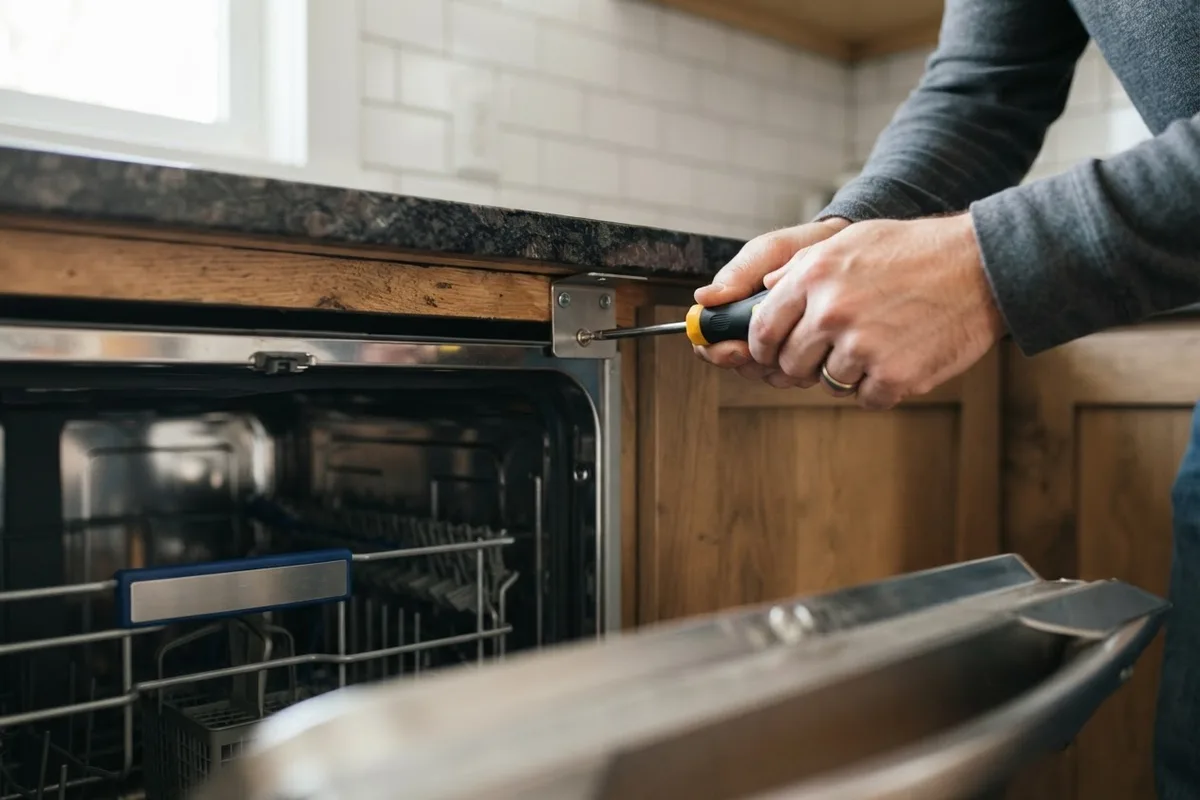
The most common reason a dishwasher tilts forward when opened is a failed top mounting bracket. In traditional laminate or solid-wood countertop installations, two metal tabs extend from the top frame of the dishwasher and screw directly into the wooden sub-counter. Over time, the repeated downward leverage of opening the door can loosen these screws or snap the thin metal tabs.
- Open the dishwasher door fully and inspect the top edge of the tub frame right below the counter.
- Look for two metal brackets secured with Phillips-head screws into the underside of the countertop.
- If the screws have pulled free, check whether the brackets themselves are bent or broken.
- Replace cracked or fatigued brackets with manufacturer-compatible metal mounting clips.
- If the screw holes in the wood are stripped, use slightly thicker, short wood screws (never longer than 1/2 inch to prevent puncturing the countertop surface) or repair the wood fibers with wooden toothpicks and wood glue before re-fastening.
Missing Side-Mount Brackets on Stone Counters
If you have granite, quartz, or marble countertops, installers cannot drill upward into the stone without risking cracking the slab. If the installer failed to convert the dishwasher to a side-mount configuration—or used weak adhesive strips that eventually detached—the machine will easily shift forward under load.
- Inspect the sides of the tub frame just inside the rubber door gasket.
- Locate the small plastic plugs covering the side-mounting screw holes (usually about two to three inches down from the top).
- Pop out the plastic caps using a flat-head screwdriver.
- Secure side-mount brackets through the tub into the adjacent cabinet stiles using 1/2-inch cabinet screws, ensuring the unit sits plumb.
- Reinstall the plastic access caps flush against the tub wall to keep moisture away from the cabinet wood.
Unadjusted or Slipping Front Leveling Legs
A dishwasher must bear its primary weight on its bottom leveling feet, not on its mounting brackets. If the front leveling legs are retracted too far or resting unevenly on the kitchen subfloor, the chassis will tip forward under the weight of wet dishes, putting destructive torque on the countertop brackets.
- Remove the bottom access panel (kickplate) by backing out the two lower screws.
- Locate the two front leveling legs resting on the floor beneath the frame.
- Use an adjustable wrench or slip-joint pliers to turn the threaded legs counterclockwise (viewed from above) to extend them downward.
- Raise the front legs until they press firmly against the floor, lifting slight upward pressure onto the underside of the counter.
- Place a bubble level across the top lip of the opened tub to confirm the machine is level left-to-right and front-to-back before reinstalling the kickplate.
Stripped Screw Holes in Cabinet Face Framing
When a dishwasher relies on side-mounting into the surrounding kitchen cabinets, repeated vibrations during the drain cycle can wallow out the pilot holes in the wood or particleboard stiles. If the screws lose their bite, the dishwasher will slide back and forth every time the latch engages.
- Back out the side-mounting screws completely and pull them away from the cabinet wall.
- Inspect the pilot hole inside the wooden stile for stripped or crumbled material.
- Pack the hole firmly with two or three wooden toothpicks coated in PVA wood glue, or tap in a small hardwood dowel plug.
- Allow the glue to cure fully for at least two hours so it creates a dense, solid core.
- Drill a fresh, narrow pilot hole into the plugged area and drive the mounting screws back in until snug. Avoid over-torquing, which strips soft particleboard instantly.
Broken or Disconnected Countertop Mounting Strip
Many modern stone installations use a dedicated metal anchor strip glued to the underside of the stone with industrial epoxy. The dishwasher's top tabs screw directly into this strip. If the adhesive shears due to heat, humidity, or aggressive pulling, the entire anchor track detaches from the stone.
- Shine a bright flashlight beneath the front edge of the countertop just above the open dishwasher.
- Check if the long aluminum mounting track has pulled away from the underside of the granite or quartz.
- Unscrew the dishwasher tabs from the loose anchor bar and slide the bar out.
- Scrape old adhesive residue from the stone surface using a razor blade, then clean the area with rubbing alcohol.
- Reattach the anchor bar using high-strength two-part epoxy or silicone construction adhesive rated for stone, clamping or propping the bar firmly until fully cured (typically 12 to 24 hours) before re-anchoring the appliance.
Dishwasher Mounting Fix Quick Reference
Use this quick breakdown to identify which mounting method matches your countertop material and problem:
| Countertop Type | Primary Mounting Method | Common Failure Mode | Best DIY Fix |
|---|---|---|---|
| Laminate / Wood | Top-mount tabs into wood substrate | Stripped screw holes in wood | Wood filler/toothpick trick + short screws |
| Granite / Quartz | Side-mount screws into cabinet stiles | Screws pulling out of cabinet frames | Plug screw holes or install side bracket kit |
| Stone (with sub-strip) | Undermount epoxy bracket bar | Adhesive separates from stone | Re-epoxy bracket strip with two-part compound |
| Any Surface | Lower leveling legs on flooring | Front legs retracted off floor | Extend threaded feet firmly against floor |
Preventive Maintenance for Cabinet-Mounted Appliances
Vibration is the enemy of appliance fasteners. As part of your regular home checkups—or while tackling a holiday appliance checklist before hosting gatherings—take two minutes to grasp the top edges of the open dishwasher tub and apply light upward and downward pressure. Any play greater than 1/8 inch signals that your leveling legs or mounting clips need attention before they tug on supply lines.
Additionally, excessive plumbing shaking can vibrate mounting hardware loose over time. If you hear loud thuds whenever your appliance fills with water, resolving dishwasher water hammer issues will reduce stress on your cabinet fasteners and prevent early wear on internal valves.
When to Call a Pro
Most loose dishwasher issues require nothing more than basic hand tools, an epoxy kit, or replacement mounting clips. However, you should pause and seek help if the surrounding cabinet framework shows severe water damage, wood rot, or mold from a hidden leak, or if shifting has kinked copper water lines or stretched electrical wiring behind the tub.
If you find damaged supply plumbing, broken internal chassis rails, or need an expert evaluation, True Appliance Repair can match you with a local appliance pro to diagnose and secure your kitchen setup safely. Professional service calls for mounting and alignment typically range from $120 to $250, though costs vary by area and appliance model.
FAQ
Can a loose dishwasher cause water leaks?
Yes. When a dishwasher shifts inside its cabinet cutout, it places repeated mechanical stress on the brass water inlet elbow, the braided supply hose, and the ribbed drain loop. Over time, that constant motion can loosen compression fittings or crack plastic drain line connections, resulting in slow, hidden floor leaks.
Can I screw my dishwasher directly into granite countertops?
No. You should never drill pilot holes directly into the underside of granite, quartz, or marble countertops. Attempting to drive screws into natural or engineered stone will split the slab, crack the edge, or strip out immediately. Instead, use manufacturer side-mount conversion kits or an undermount bracket strip joined to the stone with epoxy.
How high should my dishwasher sit under the counter?
The top gasket or edge of the dishwasher tub should sit roughly 1/8 to 1/4 inch below the finished countertop surface. Extending the front leveling feet until the chassis lightly snugs against the underside of the counter provides vertical support, but the unit should never be forced so tight that the door frame distorts or binds against the latch.
Why does my dishwasher rock from side to side?
Side-to-side rocking almost always means one of the front or rear leveling legs is not making full contact with the subfloor. Check that your flooring under the appliance is level and intact, especially if new tile was installed only up to the front of the cabinets rather than underneath the entire appliance bay.