
You set your oven to preheat for dinner, step away to prep your ingredients, and return to find the oven completely dark and cold. Having an oven that shuts off spontaneously mid-cycle is one of the most frustrating kitchen headaches a homeowner can face. It ruins meal prep, wastes energy, and leaves you wondering if a costly total replacement is right around the corner.
Fortunately, an oven that keeps turning off by itself usually points to a few specific, fixable component issues rather than a total system failure. Before you order takeout or shop for a brand-new appliance, use this DIY troubleshooting guide to identify the root cause and get your oven heating reliably again.
Safety First: Always disconnect the power supply to your electric range or unplug your gas oven before inspecting internal components or removing access panels. For gas models, turn off the gas shutoff valve before working on gas-line components. If at any point you detect the smell of gas or feel uncomfortable working with high-voltage wiring, stop immediately and contact a professional.
Test and Clean the Oven Temperature Sensor
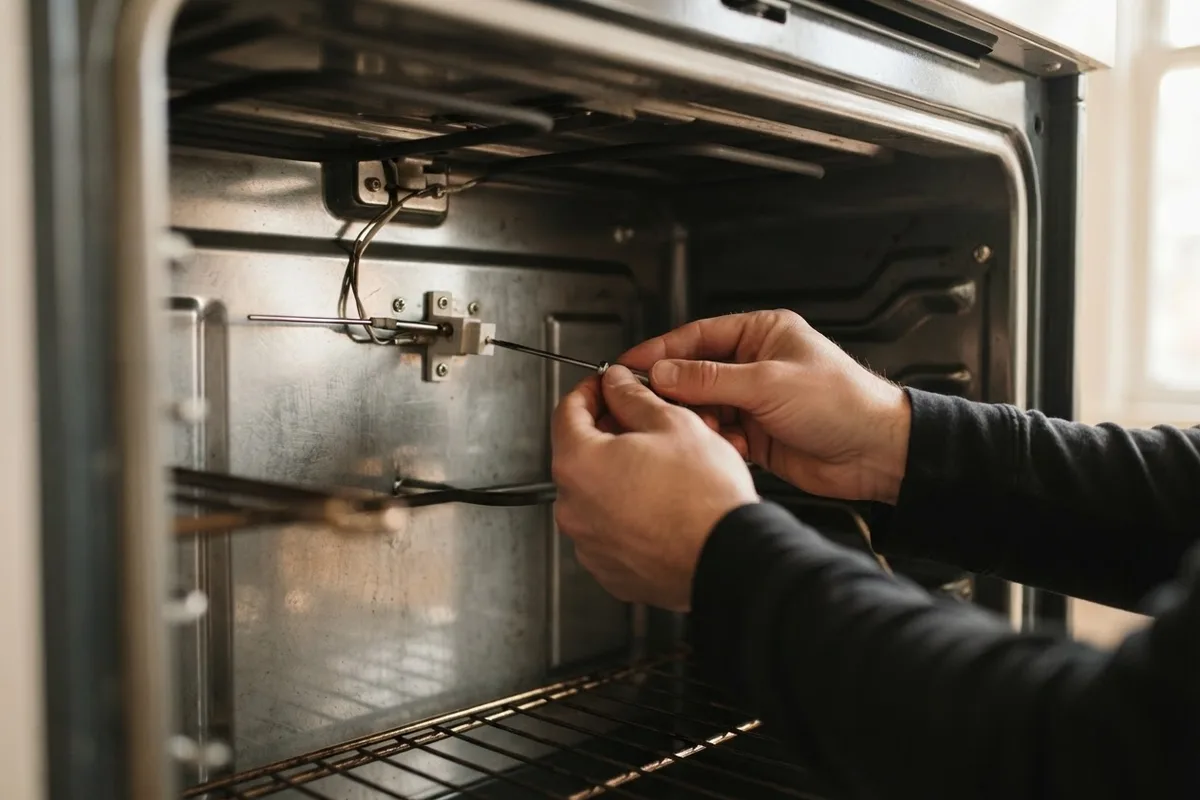
The temperature sensor—a thin metal rod protruding from the top back wall inside the oven cavity—monitors ambient temperature and sends resistance signals back to the main control board. If this sensor becomes coated in heavy grease or fails internally, it sends incorrect readings. The control board may falsely detect that the oven has reached dangerously high temperatures, triggering an automatic safety shutdown to prevent a fire hazard.
To troubleshoot and clean the sensor, follow these steps:
- Ensure the oven is completely cool and unplugged from the electrical outlet.
- Open the oven door and locate the sensor rod near the upper back corner.
- Wipe away baked-on grease or debris using a microfiber cloth dampened with warm water and mild dish soap.
- If cleaning does not resolve the shutoffs, unbolt the mounting screws holding the sensor to the back wall and carefully pull it forward to reveal its wire harness disconnect.
- Unplug the harness and test the sensor's resistance using a multimeter set to ohms. At room temperature (around 70°F), a standard temperature sensor should measure approximately 1,000 to 1,100 ohms. If the reading is significantly higher or lower, or shows open continuity, replace the sensor rod.
Clear Blocked Cooling Vents and Airflow Passages
Modern electric and gas ranges rely on internal cooling fans to push ambient air over sensitive electronic components located behind the control console. If this airflow is restricted, heat builds up inside the control housing. To protect delicate circuit boards from melting or burning, built-in safety thermal limiters will cut power to the entire unit.
Common airflow restrictions happen when homeowners line the bottom rack or lower oven vents with aluminum foil to catch drips. Foil disrupts the engineered air circulation patterns inside the oven wall cavity, trapping extreme radiant heat.
Inspect your oven for these common ventilation blockages:
- Remove any aluminum foil, silicone drip mats, or oven liners covering air vents at the bottom or sides of the oven cavity.
- Inspect the air exhaust vents located along the bottom edge of the control panel or above the oven door. Vacuum away dust, lint, or pet hair using a narrow hose attachment.
- Ensure your range maintains proper cabinet clearance according to the manufacturer manual, allowing intake air to circulate freely beneath and behind the chassis.
Inspect the Gas Oven Igniter and Flame Safety Valve
If you own a gas range, a weakening igniter is one of the most frequent reasons for an oven that turns off mid-bake. In a gas oven, the igniter must draw a continuous, specific electrical current (typically 3.2 to 3.6 amps) to keep the gas safety valve open. As an igniter ages, it degrades and loses electrical resistance.
When this happens, the igniter may get hot enough to ignite the gas burner initially during preheat. However, as it operates over 15 to 20 minutes, its electrical output drops. The safety valve detects the drop in amperage and automatically snaps shut, turning off the flame while the control panel remains powered on.
If your gas burner igniter glows dull red rather than a bright white-yellow, or if you notice the flame cutting out repeatedly during longer baking cycles, the igniter is failing. Replacing a weak igniter restores constant current flow and prevents sudden gas valve cutoffs. For a deeper breakdown of igniter issues, read our guide on gas oven igniter glowing but not igniting.
Check and Test the High-Limit Thermal Fuse
The thermal fuse (also called a safety thermostat) is an electrical safety component designed to cut off power to the heating elements or gas valve if the oven reaches unsafe temperatures. While designed as a single-use or high-temp safety switch, thermal fuses can degrade over time due to repeated high-heat exposure or power spikes.
When a thermal fuse begins to fail, normal baking temperatures can cause its internal contact points to expand and open prematurely, shutting off the oven mid-cycle. Once the oven cools down completely, the switch may close again, creating an frustrating, intermittent shut-off pattern.
Testing the thermal fuse requires pulling the range away from the wall:
- Disconnect the main power at the circuit breaker panel or unplug the power cord.
- Remove the rear access panel of the range using a nut driver or screwdriver.
- Locate the thermal fuse—typically a small plastic or ceramic piece with two wire terminals mounted to the back panel or blower housing.
- Disconnect the two wire leads from the terminals.
- Touch the probes of a multimeter set to continuity (ohms) across the two terminals. If the meter shows no continuity (infinite resistance), the fuse is blown and must be replaced.
Reset and Inspect the Main Electronic Control Board
The main electronic control board acts as the central brain of your oven, sending voltage to the bake and broil elements, igniter, and fan motors based on sensor feedback. Software glitches, power surges, or cracked solder joints on the control board relays can cause random system dropouts.
Before replacing expensive electronics, try performing a hard power reset on your oven:
- Turn off the dedicated circuit breaker supplying power to the oven or unplug the appliance.
- Leave the power completely disconnected for 15 to 20 minutes to allow all internal capacitors to drain fully.
- Restore power and monitor the unit during a test preheat cycle.
If the issue persists, avoid running self-cleaning modes, which subject the control board to extreme ambient temperatures above 800°F. Self-cleaning cycles are a primary cause of control board overheating and relay failure. Steer clear of other common pitfalls by reviewing our guide on costly appliance care mistakes that cause early breakdowns.
Oven Shut-Off Troubleshooting Guide
Refer to this quick comparison table to help diagnose why your oven shuts down prematurely:
| Potential Cause | Typical Symptom | Safety Requirement | DIY Fix Difficulty |
|---|---|---|---|
| Dirty or Faulty Temperature Sensor | Shuts off after 10–15 mins; inaccurate temp display | Disconnect power | Easy |
| Blocked Cooling Vents | Control panel feels excessively hot; shuts down with error code | Let unit cool fully | Very Easy |
| Failing Gas Igniter | Flame drops out mid-cycle; igniter glows dull red | Turn off gas & power | Moderate |
| Tripped Thermal Fuse | Sudden total loss of heat mid-bake | Disconnect power | Moderate |
| Control Board Glitch | Display blinks, clears settings, or turns off randomly | Reset breaker | Easy |
When to Call a Pro
While cleaning temperature sensors, removing airflow obstructions, and resetting circuit breakers are simple homeowner tasks, complex electrical and gas troubleshooting requires professional hands. If you suspect an issue with internal wiring harnesses, gas supply lines, or main control board replacements, it is best to leave the diagnostic work to an expert.
Working with high-voltage electricity or natural gas carries inherent safety risks. If you have completed basic DIY checks and your appliance still shuts off unexpectedly, True Appliance Repair can match you with a local appliance pro to diagnose and repair your range safely.
FAQ
Why does my oven turn off as soon as it finishes preheating?
This issue is most frequently caused by a weak gas igniter or a failing temperature sensor. When the oven reaches its target preheat temperature, the control board cycles off the heat. However, if the sensor misreads the temperature spike or the igniter fails to re-ignite the gas valve when cycling back on, the unit shuts down completely as a safety precaution.
Can a dirty oven cause it to shut off automatically?
Yes. Excessive grease accumulation inside the oven cavity or on the temperature sensor rod insulates the sensor, causing wild temperature fluctuations. Additionally, heavy smoke from burnt food residue can clog airflow vents and internal cooling passages, causing the thermal limit switch to trip and turn off the oven.
How much does it cost to fix an oven that keeps turning off?
Repair costs vary depending on the broken part, appliance brand, and local labor rates. Minor fixes like replacing a temperature sensor or thermal fuse typically range from $120 to $250. More complex repairs, such as replacing a main electronic control board or gas safety valve assembly, generally range from $250 to $450. Final pricing always varies by area and specific appliance model.