
When your dishwasher float switch gets stuck, your entire wash cycle grinds to a sudden halt. A float switch resting in the raised position tricks the appliance into thinking the tub is overflowing, stopping fresh water from entering the machine. If it is stuck in the lower position, the tub may continuously fill or trigger an automatic emergency drain sequence.
Before taking anything apart, always prioritize safety. Turn off power to the dishwasher at your home's main circuit breaker panel, and shut off the dedicated water supply valve under the sink. Once power and water are isolated, you can safely inspect and fix the mechanism causing the problem.
Clear Food Debris Trapped Under the Float
The float switch assembly sits inside the dishwasher tub, usually in the front left or front right corner. It resembles a small plastic dome or cylinder resting on the tub floor. Over weeks and months of heavy kitchen use, stray food particles, fruit seeds, broken toothpicks, and hardened grease can slip beneath the plastic cover. This debris wedges underneath the stem, locking the float in an elevated position.
To free a jammed float, follow these steps:
- Open the dishwasher door fully and slide out the bottom dish rack to gain clear access.
- Locate the cylindrical float dome in the bottom corner of the stainless steel or plastic tub.
- Gently lift the float dome straight up with your fingertips. It should slide smoothly up and down about a half-inch.
- If you feel resistance or grit, lift the dome and use a soft-bristled brush or damp microfiber cloth to sweep away trapped food particles underneath.
- Wipe the base of the tub around the mounting post to ensure no lingering debris will slide back under once water starts circulating.
Dissolve Heavy Mineral and Limescale Buildup
If you live in an area with hard tap water, calcium and magnesium deposits accumulate rapidly inside your dishwasher. Mineral scale coats the smooth plastic guide stem of the float switch, creating a rough, chalky surface that prevents the float from dropping back down by gravity after the tub drains. This is often confused with low water supply issues, but clearing the limescale quickly restores free movement.
If your wash cycle seems weak after tackling scale, reviewing why is my dishwasher water pressure low can help diagnose related water delivery restrictions.
To dissolve mineral crust on the float mechanism:
- Mix a solution of equal parts distilled white vinegar and warm water in a small bowl or spray bottle.
- Saturate the float cylinder and the vertical guide stem beneath it.
- Allow the vinegar to sit undisturbed for 15 to 20 minutes to break down the hardened calcium carbonates.
- Scrub the stem gently using an old toothbrush, moving in small circular motions to remove stubborn crust without scratching the plastic.
- Manually lift and drop the float several times. It should drop freely with a distinct mechanical click from the microswitch below.
Unclip and Clean the Entire Float Assembly
Sometimes debris or grime works its way inside the inner sleeve of the float cylinder where a surface wipe cannot reach. In this scenario, removing the float cap entirely allows for a complete cleaning.
Depending on your dishwasher brand, the float dome snaps onto a plastic stem or is secured by a small retaining clip underneath the tub:
- Check the top of the float dome for a center release tab. On many models, gently pressing the center tab allows the plastic cylinder to slide straight off the stem.
- On other models, the retaining pin is located beneath the tub behind the lower kickplate. If your model uses an under-tub clip, remove the two screws securing the lower kickplate, locate the float switch bracket, and unhook the retaining clip.
- Soak the removed plastic float dome in warm soapy water for 10 minutes.
- Clean the exposed vertical post inside the tub using a clean cloth dipped in warm water and mild dish soap.
- Slide the clean float back over the post until it locks into its track, ensuring it moves up and down freely with zero friction.
Realign a Bent or Dislodged Float Stem
The plastic float connects to a slender actuator stem that extends through the bottom of the tub to trigger a microswitch below. If a heavy pot or dropped ceramic bowl hits the float dome during loading, the stem can bend slightly or pop out of its designated alignment track. A misaligned stem rubs against the tub housing, binding up regardless of how clean it is.
Here is how to check and correct stem alignment:
- Inspect the float from above to ensure it sits perfectly vertical and centered over its base opening.
- Remove the lower front kickplate panel below the dishwasher door using a Phillips screwdriver.
- Use a flashlight to inspect the lower end of the float stem where it meets the microswitch actuator lever.
- Verify that the stem is seated directly in the center of the switch lever cradle. If it has popped to one side, gently guide the stem back into its guide channel by hand.
- From inside the tub, lift the float dome and watch the lower mechanism move. The plastic stem should press the switch lever down smoothly when raised and release cleanly when dropped.
Test the Microswitch for Electrical Continuity
If the mechanical float moves up and down effortlessly but the dishwasher still refuses to fill or complete a cycle, the electrical microswitch located beneath the tub may have failed internally. Float microswitches contain sensitive internal contacts that can wear out or corrode from heat and moisture over years of service.
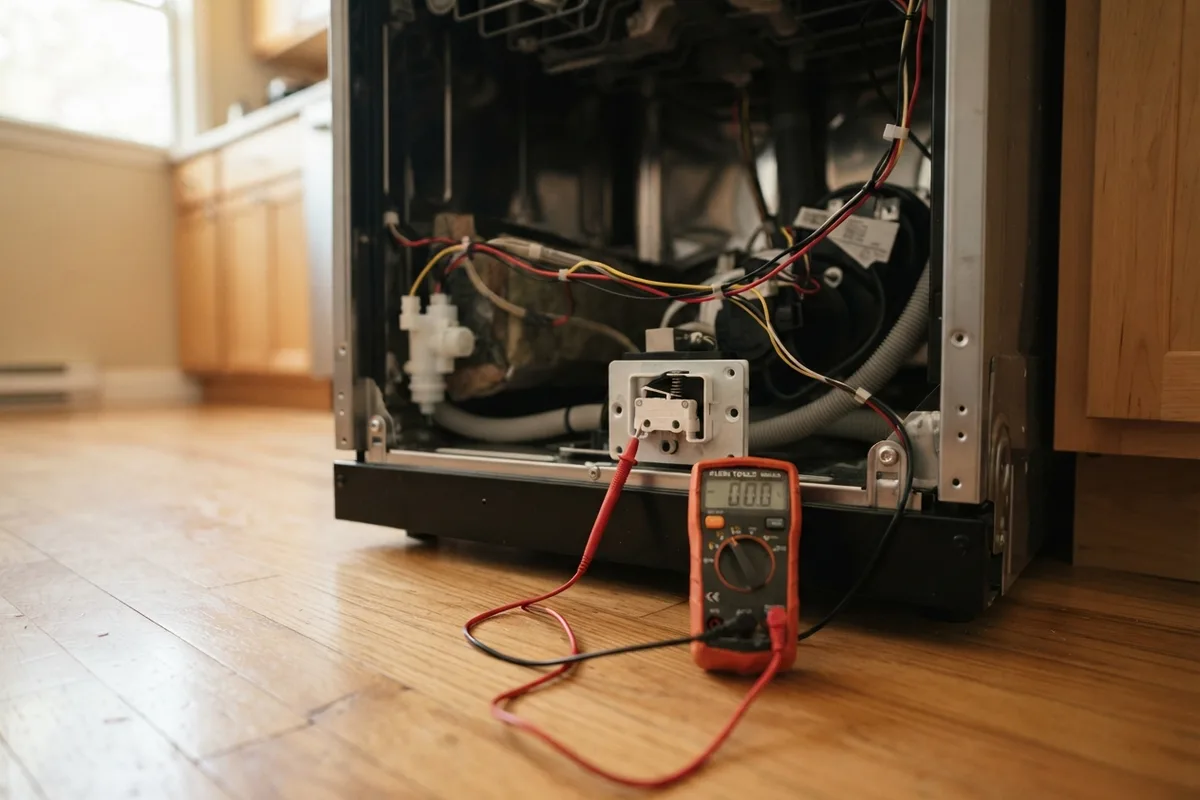
To test the microswitch using a basic digital multimeter:
- Confirm that power remains completely disconnected at the main breaker box.
- Remove the lower front access panel and locate the microswitch directly beneath the float cylinder.
- Label and disconnect the two wire slip connectors attached to the switch terminals using needle-nose pliers.
- Set your digital multimeter to the lowest Ohms (resistance) or continuity setting.
- Touch the multimeter probes to the two switch terminals. When the float is in the down position, the meter should read close to zero ohms (continuity).
- Manually lift the float stem to simulate a full tub. The meter reading should switch to open (infinite resistance/OL). If the switch fails to change states or shows no continuity when down, unscrew the switch bracket and replace the component.
| Issue Observed | Most Common Cause | Recommended DIY Solution |
|---|---|---|
| Float stuck in UP position | Food waste or grease wedged under dome | Lift dome and wipe base with warm water and brush |
| Float moves slowly / sticks mid-way | Hard water limescale on vertical guide stem | Soak with 50/50 white vinegar solution and scrub |
| Float visibly tilted to one side | Bent actuator rod or popped alignment track | Re-seat stem into lower microswitch cradle |
| Float moves freely but tub won't fill | Defective microswitch or wiring disconnect | Test with multimeter; replace microswitch if open |
| Control board unresponsive after fix | Stored electronic error state | Perform full appliance reset via circuit breaker |
After resolving the mechanical issue, your appliance may require a clean start to clear old fault codes. Review our guide on how to reset home appliances to restore standard control panel operation.
When to Call a Pro
Most stuck float switch problems can be resolved in under thirty minutes with basic household tools and thorough cleaning. However, if you have verified that the float assembly and microswitch are functional, yet the dishwasher continues to display water inlet errors, the underlying failure may involve the main electronic control board, internal wiring harnesses, or the water inlet solenoid valve.
Working behind electrical panels or tracing hidden wiring faults requires specialized diagnostic tools. If replacement parts do not resolve the issue, or if you notice scorch marks near the lower electrical harness, stop and contact a professional technician. True Appliance Repair can match you with an independent local appliance pro to diagnose and repair complex dishwasher issues safely and quickly. Typical professional repairs for dishwasher float switch and sensor assemblies range from $120 to $260 across the US, depending on your region and machine model.
FAQ
Where is the dishwasher float switch located?
On most standard residential dishwashers, the float switch is located in the bottom front corner inside the main wash tub. It appears as a small plastic dome, cylinder, or mushroom-shaped cap that sits on the floor of the machine. The electrical microswitch it controls is mounted directly underneath the tub behind the lower front kickplate panel.
Can I run my dishwasher if the float switch is stuck?
Running a dishwasher with a stuck float switch is not recommended. If the float is stuck in the raised position, the machine will not allow water to fill, running the circulation pump dry and potentially damaging the pump motor. If the switch is stuck in the lower position, the machine may overfill and cause water damage to your kitchen floor and cabinetry.
How high should my dishwasher float switch move?
The plastic float dome should have approximately 1/4 inch to 1/2 inch of vertical travel. When you lift it by hand, you should feel minimal friction, and releasing it should cause the float to drop instantly onto the tub floor with an audible click from the microswitch below.
Why does my float switch get stuck repeatedly?
Frequent float sticking is almost always caused by hard water buildup or heavy grease accumulation from washing heavily soiled dishes without scraping them first. Running a monthly cleaning cycle with a dishwasher-safe descaling agent and regularly wiping the base around the float will prevent repetitive jamming.