
Opening your dishwasher to find the upper rack dipping awkwardly to one side is frustrating. When your top basket sags or hangs unevenly, it drags against glassware on the bottom shelf, prevents the door from latching, and stops spray arms from spinning freely. In most kitchens, this issue stems from worn hardware, slipped height adjusters, or displaced rail guides rather than an expensive mechanical breakdown.
Before taking anything apart, safety comes first: pull out the rack completely only after unloading all delicate dishware, and disconnect power to the appliance at the circuit breaker if you need to reach near internal wiring or heating elements. Here is how to diagnose why your dishwasher upper rack is slanted and correct the problem with simple tools.
Check and Balance the Height Adjuster Tabs
Many modern dishwashers feature adjustable upper racks that allow homeowners to raise or lower the basket to accommodate tall stockpots below or oversized wine glasses above. These mechanisms typically use spring-loaded thumb levers on both outer sides of the basket.
- Clear all cups and plates out of the top basket so you can handle the rack without extra weight.
- Locate the plastic adjustment levers on the left and right exterior frame of the upper rack.
- Press the release tab on the lower side and lift upward until it clicks into the higher notch.
- Alternatively, press the tab on the higher side while supporting the basket underneath to lower it into the matching bottom notch.
- Confirm both levers sit in the identical slot position, then slide the rack in and out to ensure smooth, level travel.
Often, someone inadvertently bumps one lever while loading a heavy bowl, dropping only that side of the rack down a notch. Balancing both positions instantly corrects a slanted upper rack.
Inspect the Plastic Adjuster Housings for Cracks
If the adjustment levers are positioned identically but the basket still droops, inspect the plastic adjuster assembly mounted to the wire rack. Major appliance brands often use plastic adjuster bodies and actuator arms that become brittle after years of hot wash cycles and detergent exposure.
- Pull the rack out until it reaches the front stops.
- Examine the plastic housing that clamps around the wire rack tines on the sagging side.
- Check for hairline cracks, sheared plastic clips, or broken crossbars that anchor the basket to the slide bracket.
- Wiggle the rack gently by hand; if the plastic bracket flexes or separates from the wire frame, the housing has failed.
- Replacement adjuster kits are widely available, typically costing between $20 and $50 for aftermarket or factory parts depending on the brand.
Upgraded replacement kits frequently feature reinforced plastic or metal components designed to withstand repeat loading better than original factory clips.
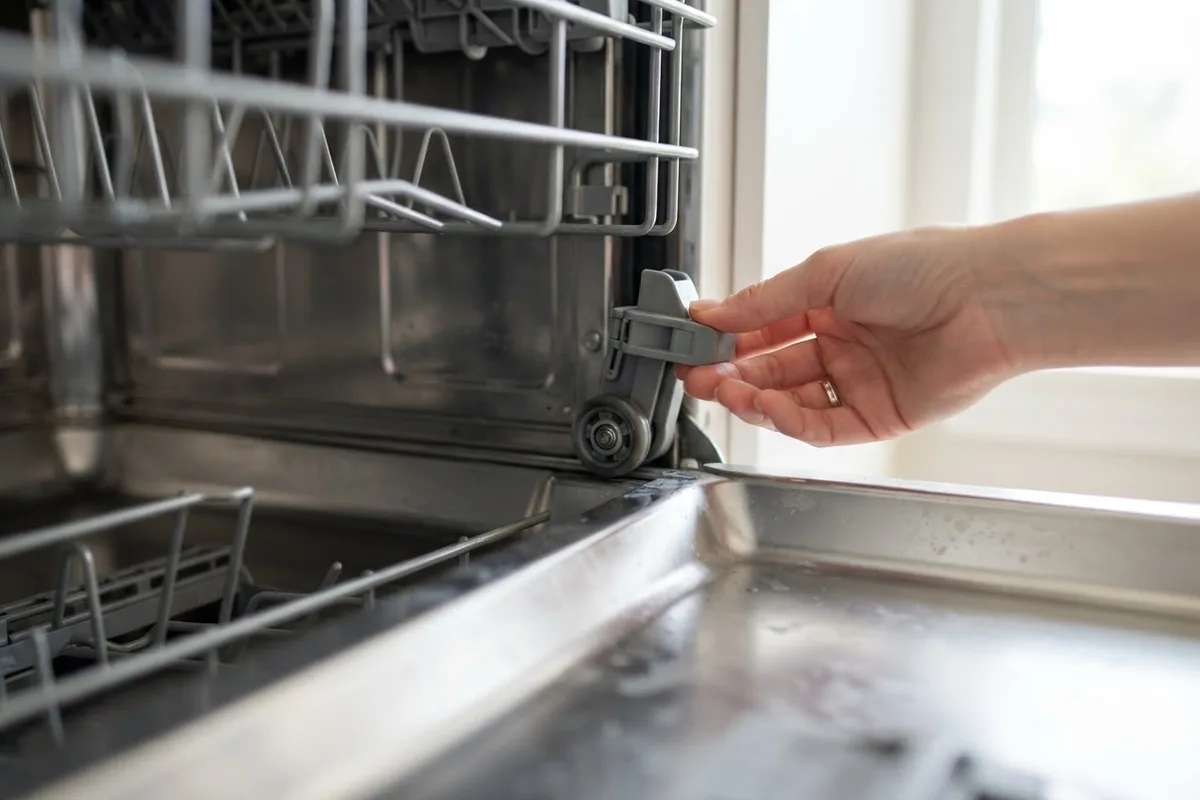
Reseat Derailed or Worn Track Roller Wheels
The upper rack relies on small plastic wheels that roll inside metal side-channel tracks attached to the cabinet walls. If a single wheel slips out of its track or snaps off its axle, the entire rack tilts toward that side.
- Slide the rack completely forward and look down the left and right metal guide tracks.
- Count the wheels on both sides (most models use two to four wheels per side) and verify each wheel is properly tucked inside the track channel.
- If a wheel popped out of the track groove, lift the front of the rack slightly and guide the wheel back between the upper and lower lips of the rail.
- Check the wheel plastic for flat spots, cracks, or loose axle pins that cause wobbling.
- If a wheel is cracked or missing, unclip the front track stop, slide the rack off, and snap in a new replacement roller assembly.
Routine vibration can push plastic wheels out of place over time, particularly if heavy ceramic mugs are concentrated on one edge of the basket.
Straighten Bent Slide Rails or Tighten Wall Brackets
The metal slide rails that support the upper rack mount directly to the inner stainless steel or plastic tub walls. If a mounting bracket loosens or the metal rail bends under excess weight, the basket will list noticeably to one side.
- Remove the rack completely by unclipping the front plastic end caps on each rail and sliding the basket off.
- Extend both metal rails outward and visually sight down their length to check for bends, twists, or warping.
- Grip the rear mounting brackets where the rails attach to the tub wall and check for wobble.
- Use a screwdriver or nut driver to snug any loose mounting screws securing the rail supports to the dishwasher tub, taking care not to strip plastic tub threads.
- If a steel slide rail has twisted noticeably from someone leaning down on an open rack, gently straighten it with pliers or replace the rail assembly.
Securing loose wall hardware ensures both rails travel parallel to each other, maintaining a level foundation for the rack.
Align the Water Delivery Tube Connection
Many dishwashers feature a middle spray arm mounted directly beneath the upper rack. This spray arm receives water through a docking manifold or delivery tube at the rear of the rack that pushes into a rubber grommet on the back wall of the appliance tub.
- Shine a flashlight toward the back wall of the dishwasher interior.
- Inspect the water feed dock mounted on the rear wall; verify the rubber seal is seated firmly and not dislodged.
- Check the plastic conduit running under the upper rack to confirm it is snapped tightly into its metal support brackets.
- If the feed conduit has popped free from the underside of the rack, it hangs down and forces the rear of the rack to lift or twist sideways.
- Snap the conduit back into its retaining clips and push the rack all the way back to verify the docking nozzle inserts smoothly into the wall port.
When this rear dock is misaligned, pushing the rack back forces the basket against a rigid obstruction, cocking the front edge at an angle.
| Issue | Primary Cause | Typical Fix Difficulty | Parts Needed |
|---|---|---|---|
| One side dropped | Height adjuster mismatch | Very Easy (1 min) | None |
| Sagging corner | Broken plastic rack adjuster | Moderate (15 mins) | Rack adjuster kit |
| Tilting & jamming | Roller wheel off track | Easy (5 mins) | Track roller or end cap |
| Whole rail drooping | Loose rail bracket screw | Easy (10 mins) | Screwdriver / nut driver |
| Rack won't seat | Dislodged rear water dock | Easy (5 mins) | Retaining clip or seal |
How to Prevent Upper Rack Slanting in the Future
Preventing future rack misalignment is simple once you address everyday loading habits. First, distribute heavy items evenly across both sides of the rack rather than loading heavy glassware or stoneware bowls entirely along one wall. Second, never use the extended upper rack as a hand rest while bending down to reach the lower basket, as downward pressure easily bends slide rails and snaps adjuster clips.
If you have noticed unusual sounds coming from your appliance alongside rack problems, review our appliance noise guide to catch underlying mechanical wear early. You can also explore our guide on why your dishwasher water pressure might be low if water distribution seems uneven.
When to Call a Pro
Most slanted upper rack issues can be resolved with inexpensive replacement clips or quick realignment. However, if your dishwasher tub wall has cracked around the rail mounting anchor, if the inner tub frame is bowed, or if structural damage prevents the door from forming a watertight seal, professional help is recommended. Typical dishwasher repairs for structural or internal component issues range between $150 and $350 depending on your appliance model and local labor rates.
If you prefer to have a specialist inspect the machine or handle stubborn mechanical repairs, True Appliance Repair can match you with a local appliance pro to get your kitchen back on track quickly.
FAQ
Can a slanted dishwasher rack cause dishes not to clean properly?
Yes. When the upper rack tilts, the middle spray arm underneath it cannot rotate freely and may strike plates below or the sides of the tub. In addition, the rear water delivery nozzle may fail to seal against the back wall port, reducing water pressure to the upper wash arm and leaving top-rack items dirty.
Can I use zip ties to fix a broken dishwasher rack adjuster?
While heavy-duty plastic zip ties can serve as a temporary emergency hold for a few days, they degrade quickly under high water temperatures and detergent chemicals. Installing an authentic replacement adjuster kit is safer and prevents sudden basket collapse that could shatter fragile glassware.
How do I know which replacement adjuster kit fits my dishwasher?
Locate the model number sticker along the inner door edge or tub rim of your dishwasher. Use that exact model number when ordering replacement parts online or from an appliance parts supplier, as rack dimensions and clip configurations vary widely across manufacturers.
Why does my dishwasher door hit the upper rack when closing?
A slanted rack sits slightly farther forward than intended, preventing the inner door panel from clearing the rack edge. Re-leveling the rack adjusters and ensuring the rear water conduit docks fully into the back wall will allow the door to latch cleanly without force.