
When your convection oven fan stops spinning, your roast takes longer, cookies brown unevenly, and multi-rack holiday baking turns into a guessing game. Before assuming the fan motor has burned out, know that several common culprits are simple settings, door switches, or food buildup you can check yourself. Work through these six practical checks in order to find out why your convection oven fan is not working and get air circulating evenly again.
Safety First: Before inspecting or touching the convection fan blade, baffle cover, or any internal components, always unplug the oven or switch off its circuit breaker at your main electrical panel. If you have a gas range, shut off the gas supply valve before pulling the unit away from the wall. Never touch internal wiring with power connected.
1. Check the Bake Mode and Preheat Delay
Before reaching for a screwdriver, verify how your specific oven model runs its convection fan. Many modern ranges are programmed to keep the convection fan off during the initial preheat phase so the cavity heats up faster using the bake and broil elements alone. Other ovens pause the fan periodically during the cooking cycle to maintain steady heat.
- Check the control panel to confirm you selected Convection Bake or Convection Roast rather than standard Bake.
- Allow the oven to finish preheating completely—usually 10 to 15 minutes—and listen after the preheat chime sounds.
- Close the oven door firmly and wait 60 seconds, as most models delay fan startup right after the door shuts.
- Consult your owner's manual to see if your brand uses an intermittent fan cycle during normal operation.
If you are also running into stiff racks while arranging trays for multi-rack baking, check out our guide on why your oven rack is stuck and 6 easy DIY fixes.
2. Test the Oven Door Switch
Convection ovens use a safety door switch (or plunger) to immediately stop the fan when you open the door, preventing a blast of hot air from hitting your face. If grease, baked-on spills, or a bent hinge keeps the plunger from pressing all the way in when the door closes, the control board thinks the door is still open and refuses to spin the fan.
- Open the oven door and locate the small pin or plunger switch along the front frame, usually near the top corner.
- Inspect the plunger for sticky grease buildup. Wipe it clean with a damp cloth and a drop of mild dish soap, then dry it.
- With the oven set to Convection Bake (and cool), gently press and hold the door switch in with a wooden spoon handle. If the fan starts spinning and the oven light turns off, the switch works, meaning the door hinge or gasket is keeping the door from pressing it fully.
- If pressing the plunger does nothing and the oven light stays on with the door shut, the door switch itself is likely faulty and needs replacement.
3. Clear Grease or Debris Blocking the Blade
Over time, roasting splatters and foil fragments can work their way behind the circular fan cover (baffle) at the back of the oven cavity. Heavy, polymerized grease or a stray piece of aluminum foil can physically jam the fan blade so it cannot spin even when the motor receives power.
- Turn off the oven breaker at your home electrical panel and confirm the oven is completely cool and has no power.
- Remove the oven racks to give yourself clear access to the back wall.
- Unscrew the 2 to 4 mounting screws holding the metal fan cover over the convection blade and set the cover aside.
- Gently try to spin the metal fan blade by hand. It should turn smoothly with almost no resistance.
- If you see foil scraps, food debris, or thick grease around the center shaft, clean the blade and surrounding area with warm soapy water or a baking-soda paste. Never spray liquid cleaner directly into the motor shaft hole.
- Reinstall the fan cover once the blade spins freely by hand.
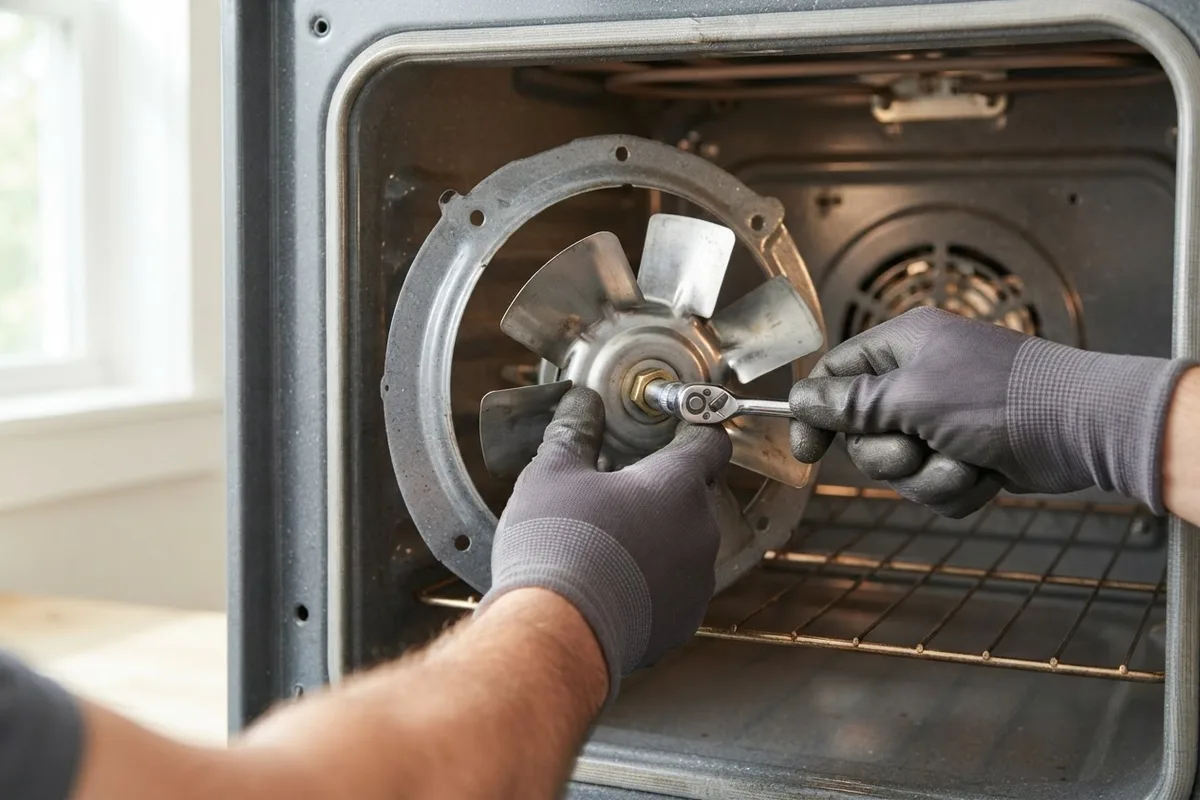
4. Inspect the Fan Blade Nut for Looseness
Sometimes you can hear a faint humming or whirring sound from the back of the oven, yet the air inside feels still and food bakes unevenly. That usually means the motor shaft is spinning, but the nut holding the fan blade onto the shaft has loosened, allowing the shaft to spin inside a stationary blade.
- With the circuit breaker still switched OFF and the fan cover removed, hold the center motor shaft steady and wiggle the fan blade gently.
- If the blade wobbles or spins independently of the center shaft, check the hex nut in the center of the blade.
- Tighten the nut carefully with a socket or nut driver. Important: Most convection oven fan nuts use reverse (left-hand) threads so normal rotation keeps them tight—turn counterclockwise to tighten if your model uses reverse threading.
- Spin the blade by hand to verify that the blade and center shaft now turn together without scraping the back wall.
If a stiff burner dial on the front panel is giving you trouble at the same time, see our steps on how to fix a stuck stove knob.
5. Reset the Oven Control Board
A brief power flicker or voltage spike can cause the electronic control board to glitch, leaving the convection fan relay unresponsive even though the bake element still heats normally. Performing a hard reset clears temporary memory errors at zero cost.
- Turn the oven off at the control panel.
- Flip the dedicated oven circuit breaker to the OFF position at your electrical box (or unplug the range).
- Wait a full 5 minutes so the capacitors on the electronic control board discharge completely.
- Flip the breaker back ON, reset the clock, and start a Convection Bake cycle at 350°F to see if the fan engages.
6. Spot Signs of a Worn Convection Fan Motor
If the blade spins freely by hand, the door switch works, and a reset does not help, the convection fan motor itself may have failed. Because the motor sits right behind the hot oven wall, its bearings and internal windings wear down over years of high-heat roasting and self-clean cycles.
- Listen closely before the fan stopped working: did it make a loud squealing, grinding, or rattling noise over recent weeks? Worn motor bearings almost always make noise before seizing completely.
- With the power OFF and the fan cover off, try turning the blade by hand again. If the center shaft feels gritty, stiff, or locked solid even with no debris present, the motor bearings have seized.
- Replacing a convection fan motor typically requires pulling the range out from the wall, disconnecting power (and gas, if applicable), and removing the rear access panel. Typical US replacement part and labor costs range from $180 to $375, though exact pricing varies by area and oven model.
Quick Troubleshooting Reference
| Symptom | Most Likely Cause | DIY Action |
|---|---|---|
| Fan stays off for first 5–10 minutes | Normal preheat programming | Wait until preheat chime finishes |
| Oven light stays on with door closed | Stuck or faulty door switch | Clean plunger or test with wooden spoon |
| Blade won't turn by hand (power off) | Baked-on grease, foil, or seized motor | Clean behind fan cover; check shaft feel |
| Motor hums at back wall, no airflow | Loose fan blade nut on shaft | Tighten center nut (check for reverse thread) |
| Fan stopped after a storm or flicker | Control board relay glitch | Flip circuit breaker off for 5 minutes |
| Loud squealing before fan died | Worn convection fan motor bearings | Replace fan motor assembly |
When to Call a Pro
Cleaning a sticky door switch, removing a piece of foil from behind the fan baffle, or tightening a loose blade nut are straightforward weekend fixes when you shut off the breaker first. However, if the fan motor windings have burned out, the wiring harness behind the rear panel looks scorched, or the main electronic control board is not sending voltage to the motor, it is time to bring in an experienced technician.
Pulling a heavy range out—especially a gas range connected to a rigid or flex gas line or a built-in wall oven—carries real safety risks if done without the right tools. If your troubleshooting points to a bad motor, door switch wiring, or control board relay, True Appliance Repair can connect you with a local oven and stove repair pro to diagnose the electrical circuit safely and get your oven ready for your next big meal.
FAQ
Can I still use my oven if the convection fan is not working?
Yes, in most ovens you can safely use standard Bake or Broil modes even when the convection fan is out of service, provided the fan is not making a grinding noise or smelling like smoke. Keep in mind that true European convection ovens (which use a third heating element right behind the fan) may not heat evenly on convection settings without airflow, so stick to traditional Bake until the fan is fixed.
Why does my convection fan turn on and off while baking?
On many ranges, cycling on and off is completely normal. Manufacturers program the fan to pause when the heating elements cycle or during preheating so the oven maintains an accurate temperature without drying out baked goods.
Does running the self-clean cycle damage the convection fan?
The extreme heat of a self-clean cycle (often 800°F to 900°F) puts heavy thermal stress on the convection fan motor bearings and electronic control board. To protect your fan motor, many technicians recommend wiping out spills by hand with a baking-soda paste rather than running high-heat self-clean cycles right before major holidays.
How much does it cost to replace a convection oven fan motor?
In the US, having a professional replace a convection oven fan motor typically costs between $180 and $375 total, including the part and labor, though prices vary by region and whether you have a freestanding range or a built-in wall oven.