
Nothing stalls dinner faster than reaching to light a burner just to find the dial will not budge. Whether you are prepping weeknight pasta or getting your kitchen ready for heavy holiday baking, a jammed range dial is a frustrating roadblock. Before forcing the handle and snapping the internal stem, use these six straightforward DIY fixes to get your stove turning smoothly again.
1. Check the Push-to-Turn Child Lock Mechanism
Sometimes a stove knob is not broken at all—it is just caught on its built-in safety lock. Both gas and electric ranges use spring-loaded collars or control lock settings that can jam if pushed at an awkward angle.
- Stop forcing the rotation: Twisting a locked dial with pliers will strip the plastic insert or snap the metal valve stem inside the console.
- Press straight inward: Place your palm flat against the face of the knob and push straight toward the control panel. If it moves inward a fraction of an inch, hold it in while turning counterclockwise.
- Pinch the safety collar: Some freestanding ranges have a small plastic ring behind the dial. Pinch the two tabs on this ring while pushing the knob in.
- Check for a digital lock: If the knob turns freely without activating the burner, check your control panel for a padlock icon. Press and hold the "Control Lock" button for three seconds to wake the cooktop.
2. Dissolve Splattered Grease Under the Knob
Every time you sear meat or simmer sauce, microscopic grease droplets float toward the control panel. Over months, that oil seeps behind the dials and cools into a sticky, glue-like resin. If your splatters have migrated to the grates as well, you may also want to check out why your stove burner is smoking once the knob is free.
- Cut the power first: Turn all burners to the "Off" position. Unplug the range from the wall or flip the circuit breaker in your electrical panel. For gas ranges, ensure the kitchen is well-ventilated.
- Warm the thickened grease: Dip a microfiber cloth into very warm, soapy water, wring it out so it is damp rather than dripping, and wrap it around the base of the stuck knob for five minutes.
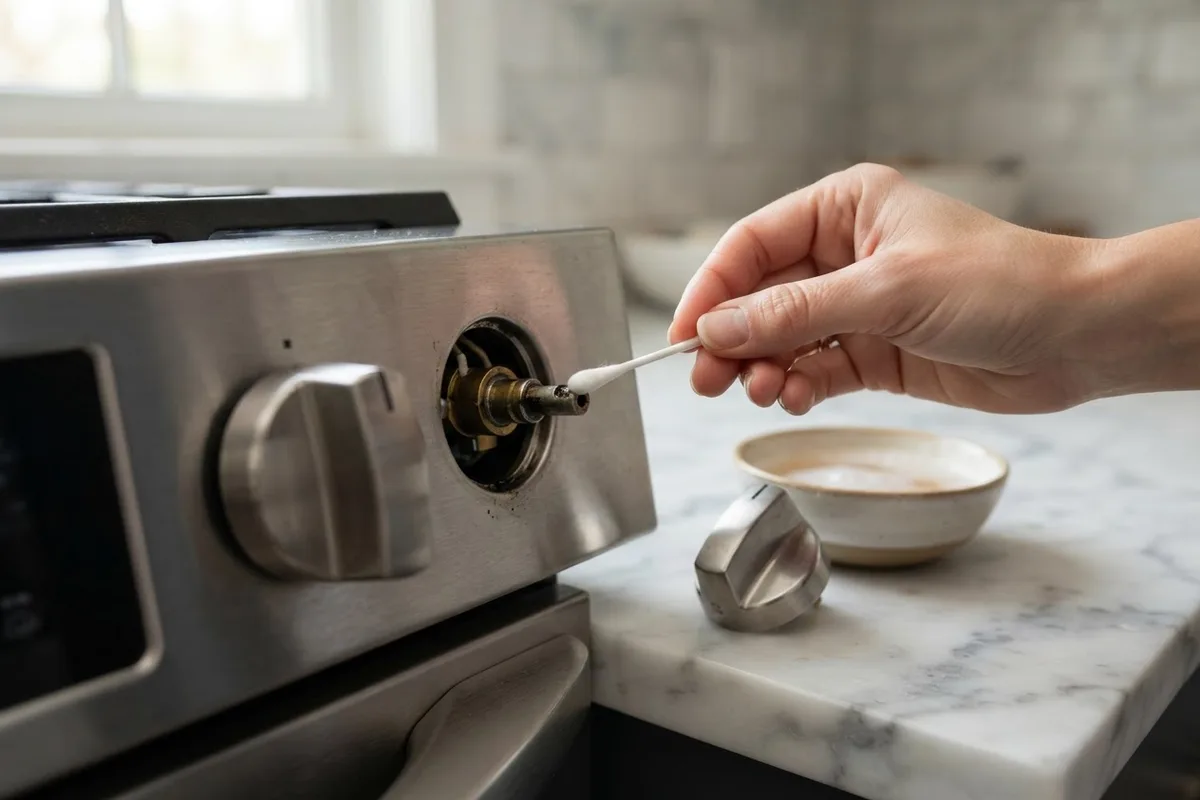
- Apply dish soap lubricant: Mix a few drops of degreasing dish soap with warm water. Use a cotton swab to dab a tiny amount into the gap between the knob and the bezel.
- Wiggle gently: Rock the knob slightly back and forth until the warm water softens the grease enough to pull the knob straight off its shaft.
3. Remove the Dial Using the Towel Trick
When a knob is wedged onto the metal D-shaft by dried food spills, your bare fingers might slip off the smooth plastic or stainless steel before you get enough leverage. A simple dish towel gives you even, damage-free pulling power.
- Confirm power is off: Make sure the appliance is unplugged or the breaker is switched off so you do not accidentally turn on an element or igniter when the knob gives way.
- Slide a thin towel behind the knob: Take a strong, thin flour-sack towel or microfiber cloth and slip the middle edge underneath the gap behind the dial.
- Wrap the fabric around the entire base: Bring both ends of the towel around the sides of the knob until the entire circumference is cradled in fabric.
- Pull straight back: Grip the bunched towel close to the control panel and pull straight toward your chest with steady, even pressure. Avoid yanking upward or downward, which can bend the metal stem.
- Wash the removed knob: Soak the freed knob in warm, soapy water for 15 minutes and scrub the hollow stem on the back with an old toothbrush.
4. Degrease the Exposed Valve Stem and Bezel
Pulling the knob off solves only half the problem. If the metal shaft (often shaped like a capital "D") and the decorative bezel around it are caked in baked-on oil, the dial will stick again the next day.
- Keep the stove unplugged: You will be working right next to electrical switches and gas valves, so never spray liquids directly onto the control panel.
- Scrape away hardened gunk: Use a wooden toothpick or a plastic card to gently scrape dried food debris out of the crease where the stem meets the panel.
- Swab with rubbing alcohol: Dip a cotton swab in 70% isopropyl alcohol or white vinegar. Rub the flat and curved sides of the metal shaft until the metal feels completely smooth and dry.
- Clean the spring and grommet: If a small metal spring or rubber seal sits around the shaft, wipe it clean with a damp cloth and make sure it sits flat against the panel.
- Dry thoroughly: Let the alcohol evaporate for five minutes before sliding the clean knob back into place.
5. Replace a Cracked Knob Insert or D-Ring
Look closely at the hollow tube on the back of your stove knob. Most manufacturers press a small D-shaped metal sleeve inside the plastic stem. When that sleeve falls out or the plastic cracks, the knob wedges crookedly onto the shaft and jams.
- Inspect the back of the dial: Flip the knob over under a bright light and look for hairline cracks in the plastic tube or a missing metal D-ring insert.
- Compare with a working knob: Pull off an adjacent burner knob that turns smoothly and compare the two stems side by side.
- Test-fit the good knob: Slide the working knob onto the problem burner shaft. If the good knob pushes in and turns effortlessly, the range switch is fine and you only need a replacement knob.
- Order an exact match: Locate your range model number (usually printed on a sticker inside the oven door frame or storage drawer) and order an OEM replacement knob, which typically costs $10 to $45 depending on the brand and finish.
6. Troubleshoot a Seized Gas Valve or Infinite Switch
If you remove the knob and try to turn the bare metal stem with your fingers (after pushing it in), and the shaft still refuses to budge, the failure is inside the control panel.
- Distinguish between gas and electric: On an electric stove, the shaft connects to an electrical "infinite switch." On a gas stove, it connects directly to a brass gas surface valve.
- Check for a bent stem: If a heavy pot was dropped against the front of the stove, the metal shaft may be bent against the control panel hole. Do not try to bend a gas valve stem back with pliers, as the brittle brass can snap and cause a leak.
- Stop if you smell gas: If the stuck knob is on a gas range and you notice any rotten-egg odor or hissing sound, stop immediately and review these safe checks for a gas oven smelling like gas.
- Leave internal valves to a technician: Internally seized gas valves have dried-out factory grease or warped internal cones that require taking apart the gas manifold—a job that requires specialized leak-testing tools.
Quick-Reference Guide: Stove Knob Symptoms & Costs
Note: Typical US part and repair ranges below vary by region, appliance brand, and model.
| Symptom | Most Likely Cause | DIY or Pro? | Typical Cost Range |
|---|---|---|---|
| Knob will not pull off the panel | Hardened cooking grease under bezel | DIY | $0 (Dish soap & towel) |
| Knob turns crookedly and binds | Cracked plastic stem or missing D-ring | DIY | $10 – $45 (New knob) |
| Bare shaft will not turn on electric stove | Seized infinite burner switch | Pro / Advanced DIY | $120 – $250 (Installed) |
| Bare shaft will not push in on gas stove | Seized internal brass gas valve | Pro Only | $150 – $350 (Installed) |
When to Call a Pro
Cleaning sticky grease off a control panel and swapping out cracked plastic dials are safe, satisfying weekend tasks. However, if the knob is completely removed and the bare metal shaft still will not depress or rotate, the internal switch or valve has seized.
Never spray household lubricants like WD-40 into a gas valve or electrical infinite switch—standard aerosol lubricants are flammable and can short out high-voltage contacts or degrade rubber gas seals. If you are dealing with a frozen gas valve, a bent manifold stem, or a shorted electrical switch, professional oven and stove repair is the safest path forward. True Appliance Repair can match you with a local appliance pro who can replace the faulty valve or switch and get your cooktop ready for the holidays.
FAQ
Can I spray WD-40 on a stuck stove knob?
No, you should never spray WD-40 or standard household oils behind a stove knob. Standard penetrating oils are flammable, attract more dust and grease over time, and can damage electrical switches or rubber seals inside gas valves. Use warm, soapy water or rubbing alcohol on a cotton swab to dissolve kitchen grease safely.
Why does my stove knob spin all the way around without turning on the burner?
When a knob spins 360 degrees freely without resistance, the hollow plastic stem on the back of the knob has cracked or lost its metal D-shaped insert. Pull the knob straight off and inspect the back; replacing the knob will restore a tight grip on the metal shaft.
What if my stove knob is stuck in the "On" position?
If a burner is actively lit or heating and the knob will not turn off, do not panic. For an electric stove, walk to your home's circuit breaker box and flip the double breaker labeled "Range" or "Stove" to cut the power immediately. For a gas stove, turn the manual gas shutoff valve behind the range (or at the main line) to the closed position, let the burner cool, and call a repair technician.
Are replacement stove knobs universal?
Universal stove knob kits with plastic adapters exist at hardware stores, but they often fit loosely and wear out quickly. Because D-shaft lengths and orientations vary widely by manufacturer, ordering the exact replacement knob using your range's model number will give you the safest, longest-lasting fit.