
Catching a whiff of sulfur or rotten eggs in your kitchen right as you gear up for fall and holiday baking is enough to stop any homeowner in their tracks. While a brief, faint odor during the first minute of preheating can be normal, a lingering or strong gas smell around your range requires immediate caution. Use this safety-first guide to tell a harmless ignition delay from an active leak and run five safe checks on your gas oven.
1. Know When to Evacuate Immediately
Before touching a single dial or troubleshooting anything, evaluate the strength of the odor. Natural gas and propane are mixed with mercaptan, a chemical that smells like rotten eggs, specifically to warn you of leaks. If the smell is strong, present when the oven has been off for hours, or accompanied by a hissing sound behind the range, treat it as an emergency.
- Do not turn on or off any light switches, kitchen exhaust fans, or appliances, as a tiny electrical spark can ignite pooled gas.
- Do not strike matches, light candles, or use your phone inside the house.
- Leave the house immediately with all family members and pets, leaving doors open behind you if you can do so without delay.
- Once you are safely down the street, call your local gas utility company or 911 to have the lines inspected.
2. Tell a Normal Preheat Whiff From a Leak
If the odor only appears right after you press "Bake" and fades within a minute, you are likely smelling a small amount of unburned gas released just before ignition. Modern gas ovens use an electric glow bar igniter that heats up, draws electrical current to open the safety gas valve, and lights the gas.
- Stand back and time how long the smell lasts after starting a 350°F preheat cycle.
- Note whether the smell disappears completely within 30 to 60 seconds after you hear the soft "whoosh" of the burner lighting.
- If the scent lingers past two minutes, fills the whole room, or returns every time the oven cycles back on to maintain temperature, turn the oven off immediately.
- Open a couple of kitchen windows to air out the space before moving on to visual checks.
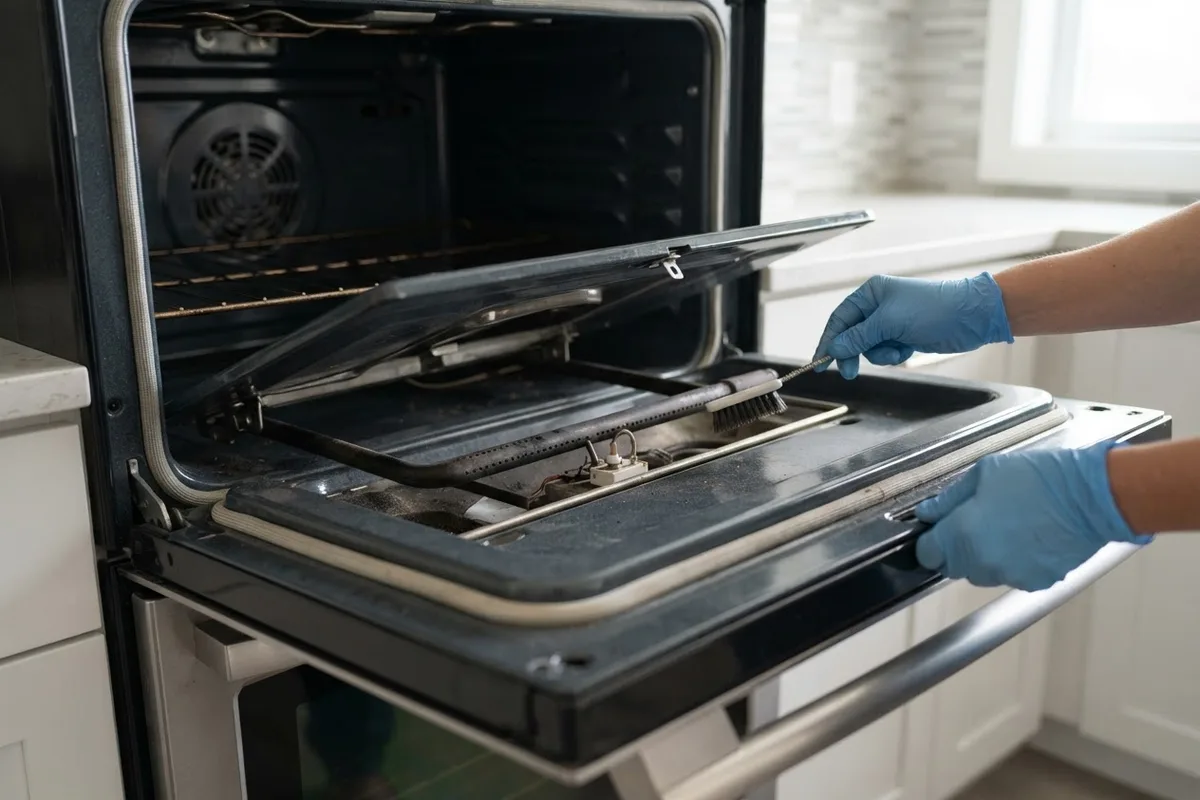
3. Check for a Weak or Delayed Oven Igniter
The most common culprit behind a gas oven smelling like gas during preheating is an aging bake igniter. As the igniter weakens over years of cooking, it takes too long to reach the temperature needed to light the gas promptly. Gas seeps into the oven cavity for several extra seconds before finally catching, creating a strong smell and sometimes a loud pop.
- With the oven cool, look through the bottom oven floor vents (or remove the bottom panel after unplugging the range) to locate the igniter next to the burner tube.
- Plug the range back in briefly, set the oven to Bake at 350°F, and watch the igniter glow through the oven window or vents.
- Time how long it takes from the moment the igniter starts glowing until the burner flame lights.
- If it takes more than 60 to 90 seconds to ignite, or glows dull orange instead of bright white-yellow, the igniter is worn out. Turn the oven off and unplug the power cord before scheduling a replacement. If you cannot see inside clearly, our guide on why your oven light is not working can help you restore visibility first.
4. Inspect Stovetop Knobs and Burner Ports
Sometimes the odor you blame on the oven is actually coming from the cooktop above it. A burner knob that was accidentally bumped by a hip, a child, or a pet while leaning against the counter can release a slow trickle of unlit gas into the kitchen.
- Check every surface burner knob on the front or top panel to confirm each one is clicked firmly into the "OFF" position.
- Remove the grates and burner caps once the stove is completely cool and unplugged.
- Scrub away baked-on grease, boil-overs, and food crumbs from the small gas ports around each burner head using warm soapy water and a soft toothbrush.
- Dry the parts thoroughly before reassembling, as wet or clogged burner ports can prevent half the burner from lighting while gas continues to flow.
5. Clear Blocked Oven Vents and Burners
Grease buildup and rust flakes on the main bake burner tube inside the oven can block half of the tiny flame ports. When those holes are clogged, gas flows out of the open ports faster than it can burn cleanly, leaving behind an unburned gas smell and uneven heat.
- Unplug the oven from the wall outlet and shut off the gas supply valve behind the range before doing any hands-on interior inspection.
- Remove the oven racks and lift out the removable bottom oven floor panel (usually held by two thumb screws or clips at the back).
- Inspect the metal burner tube for heavy grease, carbon buildup, or rusted-out holes along the sides.
- Gently brush away loose debris with a dry, stiff nylon brush, making sure never to bump or touch the fragile silicon carbide igniter nearby.
- Check the oven vent at the top rear of the range to ensure foil, baking sheets, or grease splatters are not trapping fumes inside. Note that an obstructed vent or damaged seal can also make the exterior overheat; see our guide on why your oven door is hot to the touch if you notice excess heat alongside odors.
Quick-Reference Guide: Gas Oven Odor Causes & Costs
| When You Smell Gas | Likely Cause | Immediate Action | Typical US Repair Cost (Varies by Area/Model) |
|---|---|---|---|
| First 30–60 seconds of preheat | Normal ignition cycle | None; ensure kitchen ventilation is working | $0 |
| 1–3 minutes into preheat, often with a "pop" | Weakening bake igniter | Turn off oven; replace igniter before further use | $150 – $300 |
| Faint smell near cooktop when oven is off | Bumped knob or dirty burner ports | Turn knob fully off; clean and dry burner caps | $0 (DIY cleaning) |
| Continuous smell during baking cycles | Clogged burner tube or faulty safety valve | Shut off oven and gas supply; call a technician | $200 – $400 |
| Strong smell when range is completely off | Leaking gas line, regulator, or internal valve | Evacuate home immediately; call gas utility or 911 | $150 – $450+ (after utility clears emergency) |
6. Test Exposed Connectors With Soapy Water
If you only notice a very faint gas odor directly behind the stove after moving it to clean the floor, the flexible metal gas connector could have a tiny pinhole leak or a loose fitting. Only perform this check if the smell is barely noticeable right at the back wall; if the kitchen smells strongly, evacuate instead.
- Unplug the electrical cord so no spark can occur while you are checking behind the unit.
- Mix a solution of half liquid dish soap and half water in a small cup or spray bottle.
- Brush or spray the soapy water generously over the shut-off valve and the threaded fittings at both ends of the flexible gas supply hose.
- Watch closely for 60 seconds: if expanding bubbles starts forming anywhere on the pipe or joints, you have an active leak.
- Turn the gas shut-off valve handle a quarter-turn so it sits perpendicular to the pipe (the "OFF" position), open a window, and call a professional to replace the connector line.
When to Call a Pro
Working with gas components leaves zero margin for error. While homeowners can safely verify knob positions, clean surface burner caps, and visually inspect the bake igniter glow, any repair involving the oven safety gas valve, pressure regulator, main burner manifold, or flexible gas line should be handled by an experienced technician. Never attempt to take apart a gas valve or patch a leaking gas hose yourself.
If your oven takes too long to ignite, smells like gas every time it heats up, or shows bubbling at a connection, shut off the gas valve and unplug the unit. True Appliance Repair can connect you with a local pro for dependable oven and stove repair so your kitchen is safe and ready before the holiday baking rush begins.
FAQ
Is it normal to smell a little gas when turning on a gas oven?
Yes, a faint smell of gas during the first 30 to 60 seconds of preheating is normal. A small amount of gas enters the burner tube just before the igniter gets hot enough to light it. However, the smell should burn off quickly once you hear the burner ignite; if it lingers for several minutes, turn the oven off.
Can a dirty oven cause a gas smell?
Baked-on food spills and grease on the oven floor create a smoky, acrid, or burnt odor rather than the rotten-egg smell of natural gas. However, if grease or carbon debris clogs the tiny flame holes along the metal bake burner tube, it can prevent the gas from burning completely, which will produce a true gas odor.
Why does my gas oven smell like gas when it is turned off?
A gas smell when the oven and stove are completely off points to an active leak—either from a stovetop knob that isn't clicked fully shut, a stuck internal oven safety valve, or a loose fitting on the gas supply line behind the range. Double-check that all knobs are off, and if the smell continues, ventilate the area, evacuate, and contact your gas utility.
How much does it cost to fix a gas oven that smells like gas?
Typical US repair costs range from $150 to $400 depending on the faulty part, your appliance model, and local labor rates. Replacing a weak bake igniter usually falls on the lower end of that range, while replacing an internal safety gas valve, pressure regulator, or corroded burner assembly costs more.