
Brushing past your range while dinner is baking shouldn't result in a burn. While the outside of any oven gets warm during a long roast, an oven door that becomes scorching hot to touch means high-temperature air is escaping where it shouldn't. Below, you will find five common reasons your oven door is overheating and the exact DIY steps to keep the heat locked inside.
Safety First: Before inspecting or working on your oven, turn it off, let it cool completely to room temperature, and unplug the power cord or flip the circuit breaker off. If you have a gas range, shut off the gas supply valve before moving the appliance. Stop immediately and call a professional for any gas line work, complex electrical panel testing, or internal control board repairs.
1. Replace a Worn or Torn Oven Door Gasket
The soft, braided fiberglass or silicone seal running around the perimeter of your oven opening—or directly around the inside of the door—is your primary heat barrier. Over years of baking, grease splatters and high heat cause this gasket to flatten, fray, or tear. When that happens, 400-degree air blasts straight onto the outer door frame and control panel.
Here is how to inspect and replace the gasket:
- Open the cool oven door and run your fingers along the entire length of the perimeter seal.
- Look for flattened spots, crusty baked-on food, missing chunks, or loose sections pulling away from the metal channel.
- Wipe away crusty food residue with a damp cloth and mild dish soap to see if the seal bounces back.
- If the gasket is brittle or torn, order an exact replacement part using your range's model number (usually found on a sticker inside the door frame or storage drawer).
- Pull out the old gasket—most are held in by small metal retaining clips or pressed into a groove—and press the new gasket pins firmly into each mounting hole without stretching the material.
2. Realign Sagging or Bent Oven Door Hinges
Even a brand-new gasket cannot seal properly if the oven door doesn't press firmly against the front frame. Setting heavy cast-iron Dutch ovens or holiday turkeys on the open door, or letting the door drop open instead of lowering it gently, eventually bends the spring-loaded hinges. A gap of just an eighth of an inch at the top of the door lets a steady plume of hot air rise over the handle.
Follow these steps to check and fix hinge alignment:
- Close the oven door and look at it from the side. The gap between the door and the range frame should be completely even from top to bottom.
- Hold a dollar bill at the top edge of the door, close the door on it, and tug gently. If the bill slides right out with zero resistance, the hinges are weak.
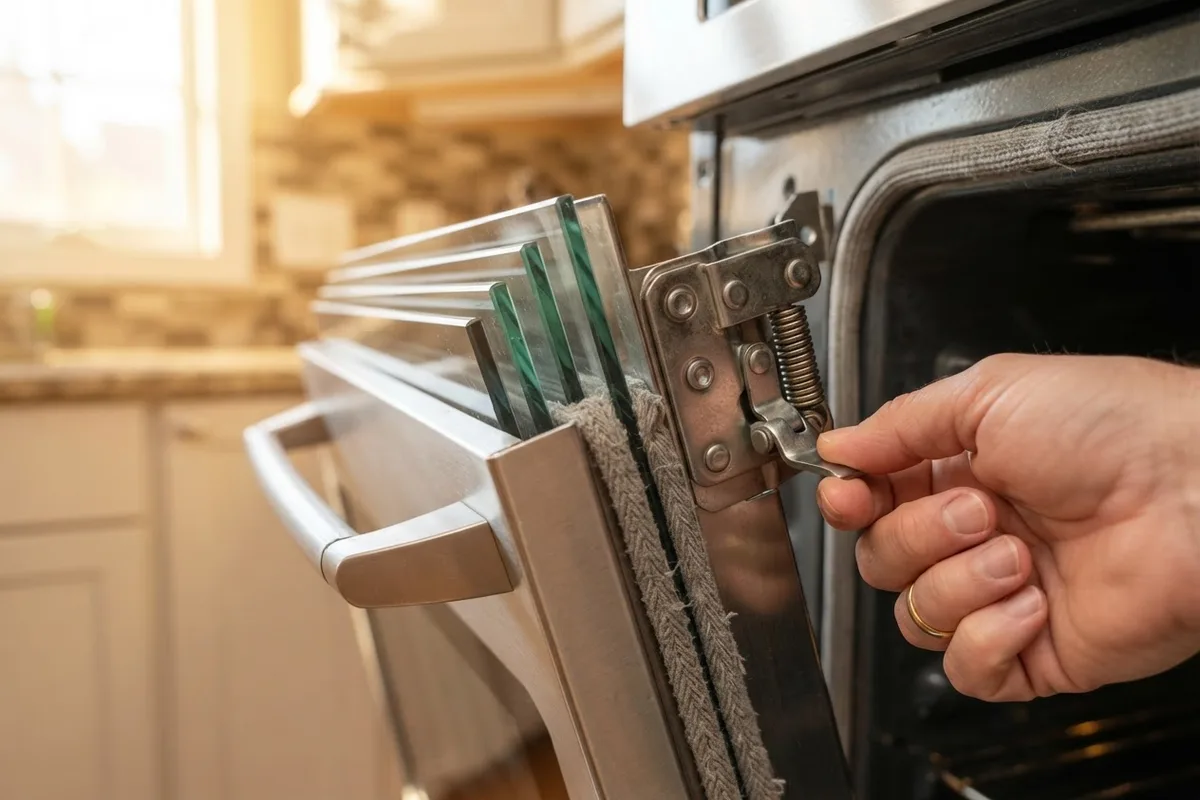
- Open the door fully and flip the two small locking tabs on the hinges forward toward you.
- Partially close the door until it stops against the locks, then lift the door up and out of the hinge slots to make sure it was seated properly.
- Reinstall the door, ensuring both hinge notches sit flat in the receiver slots. If the door still hangs crooked or loose, replace both hinges as a matched pair so the tension remains even.
3. Clear a Blocked Oven Cooling Vent
Modern ranges—especially wall ovens and slide-in ranges with electronic touchpads—use an internal air wash system and cooling vents to channel heat safely away from the outer door and electronics. Furthermore, the oven door itself has air intake slots along the very bottom edge and exhaust vents near the top handle. This design creates a natural upward draft of cool room air between the glass panes. If grease, dust, or foil blocks these vents, heat gets trapped inside the door cavity.
Here is how to restore proper airflow:
- Remove any aluminum foil from the oven racks or the bottom floor of the oven cavity; foil disrupts internal air circulation and forces excess heat toward the door.
- Inspect the vent louver located just below the control panel or at the back of the cooktop and scrub away grease buildup with warm, soapy water.
- Check the bottom edge of the oven door using a flashlight to find the narrow air intake slots.
- Use a crevice tool on your vacuum cleaner and a dry bottle brush to clear pet hair, dust bunnies, and crumbs out of the bottom door vents.
- While inspecting the interior, if you notice the cabin stays dark when you open the door, check our guide on why your oven light is not working to handle both maintenance tasks at once.
4. Check the Internal Door Glass and Heat Shield
An oven door isn't just a single sheet of glass and metal; it is an insulated sandwich containing two to four panes of tempered glass, metal baffles, and fiberglass insulation batts. The innermost glass pane is typically coated with a heat-reflective metallic oxide layer. If someone recently took the door apart to clean between the glass and put the inner panes back in backward—or if the insulation has slipped out of place—radiant heat will pass straight through to the outer glass.
Use this checklist to inspect the door assembly:
- Shine a flashlight through the front glass window and look for sagging fiberglass insulation or displaced metal baffles inside the door frame.
- Check the inner glass pane (closest to the food) for hairline cracks, chips, or missing rubber corner bumpers.
- If you recently disassembled the door for cleaning, remove the door, place it flat on a padded towel, and unscrew the top or bottom trim bracket.
- Verify that the heat-reflective glass pane is positioned in the innermost slot with the coated side facing the proper direction (check the stamped markings on the glass corner).
- Tuck any shifted fiberglass insulation back into the side channels—wearing gloves to protect your hands—before reassembling the door.
5. Test for a Runaway Thermostat or Temperature Sensor
Sometimes the door isn't the problem at all—the oven is simply running 100 degrees hotter than you set it. If the temperature sensor probe fails or a mechanical thermostat sticks closed, the bake element or gas burner runs continuously. When the inside of the oven reaches 500°F during a standard 350°F bake cycle, the outer door will feel dangerously hot.
Here is how to verify your oven's actual temperature:
- Hang an inexpensive standalone analog oven thermometer from the center of the middle rack.
- Preheat the oven to 350°F and let it run for 20 minutes after the preheat chime sounds so the temperature stabilizes.
- Look through the window (do not open the door) and read the thermometer. If it reads 375°F or lower, a simple calibration adjustment in your settings menu will fix it.
- If the thermometer spikes past 425°F or the heating element glows cherry-red without ever cycling off, turn the oven off immediately.
- Inspect the thin metal temperature sensor rod in the upper back corner of the oven cavity to make sure it isn't touching the metal wall. If you have a gas range and notice cooking issues on top as well, review these fixes for an uneven gas stove burner flame to see if your gas regulator pressure is running high.
Quick Reference: Oven Door Overheating Causes & Costs
| Symptom | Most Likely Cause | DIY Difficulty | Typical Part Cost (US Range)* |
|---|---|---|---|
| Hot air blowing out around door edges | Worn or torn door gasket | Easy | $25 – $65 |
| Door doesn't close flush at the top | Sprung or bent door hinges | Moderate | $60 – $140 (pair) |
| Entire door & control panel overheating | Blocked door air vents or cooling fan failure | Easy to Hard | $0 (cleaning) – $150 (fan) |
| Center glass window scorching hot | Shifted insulation or reversed inner glass | Moderate | $40 – $120 (glass/insulation) |
| Food burns fast & door is extremely hot | Faulty temperature sensor or stuck relay | Moderate to Hard | $20 – $200 |
Note: Part and repair prices are broad typical US ranges and vary by area, brand, and specific oven model.
When to Call a Pro
Replacing a clip-in gasket, vacuuming out bottom door vents, and checking oven temperature with a hanging thermometer are safe, straightforward weekend projects for most homeowners. However, you should step back and call a professional if:
- The internal cooling fan motor (which cools the electronics behind the control panel) has stopped running or makes a loud grinding sound.
- Your oven continues to overheat because of a stuck relay on the main electronic control board.
- An inner pane of oven glass has shattered, or taking the multi-layer door apart feels too heavy and awkward to manage safely on your own.
If you want the issue diagnosed and repaired before big family meals arrive, True Appliance Repair can match you with a local pro for dependable oven and stove repair in your neighborhood.
FAQ
How hot should the outside of an oven door get?
During normal baking at 350°F to 400°F, the outside of an oven door typically reaches between 110°F and 150°F, depending on the model and whether it has double or triple-pane glass. It will feel very warm or uncomfortable to hold your hand against for several seconds, but it should not immediately burn bare skin on brief contact. During a high-heat self-clean cycle, the door will get significantly hotter.
Is it safe to use my oven if the door gasket is torn?
You should avoid using the oven until a torn gasket is replaced. Escaping 400-degree air can melt plastic control knobs, damage expensive electronic touchpads positioned above the door, and scorch adjacent wooden kitchen cabinets. Replacing the seal takes about 15 minutes and prevents much costlier damage.
Why is my oven door hot even when the oven is turned off?
If you have a older gas oven with a standing pilot light, the small flame keeps the oven cavity and door slightly warm all the time. On a modern electric or electronic-ignition gas range, a door that stays hot when turned off means a heating element has shorted to ground or a control board relay is stuck closed—flip the circuit breaker off immediately and schedule a repair.
Why does the top of my oven door get hotter than the bottom?
Heat naturally rises, and most oven doors are engineered like a chimney: cool room air enters through slots at the bottom of the door, absorbs heat between the glass panes, and exits through vents right under the handle at the top. Because of this airflow path, the top edge of the door and the area just below the handle will always feel warmer than the bottom corners.