
When your dishwasher door suddenly feels like a lead weight and drops straight toward the floor when unlatched, loading after-dinner dishes quickly turns into a balancing act. An unbalanced door is more than a minor kitchen annoyance—letting it slam open puts extreme stress on the hinges, stretches the wiring harness inside the door, and can send your lower dish rack rolling across the kitchen. Fortunately, the tension system that counterbalances a dishwasher door is purely mechanical, and with a few basic hand tools, you can safely inspect and fix the problem yourself.
Before starting any inspection or repair, always unplug your dishwasher from its under-sink outlet or switch off its dedicated circuit breaker at your home's electrical panel, and turn off the water supply valve. You will be working near wiring harnesses and water lines behind the lower kickplate, so cutting power and water first is essential for safety.
1. Reconnect a Detached Door Tension Cable
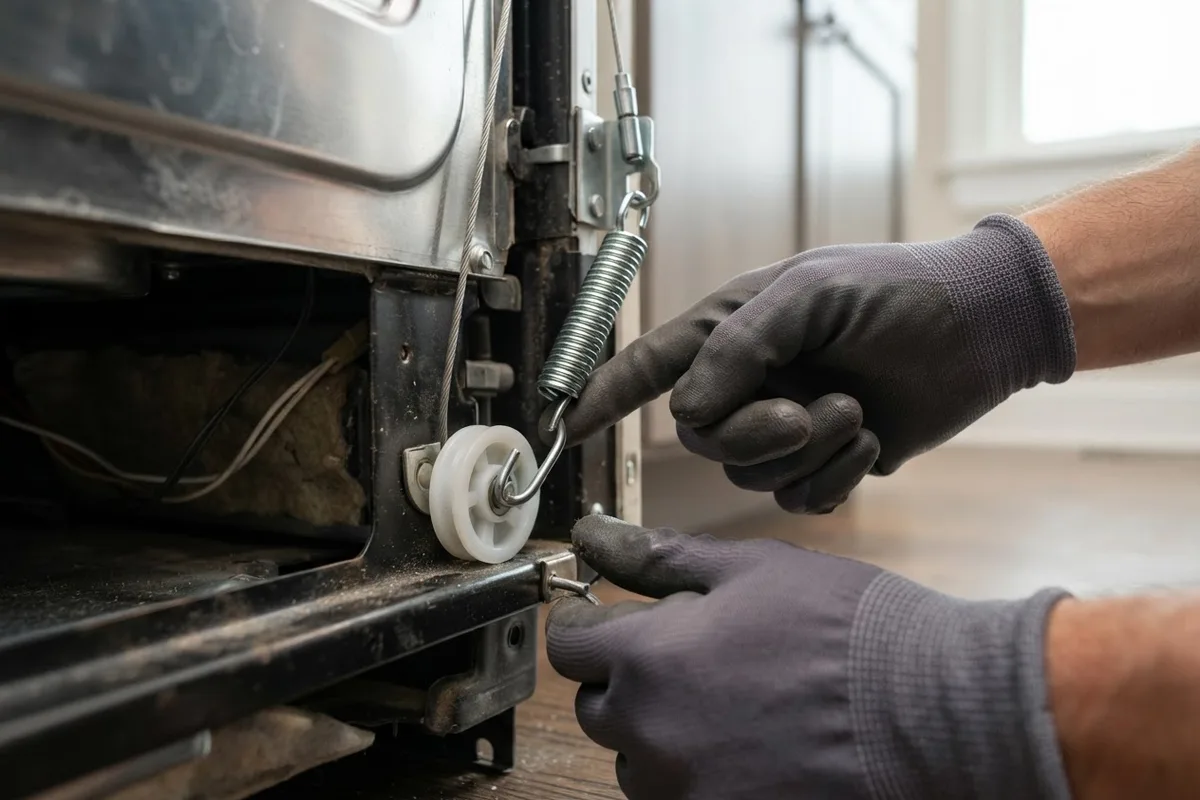
On most modern dishwashers, the weight of the door is supported by a pair of braided steel or heavy nylon cables—often called link kits or balance ropes—that run from the bottom hinge arms over plastic pulley wheels to metal tension springs. Sometimes a cable does not break at all; it simply slips off its hinge hook or jumps the pulley track when the door is bumped while open.
- Open the dishwasher door carefully, supporting its weight with one hand, and use a Phillips screwdriver or nut driver to remove the two to four screws holding the bottom access kickplate (toe panel) in place.
- Shine a flashlight along both the left and right bottom sides of the dishwasher frame. Compare both sides to see how the assembly should look.
- Locate the plastic hook at the front end of the cable. If it has popped off the metal hinge arm pin, pull the spring forward slightly using needle-nose pliers—wearing heavy work gloves to protect your hands—and slip the hook back onto the hinge pin.
- Guide the middle of the cable squarely back into the groove of the plastic pulley wheel and test the door movement slowly.
2. Replace a Snapped Door Balance Spring
If the dishwasher door feels completely weightless on one side or slams down with zero resistance, one or both of the metal recoil springs anchored along the bottom frame rail have likely snapped from metal fatigue. Even if only one spring breaks, you should always replace both springs and cables as a matched pair so the door opens evenly without twisting.
- With the power off and the lower kickplate removed, inspect the coiled metal springs stretched along the lower left and right frame rails. If the dishwasher needs to be slid out a few inches to reach the rear spring hooks, remove the top mounting bracket screws under your countertop first.
- Unhook the broken spring and its attached cable from the front hinge arm and the rear frame slot. If both springs are intact on the outside, make sure you aren't dealing with an unrelated electrical issue; for instance, if you notice an odd odor while working near the base, check our guide on why a dishwasher smells like burning.
- Hook the rear loop of the new replacement spring into the same frame slot the old one occupied.
- Thread the new cable over the plastic pulley wheel, pull the cable forward until the plastic link reaches the hinge pin, and snap it securely onto the hinge arm.
3. Swap Out Worn Plastic Pulley Wheels
Every time you open and close the dishwasher, the tension cable glides over a stationary plastic roller or pulley wheel mounted to the side of the tub frame. Over years of daily use, friction can wear a deep flat spot into the plastic wheel, crack the roller in half, or cause the center pin to seize up. When the pulley fails, the cable drags or slips off, making the door feel heavy and jerky.
- Close the dishwasher door so the tension on the springs is fully relaxed.
- Unhook the front end of the door cable from the hinge arm so the cable hangs loosely.
- Inspect the round plastic pulley wheel bolted or clipped to the lower side frame. Spin it with your finger; if it wobbles, binds, or has chipped edges, it needs replacement.
- Use a wrench or pliers to release the retaining clip or mounting bolt holding the pulley shaft to the frame, slide the new pulley wheel into place, and reattach the tension cable.
4. Adjust the Door Spring Tension Settings
Did you recently install a custom wooden cabinet panel on the front of an integrated dishwasher, or have the springs simply stretched out slightly over the years? Many dishwashers feature built-in tension adjustment slots or turning screws designed to compensate for heavier door panels or aging springs.
- Look at the rear anchor point where the back end of the door spring hooks into the metal dishwasher frame.
- On standard models, you will see three or four notched holes in a row along the frame rail. Moving the rear spring hook one notch further back increases the tension, pulling the door upward with more force.
- On European-style or fully integrated dishwashers with custom cabinet fronts, look at the front bottom corners behind the kickplate for two large adjustment screws. Turning these screws clockwise with a screwdriver or Allen wrench tightens the internal cable mechanism until the door stays stationary when opened at a 45-degree angle.
- Adjust both the left and right sides to the exact same setting so the door does not warp.
5. Inspect and Straighten Bent Door Hinge Arms
If someone accidentally trips over an open dishwasher door or drops a heavy cast-iron pot onto it, the L-shaped metal hinge arms that attach the door to the chassis can bend downward. When the hinge arms bend, the geometry of the spring lever changes—meaning the springs can no longer apply enough leverage to hold the door up, and the door may also fail to seal at the top.
- Open the door fully and look at the gap between the bottom of the outer door panel and the floor, as well as the angle of the door itself. A properly aligned door sits completely level (90 degrees to the front frame) when open; a bent hinge allows the door to slope downward past level.
- Remove the inner door panel screws along the sides of the door (keep the power off so you do not touch live control panel wires) to expose the metal hinge brackets.
- Compare the left and right metal hinge arms. If either arm is visibly twisted, cracked, or bowed, unbolt it from the door frame and chassis and install a replacement hinge kit.
- Reassemble the door panel, restore power at the breaker, and test a short rinse cycle to confirm the door gasket seals tightly without drips.
Dishwasher Door Balance Parts & Typical Replacement Costs
| Issue / Failed Part | Common Symptom | DIY Difficulty | Typical US Part Cost (Varies by Model/Area) | Typical Pro Repair Range (Varies by Area/Model) |
|---|---|---|---|---|
| Detached Tension Cable | Door drops on one side; no broken parts on floor | Easy (15 mins) | $0 (Reattachment) | $100 – $175 |
| Broken Balance Spring Kit | Loud snap; door feels very heavy and falls flat | Easy–Moderate (30 mins) | $20 – $55 (Pair) | $140 – $240 |
| Cracked Pulley Wheel | Door feels jerky, squeaks, or cable keeps slipping | Moderate (30 mins) | $15 – $35 (Pair) | $130 – $220 |
| Stretched / Out-of-Spec Tension | Door slowly drifts down instead of holding position | Easy (15 mins) | $0 (Adjustment) | $100 – $160 |
| Bent Metal Hinge Arms | Door slopes downward past 90° when fully open | Moderate–Hard (60 mins) | $45 – $110 (Pair) | $180 – $320 |
Note: All price ranges are broad US estimates for comparison and vary significantly depending on your dishwasher brand, model design, and local labor rates.
When to Call a Pro
Replacing an accessible front tension cable or adjusting a spring notch behind the kickplate is a rewarding 30-minute project for most homeowners. However, you should stop and call a professional if your dishwasher must be pulled completely out of a tight cabinet enclosure and has hardwired electrical connections or corroded copper water supply lines that could kink or leak when moved. Likewise, if a heavy door drop has yanked on the internal wiring harness and caused electrical issues—much like the faults covered in our guide on why a refrigerator is tripping the breaker—avoid touching damaged wires yourself.
If you prefer not to wrestle with heavy springs or pulling the unit from under your counter, True Appliance Repair can connect you with an independent local technician through our dishwasher repair service page, or you can reach out directly on our contact page to get matched with a pro in your area.
FAQ
Can I still run my dishwasher if the door spring is broken?
As long as the door hinges are not bent and the door latches securely at the top, the dishwasher will usually seal and run without leaking. However, you should hold the handle firmly every time you open the door until you replace the spring, as letting the door drop repeatedly can bend the hinges and crack the inner door liner.
Why should I replace both dishwasher door springs if only one snapped?
Dishwasher springs stretch and weaken gradually over thousands of open-and-close cycles. If you pair one brand-new, high-tension spring with an old, stretched spring on the opposite side, the uneven pull will twist the door frame every time you open it, leading to latch alignment issues and premature wear on the new cable.
How do I know if my dishwasher door tension is adjusted properly?
A properly balanced dishwasher door should stay put on its own when you open it partway—around a 45-degree angle—without slamming down to the floor or snapping back shut toward the latch. When opened all the way down to load the bottom rack, it should rest smoothly and horizontally without bouncing.
Why does my new dishwasher door keep springing back up when I try to load it?
New dishwashers often ship with the door springs set for the weight of a heavy outer panel, or the springs simply need to break in. Wait until you have loaded the bottom dish rack, which rests on the open door to hold it down, or decrease the spring tension by one notch at the rear frame.