
A dishwasher door that won't latch tightly can bring your kitchen routine to a screeching halt. When the door doesn't close properly, the cycle won't start, or worse, you risk water leaking all over your floor. Fortunately, you can often fix this frustrating problem yourself without calling for service. This step-by-step guide covers 6 easy DIY fixes to get your dishwasher door latching securely again.
Safety First
Before starting any hands-on work, always unplug your dishwasher or turn off the power at the circuit breaker. Additionally, shut off the water supply valve beneath the sink. Safety first! For any complex electrical panel work, wiring issues, or internal component failures, stop and call a professional.
1. Check for Obstructions and Rack Alignment
Before removing panels or buying parts, start with the most common and easiest solution. Many dishwasher doors fail to latch simply because something inside the tub is physically blocking them. Start by opening the dishwasher and inspecting the upper and lower racks. Ensure they are pushed all the way back into the tub. Sometimes, large pots, cutting boards, or long utensils like spatulas can slide forward during loading, preventing the door from closing completely.
- Fully open the dishwasher door.
- Inspect the perimeter of the tub for any fallen items, like a rogue fork or a small lid.
- Push both the top and bottom racks back as far as they will go.
- Check the tracks for any debris or buildup that might prevent the racks from sliding fully into place.
- Attempt to close and latch the door. If it clicks shut, your problem is solved. If not, proceed to the next step.
Since a dishwasher door not latching means it won't run, check out why is my dishwasher not starting for related troubleshooting tips.
2. Inspect the Door Gasket and Seals
The rubber door gasket creates a watertight seal when your dishwasher is running. Over time, this gasket can become dirty, misaligned, or damaged. A warped or displaced gasket can create enough physical resistance to prevent the door latch from catching.
- Open the door and carefully inspect the black or gray rubber gasket that runs along the top and sides of the tub.
- Look for any visible tears, cracks, or brittle spots. If the gasket is damaged, it will need to be replaced.
- Feel along the length of the gasket to ensure it is fully pressed into its track. If it has pulled away in any section, gently push it back into the groove using your thumb.
- Clean the gasket thoroughly. Use a warm, damp cloth with a mild dish soap to wipe away any food debris, grease, or mineral buildup.
- Check the bottom door seal as well, as debris here can also prevent proper closure.
If your gasket is damaged, it might also cause leaks, so refer to why is my dishwasher leaking from the door for more information.
3. Test and Adjust the Latch Strike Plate
The latch strike plate is the small metal or plastic piece located at the top center of the dishwasher's interior frame. When you close the door, the latch mechanism catches onto this strike plate to hold the door shut. If the strike plate is loose, bent, or misaligned, the door will not latch.
- Ensure the power is off and the water supply is shut.
- Locate the strike plate at the top of the dishwasher tub frame.
- Check if it is loose by gently wiggling it. If the screws are loose, use a screwdriver to tighten them securely.
- Inspect the plate for any visible bends or damage. If it is metal and slightly bent, you may be able to gently bend it back into position with pliers. If it is broken or plastic, you will need to replace it.
- Close the door slowly to see if the latch mechanism aligns perfectly with the strike plate. If it is slightly off-center, loosen the screws slightly, adjust the plate's position, and retighten.
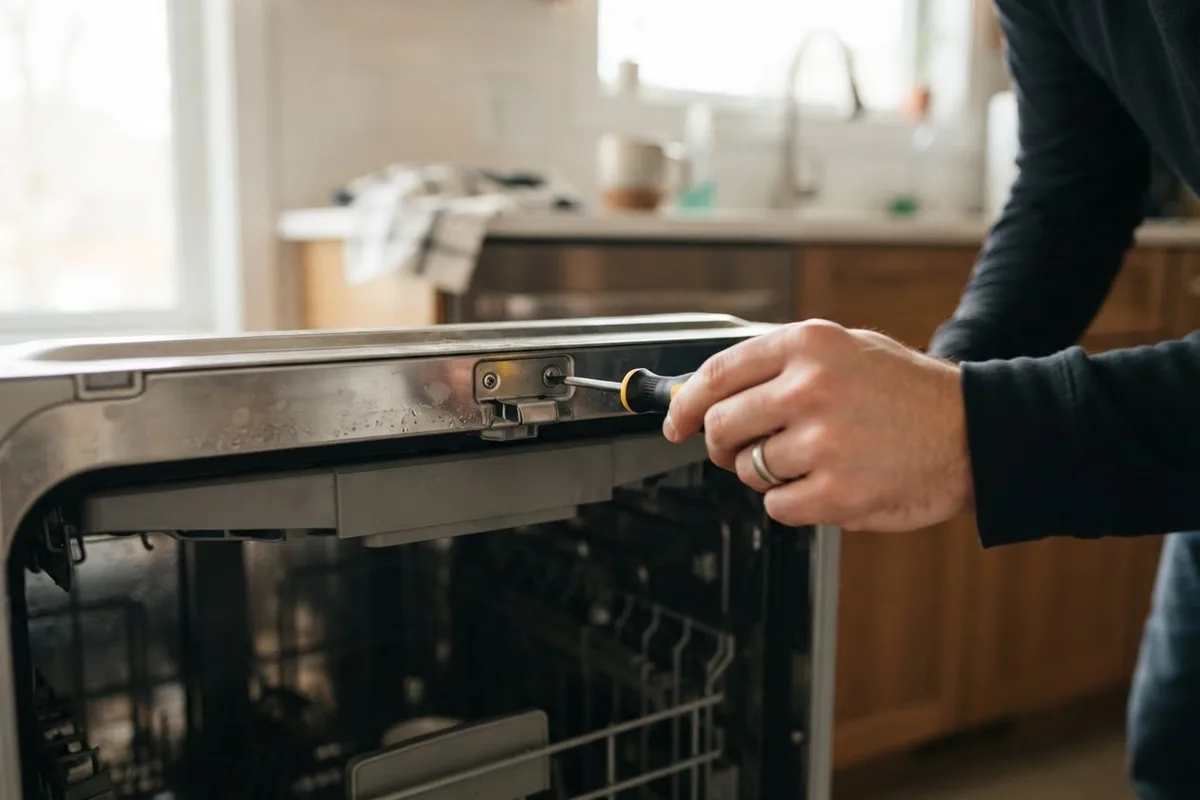
4. Examine the Door Latch Assembly
If the strike plate is fine, the issue likely lies within the door latch assembly itself. This mechanism is located inside the top of the dishwasher door panel. It contains a mechanical latch, springs, and an electrical switch that signals the dishwasher that the door is safely closed.
- Ensure the power is completely off at the circuit breaker.
- You will need to remove the inner door panel to access the latch assembly. Open the door and use a Torx or Phillips screwdriver to remove the screws holding the inner door panel to the outer panel. Be sure to support the door so it does not fall.
- Carefully separate the inner and outer door panels just enough to access the top latch area. You may need to disconnect a few wire harnesses; if so, take a picture first so you know how to reconnect them.
- Locate the door latch assembly at the top. Inspect the plastic housing for cracks and check if the internal springs are broken or missing.
- Manually test the latch by pushing it with a screwdriver. It should smoothly click into a closed position and spring back when the handle is pulled.
- If the latch is stuck, broken, or the springs are damaged, remove the assembly by unscrewing it and disconnecting the attached wires.
- Install a new door latch assembly (typically costing between $30 and $70, though prices vary by area and model). Reconnect the wires, screw the assembly into place, and reassemble the door panel.
5. Tighten or Replace the Door Hinges
Your dishwasher door relies on hinges at the bottom to open and close smoothly. Over years of use, these hinges can become loose, worn, or bent. If the hinges are out of alignment, the entire door will be slightly crooked, preventing the latch at the top from meeting the strike plate correctly.
- Fully open the dishwasher door and look down at the bottom corners.
- Inspect the hinges on both sides for any signs of damage, rust, or bends.
- Check the hinge screws. If they are loose, use a screwdriver to tighten them firmly.
- Many modern dishwashers also use hinge cables, pulleys, and springs to balance the door's weight. Inspect these components as well. A snapped hinge cable can cause the door to fall heavily and throw off the alignment.
- If a hinge is visibly bent or a cable is snapped, they will need to be replaced. Replacing hinges usually requires pulling the dishwasher slightly out from under the counter, which we will address next.
6. Verify the Dishwasher Is Level
If your dishwasher is not perfectly level, the entire frame of the appliance can twist slightly. This twisting effect, known as racking, causes the tub to become misaligned with the door. Even a slight tilt can prevent the top latch from meeting the strike plate properly.
- Place a bubble level across the top edge of the open dishwasher door. Then, check it front-to-back along the top edge of the tub.
- If the bubble is not centered, your dishwasher needs to be leveled.
- To adjust the level, you will need to access the leveling legs at the bottom front of the unit. You may need to remove the bottom access panel (toe kick) to see them.
- Using a wrench or pliers, turn the leveling legs clockwise to raise a corner or counter-clockwise to lower it.
- Continue adjusting the legs and checking with your bubble level until the dishwasher is perfectly level both side-to-side and front-to-back.
- Once level, close the door to test the latch. In many cases, simply leveling the appliance resolves door latching issues instantly.
Quick-Reference: Dishwasher Door Latch Troubleshooting
| Component | Common Symptoms | DIY Fix |
|---|---|---|
| Obstructions / Racks | Door bounces back, racks don't slide in | Push racks back, rearrange dishes |
| Door Gasket | Door feels tight but won't latch, visible leaks | Clean gasket, press into track, or replace |
| Strike Plate | Latch misses top frame, plate is loose | Tighten screws, adjust alignment, or replace |
| Latch Assembly | Latch doesn't click, handle feels loose | Replace latch assembly |
| Door Hinges / Cables | Door hangs crooked, falls rapidly | Tighten hinges, replace cables/springs |
| Leveling Legs | Dishwasher frame twisted, door misaligned | Adjust leveling legs with a wrench |
When to Call a Pro
While many dishwasher door latching issues are simple to fix with basic tools, some situations require advanced troubleshooting. If you have completed these checks and your dishwasher door still will not latch, the problem might be a warped tub frame, severely bent internal hinges, or a complex wiring issue.
If you encounter complex electrical issues, notice smoke or burning smells, or if the appliance requires extensive dismantling, it is time to stop and call in an expert. Working on internal electrical components or the sealed system without experience can be dangerous.
When DIY fixes aren't enough, True Appliance Repair can match you with a local appliance pro to get your kitchen back in working order. Give us a call or use our contact page to find reliable, local service in your area.
FAQ
Why does my dishwasher door pop open during a cycle?
If your dishwasher door pops open mid-cycle, it is usually due to a weak door latch, a damaged strike plate, or a worn door gasket that is expanding under heat. It can also happen if the dishwasher is not level, causing the frame to vibrate and the latch to slip. Inspect the latch assembly and gasket for wear, and ensure the appliance is level.
How much does it cost to repair a dishwasher door latch?
The cost to repair a dishwasher door latch depends on the parts needed. If you are doing a DIY fix, a new latch assembly or strike plate generally costs between $30 and $100. If you decide to hire a local professional, the total cost for parts and labor typically ranges from $150 to $300, though this varies by your area and the specific dishwasher model.
Can a misaligned dishwasher rack prevent the door from latching?
Yes, a misaligned or improperly loaded rack is one of the most common reasons a dishwasher door won't latch. If a rack is not pushed all the way in, or if large items like cutting boards or pans are sticking out, they will physically block the door from closing. Always ensure the racks are fully on their tracks and pushed back before closing the door.
Is it safe to run a dishwasher if the door latch is loose?
No, it is not safe to run a dishwasher with a loose or faulty door latch. The latch serves as a critical safety feature; if it fails during a cycle, the door could fly open, resulting in scalding hot water and detergent flooding your kitchen floor. Additionally, most modern dishwashers have a sensor that will prevent the machine from starting at all if the latch is not fully engaged.