
You load up your dinner dishes, add detergent, push the door shut, and press start—only to realize the dishwasher door refuses to click into place. Because modern dishwashers rely on safety switches inside the door catch to prevent hot water from spraying into your kitchen, a door that will not latch tightly keeps the entire machine from turning on.
When a dishwasher door won't stay closed, the issue usually stems from a minor physical obstruction, misaligned strike plate, distorted tub, or worn mechanical latch assembly. Before you panic or schedule an expensive service call, you can troubleshoot and resolve most latching issues yourself with basic hand tools.
Always prioritize safety before examining mechanical or electrical components. Disconnect power to the unit by unplugging it under the sink or turning off the dedicated breaker at your main electrical panel. If you are also inspecting water connections, turn off the shutoff valve underneath the sink.
Check for Rack and Dish Obstructions
The most frequent reason a dishwasher door fails to latch shut is simple mechanical interference inside the tub. Over time, heavy dish loads or displaced plastic items can shift the position of the dish racks, preventing the door from pressing fully against the cabinet frame.
- Inspect rack alignment: Open the door wide and pull both top and bottom racks all the way out. Verify that the tracks are clean and free of debris, broken glass, or hard water mineral build-up.
- Check rack stoppers: Make sure the end caps on the sliding rack tracks are intact and firmly snapped into place. If a stopper is missing, the rack can slip off its rollers and tilt forward, hitting the inner door liner.
- Verify dish height and placement: Tall cutting boards, baking sheets, or large serving platters placed along the front or side edges can press against the door gasket or top spray arm. Rearrange oversize items toward the back or center of the rack.
- Test the door closure empty: Roll both racks completely back into the tub, or remove them temporarily, and try closing the door. If it clicks into place cleanly without the racks, your issue was caused by internal placement rather than a faulty mechanical latch.
If you find that your dishwasher remains completely unresponsive even after closing the door properly, check out our guide on why is my dishwasher not turning on to rule out control board or thermal fuse problems.
Inspect and Clean the Door Latch Assembly
Food residue, grease, detergent buildup, or small foreign objects can collect inside the latch mechanism located at the top center of the interior door panel. When grime fills the latch opening, the internal spring mechanism cannot catch or hold the strike prong.
- Unplug the dishwasher: Always disconnect electrical power at the breaker box before touching electronic parts inside the door panel.
- Examine the latch pocket: Use a flashlight to inspect the latch slot at the top center of the door. Look for sticky soap scum, hard water scale, or food particles trapped inside the plastic housing.
- Clean the mechanism: Dip a small nylon brush or soft toothbrush in warm water mixed with mild dish soap. Scrub the inner catch, springs, and plastic lever arm carefully. Wipe away dissolved grease and debris with a damp microfiber cloth.
- Manually test the latch catch: Take a flathead screwdriver and gently push upward on the inner latch catch lever to see if it moves freely and springs back. If the catch feels gritty, stuck, or loose, spray a tiny amount of food-safe silicone lubricant onto the pivot points.
Wiping down the door perimeter regularly is an essential maintenance habit. Incorporating this task into a broader routine appliance maintenance checklist extends the operational lifespan of door gaskets, latches, and seals.
Realign the Door Strike Plate and Cabinet Mounting
The door latch relies on a metal or heavy plastic tongue called a strike plate (or door catch). This plate is usually screwed into the top underside of your kitchen countertop or the upper face of the dishwasher outer tub. If your kitchen cabinets shift over time or mounting screws vibrate loose, the strike plate will no longer align with the latch pocket on the door.
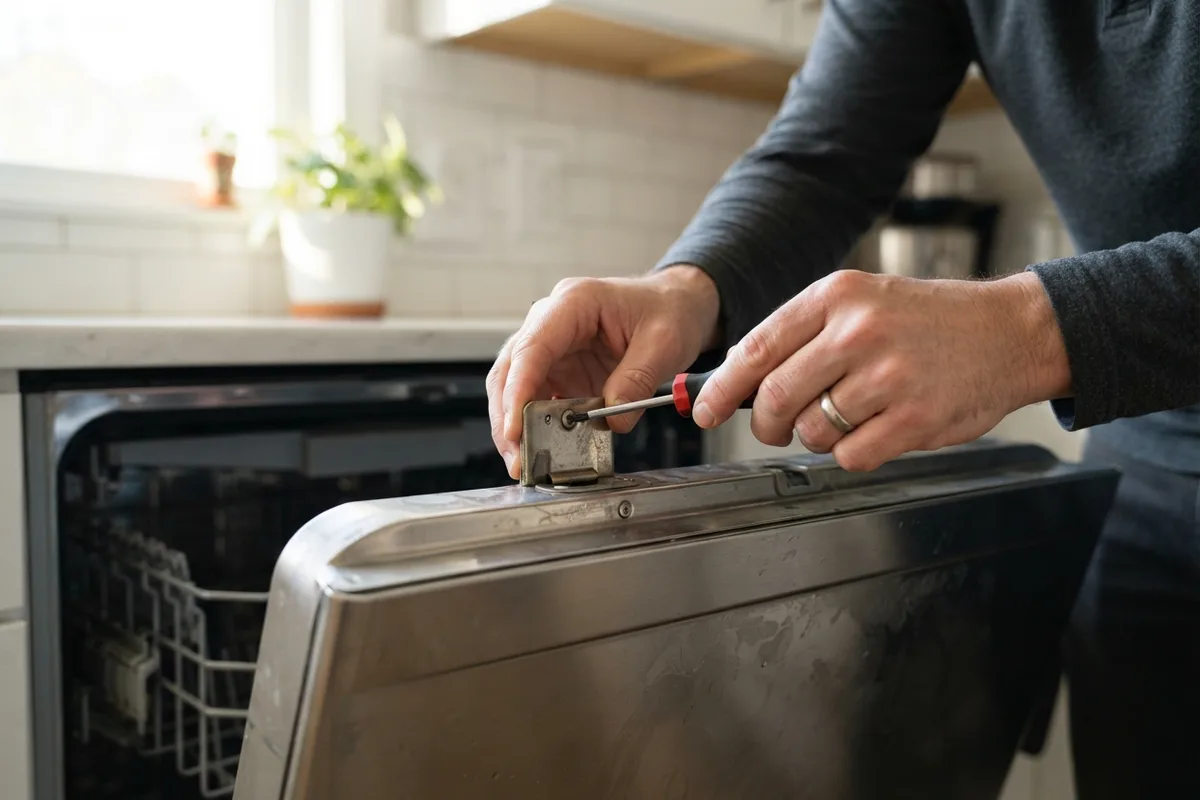
- Inspect the strike plate: Open the dishwasher door fully and locate the metal loop or tab at the top center of the cabinet opening or countertop frame.
- Check for looseness or bent metal: Grasp the strike plate gently. If it wiggles or appears bent upward or downward, it cannot slide properly into the door latch assembly.
- Loosen mounting screws: Use a Phillips screwdriver to loosen the screws holding the strike plate or top mounting brackets to the cabinet frame.
- Adjust alignment: Shift the strike plate slightly forward or backward, and center it precisely above the latch opening. Tighten the screws securely.
- Test the door seal and click: Close the door slowly, watching closely where the strike enters the latch handle. Adjust the metal prong in small increments until the door snaps shut with a firm, solid click without binding or scraping against plastic edges.
Level the Dishwasher Frame
Dishwashers must be perfectly level from side to side and front to back to function correctly. If your floor sags or the adjustable leveling legs beneath the machine loosen, the main cabinet tub can twist into a slight diamond shape. This racking effect misaligns the door frame with the outer cabinet, causing the latch to miss the strike plate entirely or pop open mid-cycle.
- Check levelness across the tub: Place a small bubble level horizontally across the top front lip of the open dishwasher tub. Next, place the level along the inner side rails running front to back.
- Examine door spacing: Close the door until it touches the frame. Look closely at the reveal—the gap between the outer door skin and adjacent kitchen cabinets on both left and right sides. The gap should be completely uniform from top to bottom.
- Access leveling legs: Remove the plastic toe kick or bottom access panel by unscrewing its mounting fasteners near the floor.
- Adjust front legs: Use an adjustable wrench or pliers to turn the front leveling feet. Turning clockwise lowers that side of the machine; turning counterclockwise raises it. Adjust the legs until the bubble level centers on both axes and the door gap is completely even.
- Verify stability: Push gently on the upper front corners of the machine to ensure all four feet rest firmly on the floor without rocking or tilting when the door swings down.
Test and Replace the Door Latch Switch
If the door closes physically but fails to stay locked, or if the dishwasher will not start even when the door feels fully closed, the internal door latch assembly or microswitches may be electrically or mechanically damaged. Modern latches house one or two miniature microswitches that signal the control board that the door is safely sealed.
- Turn off power completely: Ensure the dishwasher circuit breaker is switched off before disassembling the door panel.
- Remove inner door panel screws: Open the door wide and remove the Torx or Phillips screws along the inner stainless steel perimeter. Keep hold of the outer door skin so it does not drop or scratch your floor.
- Separate the control console: Carefully tilt the outer door skin forward to expose the upper control panel and latch housing.
- Inspect microswitches and plastic housing: Locate the plastic latch assembly at the top. Look for cracked plastic tabs, stretched tension springs, or scorched electrical terminals on the microswitches.
- Test continuity with a multimeter: Disconnect the wire harness plugs from the latch switches. Set your digital multimeter to the ohms (Ω) setting or continuity test mode. Touch the probe tips to the switch terminals while manually depressing the actuator button. The meter should display near zero ohms when closed and infinite resistance when released. If the switch shows no continuity, replace the latch assembly.
| Issue Observed | Likely Cause | Recommended DIY Solution |
|---|---|---|
| Door rebounds or bounces back | Stiff gasket or displaced dish rack | Rearrange dishware; lubricate door seal with warm soapy water |
| Door stays closed but cycle will not start | Broken microswitch or faulty wire harness | Test microswitch continuity; replace latch switch assembly |
| Latch scrapes metal strike tab | Misaligned strike plate or unlevel tub | Adjust top strike plate screws; level front cabinet legs |
| Door opens mid-cycle on its own | Damaged latch springs or distorted tub frame | Replace door latch assembly; realign cabinet mounting brackets |
When to Call a Pro
While most door latch alignment issues and basic switch replacements fall well within the comfort zone of a DIY homeowner, certain situations require specialized expertise. If adjusting the leveling legs and strike plate does not solve the issue, or if you suspect damaged door hinges, twisted frame structural damage, or shorted control board wiring, professional diagnostic equipment is recommended.
Component replacement costs for latches and switches generally range between $20 and $60 for parts, while overall repair visits typically range from $110 to $250 depending on your location and machine brand. If you prefer to avoid handling electrical wiring or disassembling door panels yourself, True Appliance Repair can connect you with a reliable technician in your local area to evaluate your dishwasher safely.
Remember to stop work immediately and contact a professional if you notice damaged wiring harnesses, burning smells near the control panel, or severe structural distortion of the main tub frame.
FAQ
Can I bypass the dishwasher door switch to complete a wash cycle?
No, you should never attempt to bypass or short-circuit a dishwasher door safety switch. The switch prevents hot water and harsh detergents from spraying out at high pressure, which poses serious risk of severe scalding, water damage, and electrical shock. Always replace a faulty switch before running the appliance.
Why does my dishwasher door pop open on its own during a wash cycle?
A door popping open mid-cycle is usually caused by excessive thermal expansion pressure, a worn latch catch spring, or an unlevel cabinet frame. If your machine is unlevel, high-temperature wash water expands the air inside the tub, creating internal pressure that pushes an improperly secured door latch open.
How much does it cost to replace a dishwasher door latch assembly?
A replacement door latch component typically costs between $20 and $70 for standard OEM parts. If you choose to hire a technician to perform the labor, total service costs usually range from $120 to $230 depending on local labor rates and machine access.
Do I need to lubricate my dishwasher door latch?
If the latch mechanism feels stiff, you can clean it thoroughly with warm soapy water and apply a tiny drop of food-grade silicone lubricant to the pivot points. Never use petroleum-based lubricants like standard WD-40, as petroleum can degrade plastic housings and rubber gaskets over time.