
Hearing a sharp, repetitive ticking or snapping sound coming from your kitchen right after you press start can be frustrating, especially with heavy fall cooking and holiday hosting right around the corner. When you have a dishwasher making a clicking noise, the culprit is usually something simple—like a tall spatula tapping the spray arm—or a minor mechanical part like a sticky dispenser latch or diverter motor. Work through the six safe, step-by-step checks below to pinpoint the sound and get your machine running quietly again.
Before inspecting internal components, always put safety first. Unplug the dishwasher under the sink or switch off its dedicated circuit breaker at your main electrical panel, and shut off the water supply valve before removing any access panels or reaching near moving parts.
1. Clear Tall Dishes Blocking the Spray Arm
A steady, rhythmic tick-tick-tick that speeds up and slows down during the wash cycle is almost always the lower or upper spray arm striking an item in the racks. Even a single long-handled spoon or a tilted baking sheet can catch the spinning plastic arm on every rotation.
- Open the door slowly and check the lower rack for tall cutting boards, platter rims, or pot handles extending downward or inward.
- Inspect the silverware basket to see if a thin fork prong, chopstick, or knife blade has slipped through the bottom mesh.
- Spin both the lower and upper spray arms by hand a full 360 degrees to confirm they rotate freely without grazing any dishware.
- Check that the upper rack is sitting level on its tracks so the middle spray arm does not clip bowls stacked on the bottom rack.
If you also smell hot plastic along with the rubbing sound, check our guide on why a dishwasher smells like burning to make sure nothing has fallen onto the heating element.
2. Remove Hard Debris From the Drain Pump Impeller
If the clicking or chattering happens right at the very beginning of the cycle or at the end when water empties into the sink, a small piece of hard debris has likely made its way into the drain pump housing. Fruit pits, popcorn kernels, broken glass fragments, or small plastic bread tags can flick against the spinning impeller blades like a playing card in bicycle spokes.
- Turn off power to the dishwasher at the breaker and bail out any standing water in the bottom of the tub with a cup and towel.
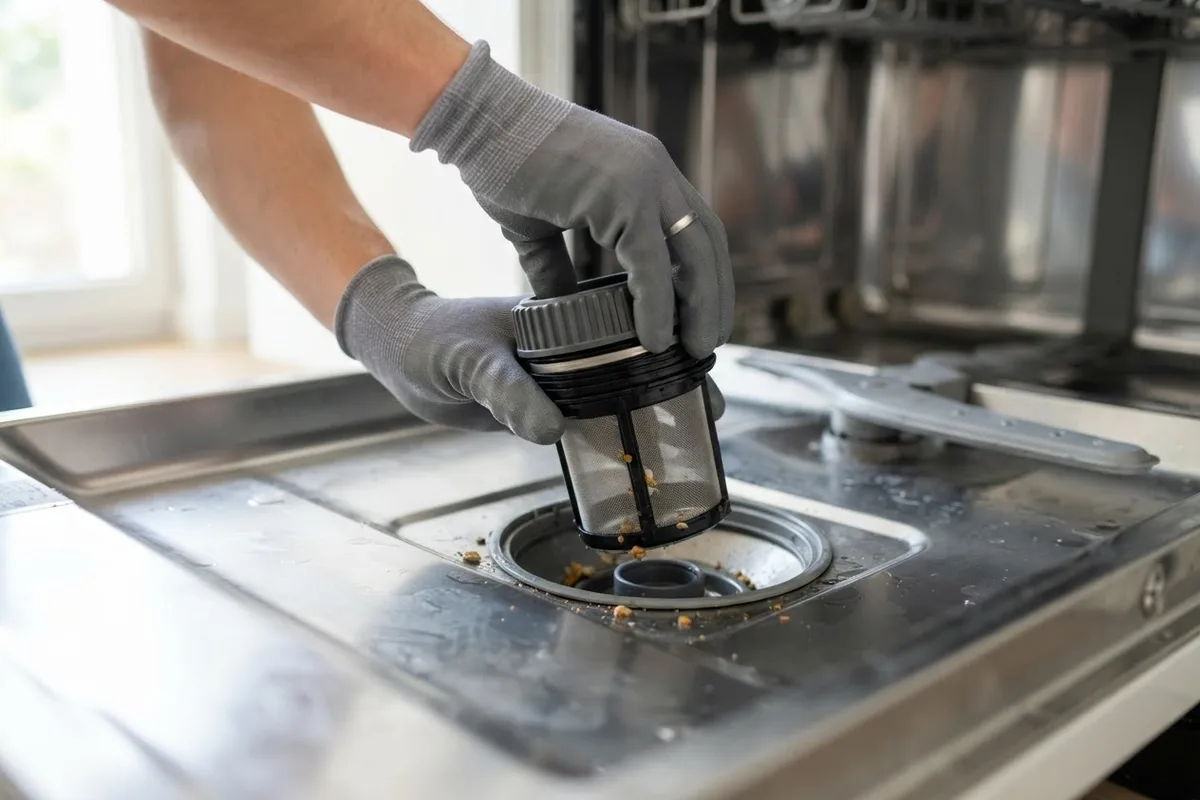
- Twist and lift out the cylindrical bottom filter assembly located in the floor of the tub.
- Shine a flashlight into the sump basin and look for the small pump cover or check-valve flapper on the side wall.
- Put on thick cut-resistant work gloves to protect your fingers from hidden glass shards.
- Gently pop off the snap-on pump cover (if your model has a removable cover) and feel around the small plastic impeller blades to remove any seeds, bones, or plastic bits.
- Spin the impeller blade with one finger to make sure it turns smoothly without catching, then snap the cover and filter securely back into place.
3. Inspect the Detergent Dispenser Door Latch
A single loud snap—or a series of rapid clicks about 10 to 20 minutes into the wash cycle—often points to the soap dispenser mechanism on the inner door panel. When the spring-loaded lid tries to release or the electric wax motor attempts to unlatch a gummy, stuck cover, it can click repeatedly without fully popping open.
- With the dishwasher empty, inspect the plastic detergent cup and rinse-aid cap on the inside of the door.
- Look for hardened gel detergent, caked powder, or mineral crust around the sliding catch and hinge pin.
- Scrub the latch channel and hinge spring using warm water, a splash of white vinegar, and an old toothbrush until the slider moves smoothly.
- Check the small rubber gasket on the inside of the dispenser door; if it is swollen or torn, it can bind the latch.
- Avoid stacking tall cutting boards or large plates in the front left corner of the bottom rack, where they can pin the dispenser door shut and cause it to click against the dish.
4. Check the Door Latch Strike and Side Springs
If you hear a metallic click or pop when pushing the door shut, leaning against the counter, or while the tub warms up during the cycle, the noise may be coming from the door alignment or suspension springs rather than the wash motor.
- Open and close the door slowly while watching the top metal or plastic strike plate enter the latch assembly in the control header.
- If the strike clips the edge of the latch opening, tighten any loose mounting screws holding the latch or the under-counter mounting brackets.
- Turn off the breaker and unscrew the lower kickplate panel at the floor.
- Look along both bottom sides of the frame to inspect the heavy tension springs and plastic pulley wheels that counterbalance the door.
- Make sure the friction cable isn't frayed or catching on the metal frame edge. If the door drops down fast when opened, see our walkthrough on fixing a heavy dishwasher door to replace worn cables safely.
5. Test the Water Inlet Valve Solenoid
When a dishwasher clicks once or twice at the start of a cycle and then sits silent without filling with water, the sound is usually the water inlet valve solenoid trying to open. Either the water supply is restricted, or the electromagnetic coil on the valve is failing.
- Look under the kitchen sink and make sure the hot water shutoff valve feeding the dishwasher line is turned completely counter-clockwise (fully open).
- Shut off the breaker and the water valve, then remove the dishwasher's bottom toe-kick panel.
- Locate the water inlet valve at the front left or right corner where the braided water supply hose connects.
- Place a shallow pan and towel underneath, unscrew the supply line, and inspect the tiny mesh inlet screen inside the valve port.
- If the screen is clogged with rust flakes or calcium sediment, gently brush it clean so water pressure can stabilize the valve plunger.
- If the solenoid continues to click rapidly without letting water through—or if the plastic body shows any moisture or hairline cracks—the inlet valve assembly needs to be replaced.
6. Listen for a Failing Diverter Motor or Control Relay
Modern dishwashers use a motorized diverter disc underneath the tub to alternate water pressure between the lower and upper spray arms. When the diverter's internal plastic gears strip or the position switch sticks, it produces a rhythmic clicking or ratcheting sound underneath the center of the machine every few minutes. Similarly, a failing electronic control board inside the top of the door can make a faint, rapid clicking sound as its small black relays chatter.
- Start a rinse cycle and kneel beside the unit to isolate whether the clicking comes from the very top of the door (control board relays) or dead center underneath the floor of the tub (diverter motor).
- If the sound comes from the top console and the panel lights flicker or fail to advance, turn off the breaker for five minutes to reset the board.
- If the clicking comes from underneath the center of the tub in a steady pattern every few seconds, turn off power and lift out the lower spray arm and filter to check the small round diverter disc for lodged toothpicks or broken plastic tabs.
- Because replacing a diverter motor risks disturbing the main sump water seal—and control board issues involve live voltage testing—stop here if cleaning debris does not quiet the noise.
Quick Guide: Match the Clicking Sound to the Cause
| What the Clicking Sounds Like | When It Happens | Most Likely Culprit | DIY Difficulty |
|---|---|---|---|
| Steady tick-tick-tick that speeds up | During the main wash cycle | Spray arm hitting a tall dish or utensil | Easy (1 minute) |
| Fast chattering or card-in-spokes sound | Start or end of cycle (draining) | Seed, glass, or bone in drain pump impeller | Easy–Moderate |
| Single loud snap or several sharp clicks | 15–20 minutes into the wash | Detergent dispenser latch sticking or blocked | Easy |
| Click followed by silence (no water) | Immediately after pressing Start | Water inlet valve solenoid or shutoff valve | Moderate |
| Rhythmic ratcheting under the tub center | Every few minutes during wash | Stripped diverter motor gears or stuck disc | Pro Recommended |
| Rapid, quiet ticking inside top door panel | Anytime unit has power or mid-cycle | Chattering relay on electronic control board | Pro Recommended |
When to Call a Pro
Clearing a blocked spray arm, cleaning a sticky detergent latch, or fishing a lemon seed out of the drain sump are straightforward DIY jobs that take less than 20 minutes with basic household tools. However, if the clicking comes from a chattering electronic control board relay, a stripped diverter valve motor underneath the sump, or a hardwired electrical connection, it is safest to put the tools down and bring in a technician. Working on under-tub motors can easily disturb factory water seals and lead to hidden floor leaks, and electrical diagnostics require specialized meters.
Typical professional repair costs for a clicking dishwasher range from about $140 to $320 for parts and labor—whether replacing an inlet valve, drain pump, or diverter assembly—though exact pricing varies by area and model. If you want the noise resolved quickly before guests arrive, True Appliance Repair can match you with an independent local appliance pro who can diagnose the component and get your kitchen back on track.
FAQ
Is it safe to run my dishwasher if it is making a clicking noise?
If the clicking is simply a spray arm tapping a tall plate, it is safe to pause the cycle, rearrange the rack, and keep running it. However, if the clicking comes from the drain pump, under-tub motor area, or control panel, you should cancel the cycle and inspect it first so a jammed impeller or failing relay doesn't burn out the motor or cause a leak.
Why is my dishwasher clicking when it is turned off?
A dishwasher that clicks while off or in standby mode almost always has an electronic control board issue—specifically a stuck power relay—or a sticky float switch assembly. Turn off the circuit breaker right away to stop power to the unit and schedule a professional inspection.
How much does it cost to fix a clicking dishwasher?
DIY fixes like rearranging dishes, scrubbing a sticky soap dispenser latch, or pulling a fruit pit out of the sump cost nothing at all. If a part needs replacement by a technician, a new water inlet valve, drain pump, or diverter motor typically runs between $140 and $320 total, though rates vary by area and model.
Why does my dishwasher click three or four times and then not start?
When you press start and hear three or four distinct clicks from the door header or beneath the tub without the cycle beginning, the door latch sensor may not be registering that the door is fully closed, or the control board relay is failing to send voltage to the water inlet valve. Push the door firmly shut to test the latch, and check that the hot water supply valve under the sink is open.