
Hearing a loud crunching or harsh mechanical rumble from your kitchen right before the holiday hosting rush is never fun. If you are wondering why your dishwasher is making a grinding noise, the culprit is usually a stray popcorn kernel, a small bone, or a worn internal part rather than a total breakdown. By working through these six safe DIY checks, you can find the source of the sound, protect your pump from damage, and get your machine running quietly again.
Before you begin any hands-on inspection, always unplug your dishwasher under the sink or turn off its dedicated circuit breaker at your home's electrical panel, and shut off the hot water supply valve.
1. Clear Hard Debris from the Sump and Chopper Blade
Many modern dishwashers use a small stainless steel chopper blade at the bottom of the tub to macerate soft food particles before they wash down the drain. When something hard—like a lemon seed, olive pit, glass shard, or toothpick—slips past the filter, the chopper blade strikes it repeatedly and creates a loud, startling grinding sound during the wash cycle.
- Turn off the power at the breaker and pull out the bottom dish rack.
- Twist and lift out the cylindrical lower filter and the flat mesh screen at the floor of the tub.
- Sponge out any standing water in the sump well so you can see clearly, wearing thick rubber or cut-resistant gloves to protect your fingers from broken glass.
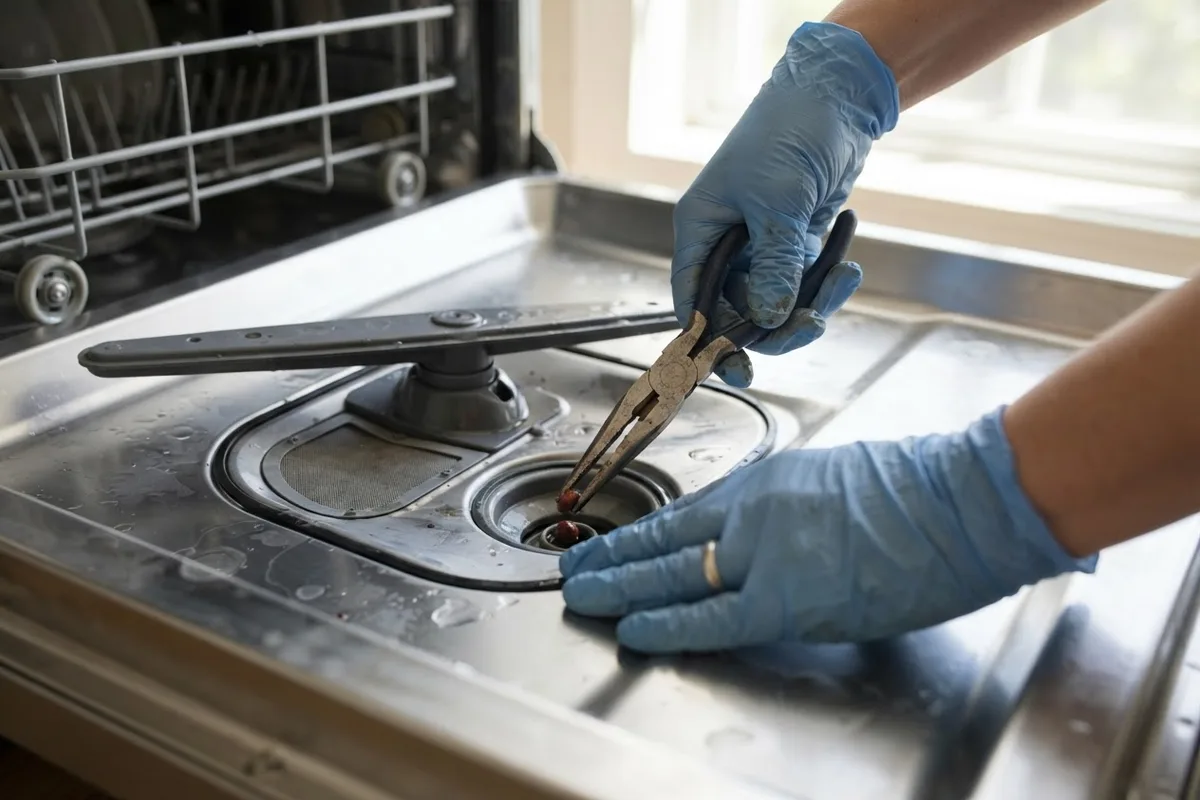
- Shine a flashlight into the side opening of the sump where the chopper screen and blade sit, removing any trapped seeds, twist ties, or bone fragments with needle-nose pliers.
- Inspect the small spring-loaded chopper blade assembly; if the metal teeth are bent or sheared off from hitting a hard object, unhook the assembly and snap a replacement into place.
2. Remove Foreign Objects from the Drain Impeller
If the grinding noise only happens at the very beginning of a cycle or right at the end when dirty water is being pumped out, the issue is likely inside the drain pump housing. Small pieces of broken china or hard plastic can make it past the sump and rub against the spinning plastic fins of the drain impeller. Notice whether your kitchen sink is also making a racket; if the sound happens when you flip the wall switch rather than during the dishwasher cycle, check our guide on why a garbage disposal is vibrating instead.
- Confirm the circuit breaker is off and the hot water shutoff valve under the sink is closed.
- Unscrew the lower access kickplate at the base of the dishwasher and place a shallow towel underneath the drain pump to catch residual water.
- Twist the drain pump motor counterclockwise (or remove its mounting screws, depending on your model) and pull it gently away from the sump housing.
- Reach into the pump cavity with gloved fingers or pliers to pull out any glass shards, fruit pits, or gravel.
- Spin the plastic impeller fins by hand; they should move in smooth, magnetic steps without scraping against the housing.
3. Check for a Worn Circulation Pump Motor Bearing
When a dishwasher produces a constant, low-pitched grinding or growling noise the entire time water is spraying, the main circulation pump motor bearing may be failing. Over years of exposure to heat and moisture, the internal seal can wear down, allowing water to wash away the grease inside the motor bearings. Once the metal bearings run dry, they grind against their raceway every time the motor spins.
- Open the dishwasher door mid-cycle (before disconnecting power) just long enough to confirm whether the grinding occurs while the spray arms are actively washing.
- Shut off the breaker, remove the lower kickplate, and locate the larger motor assembly bolted to the center of the sump.
- Look closely around the base of the circulation motor for white, chalky mineral trails or rust stains, which indicate a slow water leak through the shaft seal.
- With the power strictly off, reach under and try to wiggle the motor shaft or cooling fan blades if they are exposed; any side-to-side play or gritty resistance confirms the bearing is worn out.
- Because replacing a circulation pump and seal assembly requires pulling the dishwasher out from under the counter, many homeowners opt for professional dishwasher repair at this stage.
4. Fix a Loose or Obstructed Spray Arm
Not every grinding sound comes from deep inside the motor. If a tall soup ladle, pot handle, or oversized platter drops through the grates of the dish rack, the plastic spray arm will smack or scrape against it on every rotation. Over time, the plastic center bushing that holds the lower or middle spray arm level can also wear down, allowing the arm to wobble and grind against the floor of the tub or the heating element.
- Pull out both racks and check that no silverware handles, long-stemmed glasses, or pan lids are hanging below the rack wires.
- Grip the lower spray arm and gently try to rock it up and down; if it tilts steeply enough to touch the circular heating element or tub floor, the plastic hub is worn.
- Unscrew or twist the locking nut at the center of the spray arm and lift the arm straight up.
- Flip the spray arm over to inspect the underside for melted plastic, deep gouges, or a missing nylon thrust washer.
- Rinse out the spray jets under the kitchen faucet, place a new nylon washer on the mount if needed, and lock the arm back down so it spins freely with a gentle push.
5. Inspect the Water Inlet Valve for Sediment
Does the grinding or buzzing noise happen exclusively during the first 60 to 90 seconds after you press start, while the tub is filling with water? Your water inlet valve may be vibrating or grinding due to mineral scale and rust particles from your household plumbing. If you hear a rapid snapping sound instead of a buzz or grind, read our guide on why a dishwasher is making a clicking noise to rule out a relay or latch issue.
- Turn off the electrical breaker and shut off the hot water supply valve under the sink.
- Remove the bottom toe-kick panel to find the water inlet valve, usually mounted on the front left or right corner of the frame.
- Place a small bowl under the valve and use an adjustable wrench to unthread the braided hot water supply line.
- Peer inside the threaded brass or plastic inlet port to inspect the tiny mesh sediment screen.
- Gently brush away any sand, pipe scale, or calcium deposits with an old toothbrush—never poke a hole through the screen—and reconnect the line.
- If the valve continues to make a loud grinding chatter when filling, the internal solenoid plunger is worn and the valve assembly should be replaced.
6. Replace Damaged Dish Rack Rollers and Wheels
Sometimes the grinding sound happens before you even press the start button. When you slide a heavy bottom rack loaded with plates in and out, cracked plastic wheels or a seized axle will grind roughly across the stainless steel tub tracks. Ignoring broken rollers can eventually dent the inner door liner or wear away the protective coating on the rack tines.
- Empty the noisy dish rack and pull it completely out of the dishwasher onto a counter.
- Spin each plastic roller wheel by hand to find the ones that feel flat-spotted, cracked, or stiff on their axles.
- Pinch the plastic retaining clip on the back of the damaged wheel assembly and pop it off the wire frame.
- Wipe down the metal side tracks inside the upper tub walls with warm, soapy water to remove gritty food buildup.
- Snap new replacement wheels onto the rack until they click securely, then slide the rack back in to verify smooth, quiet movement.
Dishwasher Grinding Noise Quick-Reference Guide
Use this table to match when the sound occurs with the most likely cause and typical US part cost (prices vary by area and model).
| When the Grinding Happens | Most Likely Cause | Typical Part Cost (DIY) | Typical Pro Repair Range |
|---|---|---|---|
| During the main wash cycle | Hard seed or glass in the chopper blade | $0 – $35 (chopper assembly) | $120 – $220 |
| Only when draining water out | Debris stuck in the drain pump impeller | $0 – $65 (drain pump) | $150 – $275 |
| Constant loud growl while washing | Worn circulation pump motor bearing | $95 – $180 (motor & sump) | $250 – $400 |
| Rhythmic scraping every few seconds | Spray arm rubbing rack items or tub floor | $0 – $40 (spray arm) | $110 – $190 |
| First 60 seconds while filling | Sediment or bad solenoid in inlet valve | $25 – $60 (inlet valve) | $140 – $240 |
| When sliding racks in and out | Cracked or flat-spotted rack rollers | $15 – $35 (wheel kit) | Easy DIY swap |
When to Call a Pro
Clearing a lemon seed from the sump, swapping out a cracked rack wheel, or lifting a soup ladle out of the spray arm's path are safe, satisfying tasks any homeowner can handle in under thirty minutes. However, you should stop and call an appliance professional if the grinding noise points to a seized circulation motor, if you spot water pooling underneath the machine, or if you see scorched wiring around the pump housing.
Pulling a built-in dishwasher out from under a countertop to replace the main motor assembly involves disconnecting plumbing lines, handling sharp sheet metal, and testing high-voltage electrical terminals. If you would rather skip the heavy lifting, True Appliance Repair can match you with an independent local pro who can diagnose the noise and get your kitchen back in order—just visit our contact page to get started.
FAQ
Is it safe to run my dishwasher if it is making a grinding noise?
It is best to cancel the cycle and inspect the sump before running the machine again. If a piece of broken glass or a hard pit is trapped in the chopper area or drain pump, continuing to run the dishwasher can snap the plastic impeller fins or tear the rubber pump seal, turning a free debris cleanout into a costly part replacement.
Why does my dishwasher make a grinding noise even when no water is moving?
If you hear a brief grinding or whirring sound right after latching the door or at the very end of the cycle, you may be hearing the motorized vent fan or diverter motor. The diverter motor sits beneath the sump and rotates a plastic disc to direct water between the upper and lower spray arms; if mineral buildup gets past its seal, the small gears inside will grind as they turn.
How much does it cost to fix a dishwasher grinding noise?
If the noise is caused by a foreign object like a popcorn kernel, bone fragment, or glass shard, clearing it yourself costs nothing. If a part needs to be replaced by a technician, typical US repair costs range from $140 to $275 for a new drain pump or water inlet valve, and $250 to $400 for a full circulation pump and motor assembly (varies by area and model).
Can hard water cause a dishwasher to make grinding sounds?
Yes, untreated hard water leaves crusty calcium deposits inside the water inlet valve, around the spray arm bearings, and on the circulation pump shaft seal. Over time, this abrasive scale wears down rubber seals and plastic bushings, leading to squealing, chattering, and grinding noises during the wash cycle.