
Hearing a gentle swish of water from your kitchen is completely normal, especially when you are running back-to-back loads after big autumn family dinners. However, if your dishwasher making a whooshing noise suddenly sounds like a loud, rhythmic wind tunnel or a sloshing wave that echoes into the living room, something inside the wash tub or beneath the door is out of place. Before you assume the motor is failing, work through these six practical, homeowner-safe fixes to quiet your machine down.
Safety First: Before inspecting internal parts, removing kickplates, or reaching near the heating element and pump area, always turn off the dishwasher and unplug it under the sink, or flip its circuit breaker off at your home electrical panel. Shut off the hot water supply valve under the sink before checking any water inlet lines.
1. Rebalance Lightweight Dishes and Tall Sheet Pans
Sometimes the loudest whooshing sound has nothing to do with a broken mechanical part. When high-pressure water jets hit a wide, flat surface at an awkward angle, or flip a lightweight plastic bowl upside down, it creates a hollow acoustic echo inside the stainless steel or plastic tub.
- Open the dishwasher door carefully mid-cycle (wait a few seconds for the hot spray to stop) and look at the top rack.
- Check for lightweight plastic containers, measuring cups, or silicone lids that may have flipped over and are catching water like a drum.
- Inspect the bottom rack for tall baking sheets, cutting boards, or oversized platters loaded along the front or sides.
- Rearrange tall items so they sit along the outer back or side edges without blocking the path of the water jets, and secure small plastics under rack tines.
- Resume the cycle and listen to see if the rhythmic whooshing sound disappears.
2. Clear and Snap Down a Loose Lower Spray Arm
As the lower spray arm spins, water shoots out at specific angles to propel the arm around the tub. If the hub nut loosens or a single jet nozzle becomes partially obstructed by a lemon seed or piece of foil, the water stream sprays sideways against the thin inner door panel, creating a loud, pulsing whoosh every two seconds.
- Turn off the power at the breaker and slide the bottom dish rack completely out of the tub.
- Grab the lower spray arm and gently wiggle it up and down; it should spin freely with almost no vertical wobble.
- Twist the central locking nut counterclockwise (or unclip the retaining tab, depending on your model) and lift the spray arm out.
- Hold the arm up to the light and use a wooden toothpick or tweezers to pull any trapped debris out of the outer corner jets.
- Set the spray arm back onto its manifold post and twist the locking collar firmly until it clicks flat, ensuring the spray jets point straight up rather than sideways at the door.
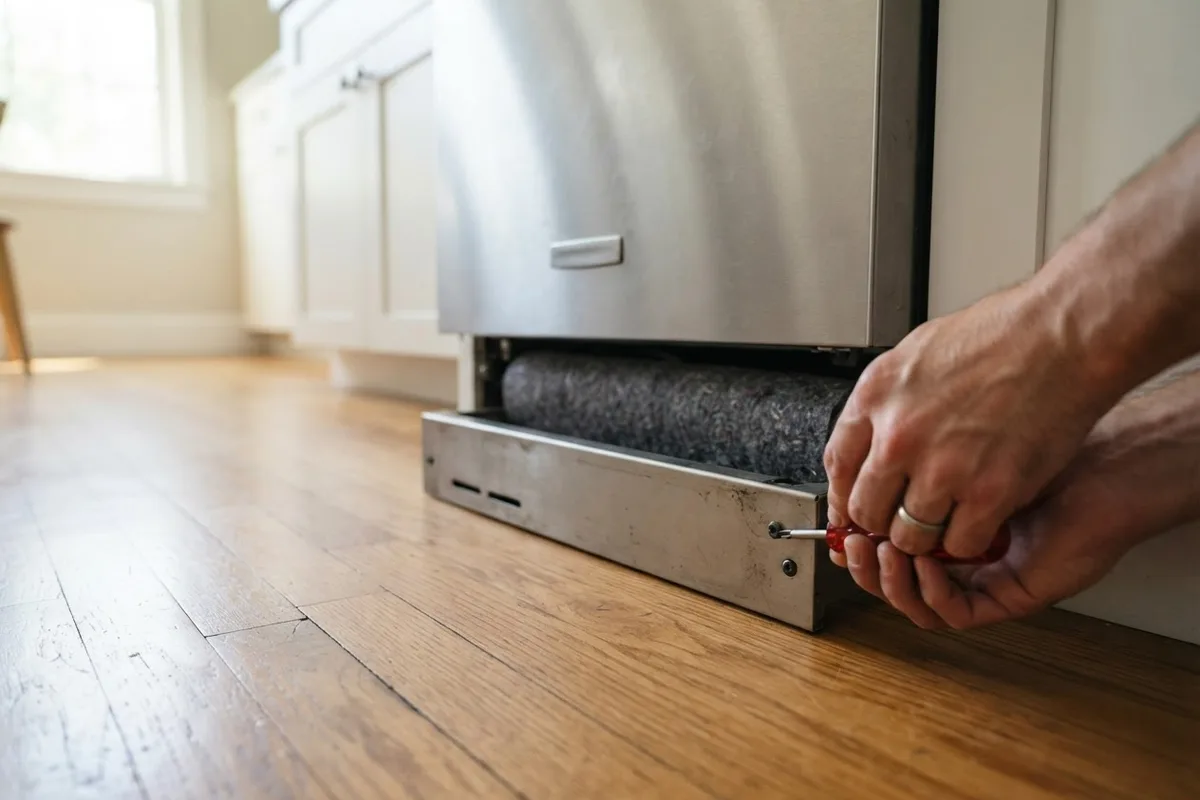
3. Refasten the Toe-Kick Sound Insulation Blanket
Most dishwashers rely on a thick felt or fiberglass insulation blanket tucked behind the bottom access panel (the toe-kick) to muffle the sound of rushing water inside the circulation pump. When this blanket slips down or gets pushed aside during floor cleaning, normal water circulation suddenly sounds like a loud rushing river.
- Shut off power to the dishwasher at your home breaker box.
- Locate the two or four screws holding the bottom metal or plastic toe-kick panel near the kitchen floor and remove them with a screwdriver.
- Pull the lower access panel away and look for a heavy dark gray or yellow acoustic insulation pad.
- If the insulation sheet has slumped onto the floor or bunched up behind the panel, unfold it and tuck the top edge back onto the retaining clips along the underside of the tub.
- Make sure the blanket hangs smoothly across the front without touching any exposed wiring or moving motor shafts, then screw the toe-kick panel snugly back into place.
4. Replace a Flattened Lower Door Baffle Seal
While the three-sided perimeter door gasket keeps water from dripping out the sides, a separate horizontal strip of rubber—called the lower door seal or sweep baffle—sits along the bottom interior edge of the door. When this rubber strip cracks or flattens out, the sound of splashing water escapes directly through the bottom air vent gap.
- Open the dishwasher door all the way down and inspect the bottom interior lip where the door meets the wash tub.
- Run your fingers along the rubber baffle strip to check for tears, brittle spots, or sections that have pulled out of the metal channel.
- Wipe away any greasy buildup along the bottom door seam using a damp microfiber cloth and warm soapy water, as grime can hold the flap open.
- If the rubber strip is warped or torn, order an exact model-match lower door seal (usually $20 to $45, though part prices vary by model and region).
- Press or slide the new rubber baffle firmly into the bottom door channel before running a test rinse.
5. Fix a Low Water Level Causing Pump Cavitation
When a dishwasher does not fill with enough water, the circulation pump sucks in a mixture of water and air. This condition, known as cavitation, produces a loud, hollow whooshing and gulping noise instead of a steady hum. If the sound eventually turns into a high-pitched whine, check our guide on why your dishwasher is making a squealing noise.
- Start a normal wash cycle and let the machine finish its initial two-minute water fill.
- Open the door and look at the floor of the tub; water should cover the bottom sump basin and touch the base of the float dome.
- Look under the kitchen sink and make sure the hot water shutoff valve feeding the dishwasher is turned completely counterclockwise (fully open).
- Back inside the tub, locate the small plastic float cylinder in the front corner and lift it gently up and down to verify it moves smoothly and isn't stuck in the "full" position.
- If the tub stays nearly dry despite an open sink valve and free float, the water inlet valve behind the kickplate may be clogged with sediment and need replacement.
6. Inspect the Diverter Valve Disc Alignment
Modern dishwashers save water by alternating flow between the bottom spray arm and the upper spray arm using a motorized diverter valve inside the sump. If the internal plastic diverter disc gets partially stuck between ports, pressurized water forces its way past the edge, creating a loud, turbulent whooshing sound. If you also hear hard tapping as the arm rotates, read our tips on fixing a dishwasher making a rattling noise.
- Disconnect power to the appliance at the breaker panel and remove the bottom dish rack and lower spray arm.
- Twist and lift out the cylindrical bottom filter assembly and the flat mesh plate so you can see clearly into the sump basin.
- Shine a flashlight into the small round diverter port opening near the center of the sump.
- Look for small pieces of broken glass, fruit pits, or hard plastic labels wedged against the rotating diverter disc and remove them carefully with needle-nose pliers.
- Reinstall the filter plate, cylindrical filter, and lower spray arm, then restore power and run a rinse cycle to verify the diverter transitions quietly between racks.
Quick Reference: Dishwasher Whooshing Noise Troubleshooting
| Whooshing Sound Pattern | Likely Cause | DIY Difficulty | Typical Part Cost (Varies by Area/Model) |
|---|---|---|---|
| Rhythmic whoosh every 2–3 seconds | Tilted lower spray arm or clogged corner jet | Easy | $0 – $35 (new spray arm) |
| Hollow echoing whoosh from top rack | Flipped plastic bowls or poorly angled pans | Easy | $0 |
| Loud constant rushing from floor level | Slipped toe-kick sound blanket or worn lower door seal | Easy | $0 – $45 (lower door baffle) |
| Airy, gulping whoosh with poor cleaning | Low water fill causing circulation pump cavitation | Moderate | $30 – $75 (water inlet valve) |
| Loud pressurized hiss/whoosh mid-cycle | Stuck diverter valve disc or worn pump impeller | Advanced / Pro | $150 – $320 (pro repair range) |
When to Call a Pro
Most acoustic whooshing problems come down to displaced sound insulation, a worn lower door seal, or a wobbly spray arm—all jobs you can tackle in under thirty minutes with basic household tools. However, if you notice water dripping onto the floor beneath the tub (often a sign of a leaking diverter motor shaft seal), if the water inlet valve needs replacement in a tight cabinet space, or if the circulation pump motor continues to gulp and surge despite proper water levels, it is time to step back. Working around live electrical connections and pressurized plumbing lines carries risk of shock or water damage.
Professional dishwasher repair for a faulty water inlet valve, diverter motor assembly, or circulation pump typically runs between $150 and $350 including parts and labor, though exact pricing varies by area and model. If your kitchen cleanup crew needs expert attention before the busy holiday hosting season, True Appliance Repair can match you with an experienced local appliance pro to diagnose and quiet your machine safely.
FAQ
Is it normal for a dishwasher to make a whooshing sound?
A soft, steady swishing or gentle whooshing sound is completely normal as the circulation pump pushes hot water through the spinning spray arms. You should only troubleshoot the noise if it suddenly becomes much louder than usual, takes on a harsh rhythmic pulsing against the door, or sounds like the pump is sucking air.
Why does my dishwasher sound like wind is blowing inside it?
A loud wind-tunnel sound usually happens when the acoustic insulation blanket behind the bottom toe-kick panel slips out of place, or when the lower interior door sweep seal flattens out. Both issues allow the normal sound of high-pressure water jets to escape directly into your kitchen.
Can a clogged dishwasher filter cause a loud whooshing noise?
Yes. When the bottom cylindrical filter is coated in grease or food debris, water cannot flow back into the circulation pump fast enough, starving the pump and causing a loud, airy gulping or whooshing sound.
Why does the whooshing noise happen in a rhythm every few seconds?
A rhythmic whoosh that repeats every two to three seconds almost always points to the lower or upper spray arm. As the arm rotates, a clogged corner nozzle or worn center bearing causes the water stream to hit the thinner sheet metal of the front door once per rotation.