
When your dishwasher stops heating water, your dishes come out covered in food residue, grease, and wet streaks. Modern dishwashers rely on hot water—usually between 120°F and 150°F—to dissolve detergent, sanitize cookware, and dry plates efficiently. Before you start shopping for a replacement unit, several common issues can cause a heating failure that you can easily check and fix yourself.
Always safety first: before inspecting electrical components or reaching beneath your appliance, unplug the dishwasher from the wall outlet or flip the dedicated circuit breaker off at your main panel. Shut off the water supply valve located beneath the kitchen sink as well. For advanced electrical panel work or internal control board wiring, stop and consult an experienced technician.
Inspect and Reset the High-Limit Thermostat
The high-limit thermostat is a safety device designed to prevent your dishwasher from overheating. If the appliance experiences a temperature spike, this switch trips and cuts power to the heating element, keeping the water cold during future cycles.
- Unplug the dishwasher and remove the bottom toe-kick access panel using a screwdriver.
- Locate the high-limit thermostat, which is typically mounted directly against the bottom of the tub near the heating element terminal legs.
- Look for a small red or black reset button on the thermostat housing. Press it firmly until you feel or hear a distinct click.
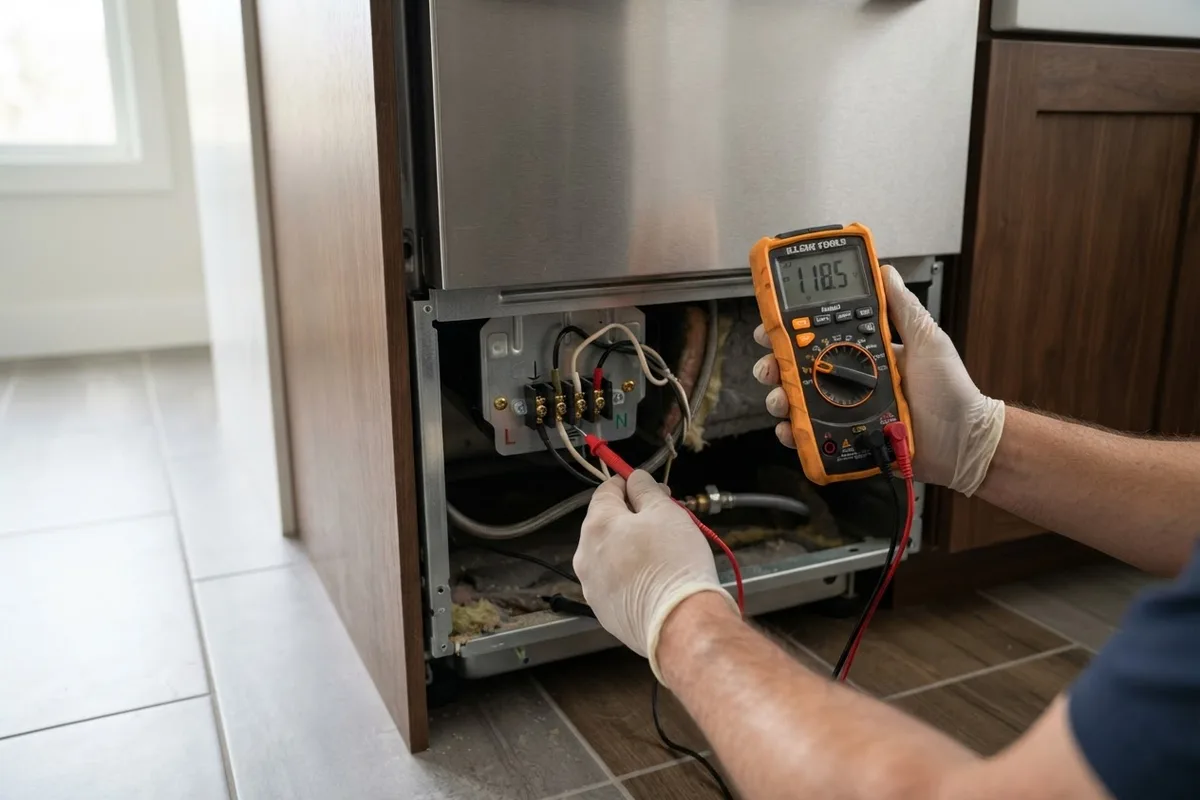
- If your model does not have a manual reset button, use a multimeter set to the ohms setting to check for continuity across the two electrical terminals. A reading of infinity indicates a blown thermostat that requires replacement.
Resetting a tripped safety switch often restores normal heating immediately. If the thermostat trips repeatedly, it may point to a failing component or restricted airflow around the motor base. If you are also dealing with poor drying performance, review our guide on why your dishwasher is not drying for additional troubleshooting steps.
Test the Heating Element for Visible Damage
The heating element is the metal loop located at the very bottom of your dishwasher tub. It warms the water during wash cycles and generates radiant heat during the drying phase. Over time, mineral deposits, thermal stress, or food buildup can cause the element to burn out or crack.
- Open the dishwasher door, remove the bottom dish rack, and clear out any standing water.
- Examine the heating element for visible signs of damage, such as blistering, black scorch marks, flaking metal, or physical cracks along the outer sheath.
- To test the element electrically, disconnect the dishwasher power, remove the lower access panel, and disconnect the two wire leads attached to the element terminals under the tub.
- Touch multimeter probes to the terminal pins. A functional heating element usually reads between 15 and 30 ohms of resistance. A reading of zero or infinity means the element has failed and must be replaced.
Replacing a burnt-out heating element is a straightforward DIY task for many homeowners. Taking time for routine care can prevent these component failures; check out our guide on DIY appliance maintenance steps to prevent repairs to extend the lifespan of all your home appliances.
Check Your Home Water Heater Temperature Settings
Many homeowners assume the dishwasher generates all its hot water internally. In reality, most residential dishwashers rely primarily on the hot water supplied directly from your home water heater, using internal heaters only to boost or maintain temperatures.
- Locate your home hot water heater in the utility room, garage, or basement.
- Inspect the temperature dial on the tank or digital panel. The optimal setting for proper dishwasher performance is 120°F (49°C).
- Avoid setting the home water heater above 125°F to prevent scalding risks and unnecessary energy consumption.
- Test the water temperature at your kitchen faucet by running the hot tap for two minutes into a glass with a candy or meat thermometer. If the water measures below 115°F, adjust your water heater thermostat upward slightly and retest after two hours.
If your home water heater is underperforming or set too low, your dishwasher will start its cycle with lukewarm water, leading to poor cleaning results even if the internal heater is functioning properly.
Clear the Water Inlet Valve and Flood Switch
A dishwasher heating element relies on a minimum level of water inside the tub to operate safely. If the water inlet valve is clogged or the float switch is stuck, the machine may underfill, triggering safety sensors that disable the heater to prevent tub damage.
- Open the door and lift the plastic float dome located near the front corner of the tub bottom. Listen for a clear click when you raise and lower it.
- Remove any wrapped hair, food debris, or soap scum beneath the float assembly that might keep it stuck in the raised position.
- Disconnect power and water supplies, then locate the water inlet valve behind the lower access panel where the braided supply line attaches.
- Unscrew the inlet hose and check the small wire mesh filter inside the valve port. Clean out mineral deposits or sediment using an old toothbrush and warm water.
Ensuring proper water volume allows the heating element to fully submerge and warm the wash water as designed. If your machine is filling slowly or stopping mid-cycle, see our detailed guide on why your dishwasher is stopping mid-cycle.
Run the Kitchen Sink Hot Water Before Starting
One of the simplest ways to ensure your dishwasher reaches peak wash temperatures is to purge the cold water from your hot water supply line before starting a wash cycle.
- Walk to your kitchen sink before pressing start on your dishwasher.
- Turn the kitchen faucet handle entirely to the hot setting and let the water run until it comes out steaming hot.
- Turn off the faucet and immediately press start on your dishwasher cycle.
- Select temperature-boosting cycle options on your control panel, such as "Hi-Temp Wash", "Sanitize", or "ProWash", which force the internal heater to run longer.
Purging the line prevents the dishwasher from filling its initial wash basin with cold water trapped inside long plumbing runs between your hot water heater and the kitchen sink.
Quick Diagnostics for Dishwasher Heating Issues
Use this quick reference guide to identify why your dishwasher water is staying cold and determine your next troubleshooting step:
| Symptom / Observation | Suspected Cause | Recommended DIY Action | Difficulty Level |
|---|---|---|---|
| Dishes cold and wet at cycle end | Tripped high-limit thermostat | Press red reset button or check continuity | Easy |
| Visible cracks or dark spots on element | Burnt-out heating element | Test with multimeter; replace element | Moderate |
| Water from kitchen tap feels tepid | Low home water heater setting | Adjust home water heater to 120°F | Easy |
| Low water level inside tub | Clogged inlet valve screen / stuck float | Clean float stem and inlet valve screen | Moderate |
| Long plumbing distance from water heater | Cold water trapped in supply line | Run hot water tap at sink before starting | Easy |
When to Call a Pro
While checking water heater settings, resetting thermostats, and clearing float switches are accessible DIY projects, some heating failures involve complex electrical systems. If you have verified that the heating element and thermostat have continuity but the unit still stays cold, the main electronic control board, timer assembly, or internal door wiring harness may be faulty.
Working with high-voltage control boards or replacing intricate internal wiring requires specialized tools and diagnostic equipment. If you are uncomfortable working with electrical connections or if troubleshooting has not resolved the issue, True Appliance Repair can match you with a local appliance pro who can safely inspect and fix your machine. Professional repair services for dishwasher heating problems typically range from $150 to $300 depending on the part needed, though actual costs vary by area and machine model. For specialized help with your dishwasher, explore our dedicated dishwasher repair services.
FAQ
Why is my dishwasher running but the water stays cold?
If the dishwasher runs its full cycle but the water never warms up, the primary causes are a blown high-limit thermostat, a burned-out heating element, or a faulty control board relay. It can also occur if the home hot water heater is set too low or if cold water was sitting in the supply pipe when the cycle started.
Can a dishwasher run without a working heating element?
Yes, most dishwashers will continue to cycle water and run through wash programs even if the heating element is broken. However, detergent tablets will not dissolve properly, grease will remain on dish surfaces, dishes will remain soaking wet at the end, and the sanitizing phase will fail.
How do I know if my high-limit thermostat is bad?
You can test a high-limit thermostat by disconnecting power, removing the bottom panel, and testing the thermostat terminals with a multimeter set to ohms. A working thermostat shows near 0 ohms of resistance at room temperature. If the meter displays infinite resistance, the internal fuse has blown and the switch needs to be replaced.
How much does it cost to fix a dishwasher that is not heating?
Replacing simple components like a high-limit thermostat or heating element yourself generally costs between $20 and $60 for parts. If you hire a professional technician, total repair costs typically range from $150 to $300 including labor, though exact pricing varies by geographic region and dishwasher brand.