
Opening your dishwasher expecting clean dishes only to find cold, dirty water and a cycle that quit halfway through is a frustrating household surprise. A dishwasher stopping mid-cycle usually points to a safety sensor triggering, a door latch issue, or a overheating component shutting down power. Before you give up and start washing dishes by hand, follow these straightforward troubleshooting steps to identify the problem and restore your machine.
Safety First Before You Begin
Always prioritize safety whenever you troubleshoot or work on major home appliances. Before inspecting any electrical connections, removing panels, or reaching into interior components, unplug the dishwasher from the wall outlet or switch off its dedicated circuit breaker in your home's main panel. If your troubleshooting requires inspecting water lines, shut off the hot water supply valve located underneath your kitchen sink. Never attempt internal electrical repairs or main control board wiring yourself; if an issue involves your household electrical panel, turn off power immediately and consult a professional.
1. Inspect the Door Latch and Microswitches
Dishwashers rely on an internal safety switch to ensure the door remains firmly sealed throughout every stage of the wash. If the door latch assembly slips, weakens, or alignment shifts during a heavy wash cycle, the dishwasher instantly cuts power to prevent water from splashing onto your kitchen floor.
Start by opening the door and examining the latch mechanism mounted at the top center or sides of the tub frame. Look for broken plastic tabs, food debris buildup, or misaligned strike plates. Close the door firmly and press against it—if there is excessive play or the door pops open when gently tugged, the latch switches may need adjustment or replacement.
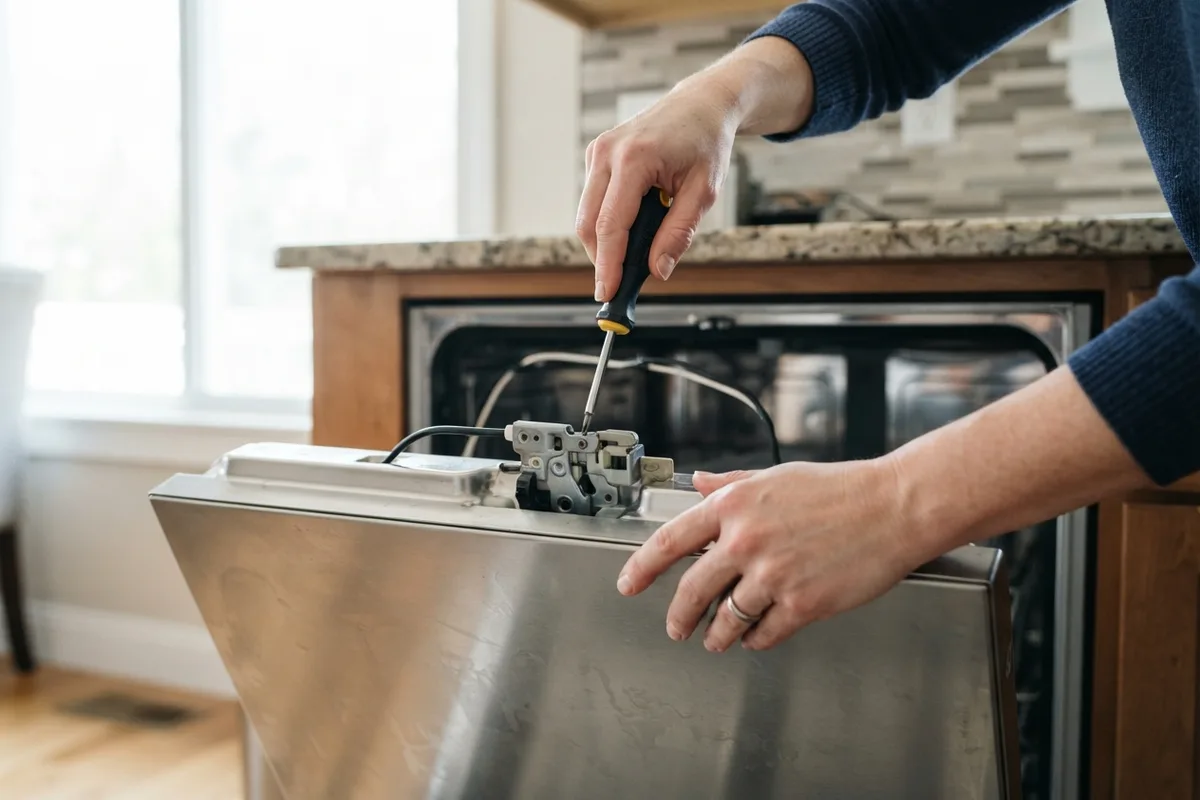
To inspect the switches deeper, turn off power to the unit and unscrew the inner door panel using a Torx or Phillips screwdriver. Check the microswitches attached to the latch handle for scorching or physical damage. Replacing a worn door latch assembly is an accessible DIY repair that usually takes less than 20 minutes with basic hand tools. For more latch-specific troubleshooting, read our guide on Why Is My Dishwasher Door Not Latching? 5 Easy Fixes.
2. Check for Overheating and High-Limit Thermostats
Modern dishwashers feature built-in safety thermostats (often called high-limit switches or thermal fuses) designed to trip if internal temperatures reach unsafe levels. If your dishwasher heats water during the wash or sanitize cycle and suddenly shuts off completely without draining, an overheating element or faulty thermostat might be the culprit.
Water that fails to reach the proper temperature can stall cycles, while water that gets too hot causes the thermal fuse to blow and cut power. Turn off power at the breaker, remove the bottom toe-kick panel (access plate), and locate the high-limit thermostat positioned on the underside of the tub near the heating element terminal leads.
Inspect the wiring connected to the thermostat for signs of melting or corrosion. You can test the continuity of the switch using a digital multimeter set to ohms. If the thermostat shows no continuity at room temperature, it has failed and must be replaced to allow the appliance to complete a full heating and wash cycle.
3. Clear Water Supply and Inlet Valve Faults
If your dishwasher stops during the fill stage or right before transitioning into a main wash or rinse phase, it may not be receiving sufficient water within the expected timeframe. Most dishwashers use a timed fill system controlled by an electronic water inlet valve. If the control board detects that the internal water level hasn't been met within a set window (usually two to three minutes), the cycle automatically cancels to protect the circulation pump motor.
Check the hot water supply line under your sink to confirm the shut-off valve is fully open. Next, inspect the inlet hose for kinks, bends, or pinches that restrict water flow. Turn off power and the water supply, then disconnect the inlet hose from the valve at the bottom front of the machine.
Examine the small wire mesh filter screen inside the inlet valve port. Hard water deposits, sediment, or pipe rust can clog this screen over time, drastically reducing water pressure into the tub. Gently clear sediment with a soft toothbrush. If the valve itself hums without letting water pass, the internal solenoid may have failed, requiring a replacement inlet valve.
4. Perform a Hard Power Reset on the Main Control Board
Modern dishwashers are essentially specialized computers. Electrical line surges, quick power flickers, or minor system glitches can cause the control board to freeze mid-cycle, leaving the display lights flashing or unresponsive.
A hard power reset clears corrupted memory from the control module and restores normal logic. To perform a reset properly, follow these simple steps:
- Press and hold the Start / Cancel button for 3 to 5 seconds to force the machine to clear any active program.
- Unplug the dishwasher power cord from the wall outlet, or turn off the circuit breaker in your electrical panel.
- Leave the power disconnected for a full 10 to 15 minutes to allow internal capacitors to discharge completely.
- While waiting, inspect the control panel buttons to ensure no keys are stuck in a down position.
- Restore power at the breaker or plug, select a basic Express or Normal wash cycle, and press Start.
If the dishwasher repeatedly stops at the exact same minute mark during every cycle even after a reset, the main control board or main harness may have damaged trace lines.
5. Clean the Flood Switch and Float Assembly
Inside the dishwasher tub near the front left or right corner sits an overfill float. As water fills the tub, this float rises. If the water level gets too high, the float triggers an underlying microswitch (the flood switch), which immediately cuts power to the water inlet valve and forces the drain pump to run or causes the machine to halt entirely.
Over time, food particles, grease, and soap scum can accumulate underneath the plastic float dome, causing it to get stuck in the raised "up" position even when the tub is empty. When this happens, the control board misinterprets the signal, thinking the tub is overflowing, and aborts the cycle.
To clean and test the float assembly:
- Ensure power to the machine is switched off.
- Lift the plastic float cylinder inside the tub upward and clean out any trapped debris beneath it with warm water and soap.
- Move the float up and down manually; you should hear a distinct click from the microswitch below the tub floor.
- If the float moves freely but the switch fails to click, access the microswitch under the tub to verify its mechanical operation.
Regularly taking care of minor components like floats is a great addition to your routine home upkeep. For more maintenance ideas, check out our guide on 7 Forgotten Appliance Maintenance Tasks to Prevent Repairs.
Quick Troubleshooting Reference Guide
Use this quick summary table to match your dishwasher's symptoms with the most likely cause and recommended fix:
| Symptom / Behavior | Primary Suspect | Recommended Action |
|---|---|---|
| Stops suddenly with door unlatched | Door latch microswitch or catch | Align door catch or replace latch assembly |
| Stops during heating/sanitize portion | Thermal fuse / high-limit thermostat | Test thermostat continuity with a multimeter |
| Stops 2–3 minutes into cycle start | Water inlet valve / low water pressure | Clear inlet valve screen or open water line |
| Display flashes or freezes mid-wash | Control board logic glitch | Perform a 15-minute circuit breaker reset |
| Stops and drain pump runs continuously | Stuck overfill float switch | Clean debris under the interior float dome |
When to Call a Pro
While simple latch adjustments, float cleaning, and power resets are manageable DIY tasks, certain dishwasher repairs require specialized diagnostic tools and expertise. If your dishwasher continues to shut down mid-cycle after running through these checks, or if you notice burnt wiring, melted control module connectors, or persistent household circuit breaker trips, it is time to turn the job over to an expert.
Working with high-voltage connections and intricate water lines carries risks of electrical shock or major home water damage. If you feel uncertain at any point, True Appliance Repair can match you with a local appliance pro who can diagnose complex electrical issues and safely replace internal pump motors or main circuit boards.
Frequently Asked Questions
Why does my dishwasher stop running after 10 minutes?
A cycle that cuts out roughly 10 minutes in usually points to a thermal fuse tripping due to overheating, or a failure during the initial water-fill phase. If the control board doesn't register adequate water volume or detects an overheating heating element, it automatically aborts the cycle to protect internal components.
Can a clogged drain hose cause the dishwasher to stop mid-cycle?
Yes. If your dishwasher cannot evacuate wastewater at designated cycle intervals, the control board will trigger an error code and pause the program to avoid overflowing your kitchen. Inspect the drain hose connected under your sink or disposal for clogs, kinks, or severe bends.
How much does it typically cost to fix a dishwasher that stops mid-cycle?
Minor DIY fixes like cleaning a float switch or resetting a breaker cost nothing. If a professional replacement is required, typical repair costs range from $120 to $300 for parts like door latches, water valves, or thermostats, while main control board or motor replacements can cost $250 to $450 depending on your area and appliance model.
Is it worth repairing a dishwasher that keeps shutting off?
If your dishwasher is under 8 to 10 years old and the repair involves an inexpensive component like a latch switch, thermal fuse, or inlet valve, repairing it is highly cost-effective. However, if the machine is older and requires an expensive main control panel or motor unit, replacing the appliance may be the smarter long-term investment.