
Pushing the start button on laundry day only to hear a low, straining buzz with zero drum movement is an instant headache. When you hear your dryer making a humming noise—or humming continuously while tumbling—the drive motor is usually receiving electricity but struggling against a physical jam, a seized roller, or a weak electrical component. Before you haul wet clothes to the laundromat, work through these six practical checks to pinpoint the culprit and get your laundry routine back on track.
Safety First: Always unplug your clothes dryer from the wall outlet (or flip the dedicated circuit breaker off) before removing access panels or reaching near the blower housing. If you own a gas dryer, shut off the gas supply valve behind the machine before moving it, and never attempt DIY repairs on gas valves or internal gas piping.
1. Clear a Jammed Blower Wheel
The most frequent reason a dryer hums and refuses to spin is a small item wedged inside the blower wheel. Because the blower fan is attached directly to the drive motor shaft, a single rogue baby sock, dryer sheet, or coin that slips past the lint screen can lock the fan blades solid. When you press start, the motor hums loudly as it tries to turn the stuck shaft.
- Unplug the dryer from the wall outlet and pull the lint screen straight out of its housing.
- Shine a flashlight down the lint trap chute and use a flexible lint brush or vacuum crevice tool to pull out any visible debris.
- Pull the dryer away from the wall, loosen the clamp on the 4-inch exhaust transition duct, and slip the vent hose off the rear exhaust port.
- Reach carefully into the rear exhaust pipe (wearing work gloves) to feel the plastic blower blades.
- Remove any lodged objects and gently rotate the wheel by hand to confirm it spins freely without wobbling.
2. Test the Push-to-Start Switch
If the humming only happens for the exact split second you hold your finger on the start button—and stops the moment you let go—the push-to-start switch or its relay may have burned internal contacts. A failing start switch delivers just enough current to make the motor buzz briefly, but not enough to engage the centrifugal switch that keeps the drum turning.
- Unplug the dryer entirely before opening the top control console.
- Remove the two to four Phillips or hex-head screws along the back edge of the control panel and tilt the console forward.
- Locate the push-to-start switch on the inside of the panel and inspect the plastic housing and wire terminals for dark scorch marks or melted plastic.
- Pull the wire connectors off the switch terminals (take a photo with your phone first so you remember the wire placement).
- Set a digital multimeter to the continuity setting, touch the probes to the switch terminals while pressing the start button in, and replace the switch if the meter shows no continuity.
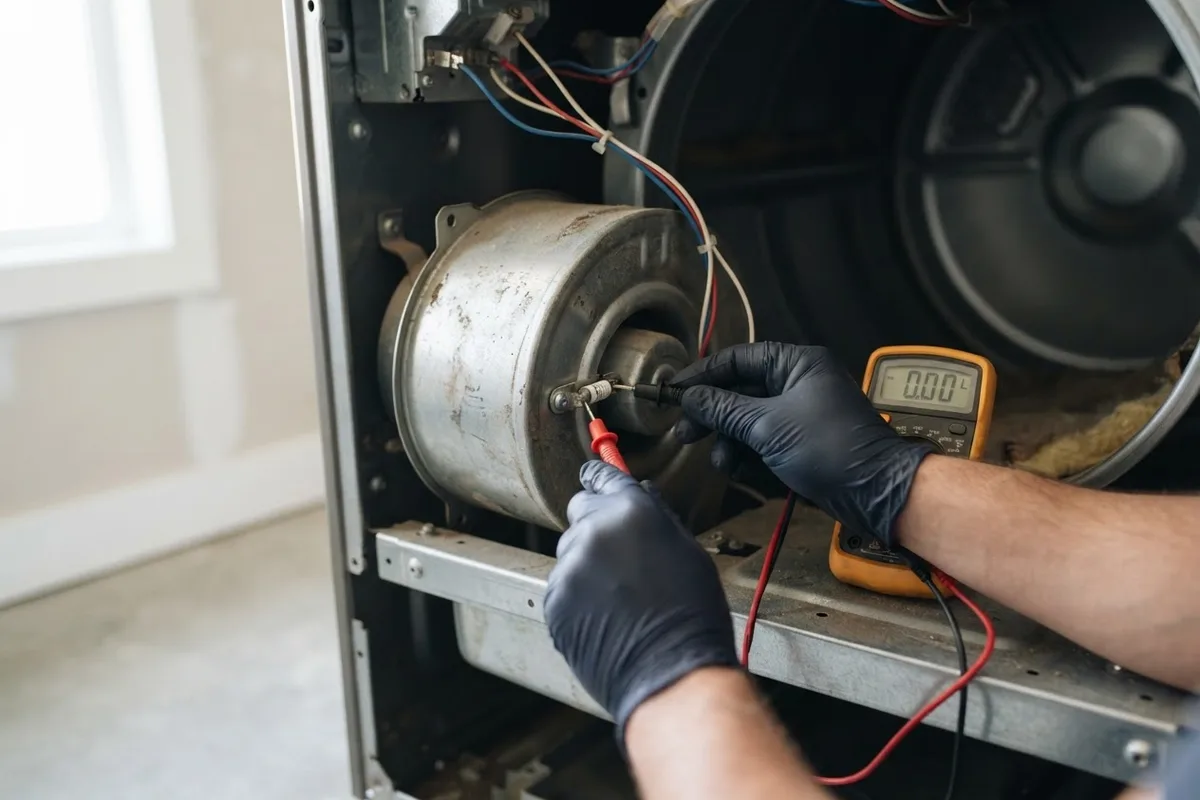
3. Reset a Tripped Thermal Fuse
On certain dryer models, an open thermal fuse or a tripped high-limit cutoff will interrupt the main motor circuit while allowing a secondary timer or control board transformer to emit a faint electrical hum. Thermal fuses blow when poor airflow causes the dryer cabinet to overheat—a super common issue during chilly fall and winter months when families run back-to-back loads of heavy fleece, flannel sheets, and thick hoodies.
- Unplug the machine and slide it forward so you can access the back panel.
- Unscrew the hex-head screws holding the rear metal access panel and set the panel aside.
- Find the thermal fuse mounted on the blower housing; it looks like a small white or black plastic strip about an inch long with two wires attached.
- Disconnect one wire slip-connector from the fuse terminal.
- Test across the two terminals with a multimeter set to continuity; if the meter does not beep, the fuse is blown and must be replaced.
- Before installing a new fuse, thoroughly clean your entire exhaust vent line to the outside hood so the new fuse does not blow again.
4. Check for a Seized Drum Roller or Belt
Sometimes the drive motor is healthy, the blower wheel is clear, and the electrical switches work, yet a mechanical jam inside the cabinet holds the drum hostage. If a drum support roller seizes on its axle, an idler pulley locks up, or a frayed drive belt knots around the motor pulley, the motor will sit and hum until its internal thermal overload clicks off. If your machine was recently noisy before stopping, check out our guide on why a dryer makes a grinding noise for deeper mechanical checks.
- With the dryer unplugged, open the loading door and try to turn the empty drum clockwise and counterclockwise by hand.
- Note the resistance: a normal dryer drum takes a little effort to turn because it spins the motor and blower, but it should rotate smoothly without locking.
- Look at the felt seal around the front and rear edges of the drum to ensure an underwire, zipper pull, or coin isn't wedged tightly between the spinning drum and the stationary bulkhead.
- If the drum will not budge even an inch, pop the top panel and front bulkhead off to inspect the rubber drive belt, idler pulley, and drum support rollers.
- Spin each roller by hand; replace any roller that feels gritty, wobbles, or refuses to turn.
5. Inspect the Motor Start Capacitor
Many modern dryers—especially compact, ventless, and European-style models—use a start capacitor wired alongside the drive motor. This small cylindrical battery-like component gives the motor the high-torque electrical boost it needs to get a heavy wet load moving from a dead stop. When a capacitor weakens or leaks, the motor simply sits and hums until you give the drum a manual push.
- Unplug the dryer and remove the rear or lower access panel to locate the cylinder-shaped capacitor mounted near the drive motor.
- Safety Warning: Capacitors store electrical charge even after the appliance is unplugged. Before touching the terminals, discharge the capacitor safely by holding an insulated screwdriver with its metal shaft across both terminals for five seconds.
- Inspect the casing for physical signs of failure, including a bulged top, cracked plastic, or oily residue leaking from the seams.
- If the capacitor looks swollen or tests below its rated microfarad (uF) capacity on a capacitance meter, swap in an exact OEM replacement.
6. Diagnose a Failing Drive Motor
If the blower wheel turns smoothly, the drum rotates freely by hand, and the switches test fine, the drive motor itself may have worn bearings or a stuck centrifugal switch. Over years of heavy laundry use, lint dust settles inside the motor windings and gums up the internal spring-loaded mechanism that shifts the motor from its starting winding to its running winding. Similarly, if your washer is acting up during the same laundry session, you can troubleshoot drainage issues in our guide on why a washer backs up into the sink.
- Unplug the dryer, let the motor cool down for 30 minutes, and plug it back in to try starting an empty cycle.
- Listen closely: if the motor hums for 5 to 10 seconds, clicks loudly, goes silent, and smells faintly warm, its internal thermal overload switch is tripping to prevent an electrical fire.
- Unplug the dryer again, remove the drive belt from the motor pulley, and try spinning the motor shaft by hand.
- If the motor shaft feels stiff, grinds, or refuses to turn with the belt removed, the motor bearings have seized and the motor assembly needs replacement.
Quick-Reference Guide: Dryer Humming Symptoms & Costs
Note: Typical US part and professional repair ranges vary by area, dryer brand, and model.
| Humming Symptom | Most Likely Cause | DIY Difficulty | Typical Repair Cost (Parts vs. Pro) |
|---|---|---|---|
| Hums loudly, won't spin, stops after 10 seconds | Jammed blower wheel or seized drum roller | Easy to Moderate | $0–$35 DIY / $120–$220 Pro |
| Hums only while holding the start button down | Faulty push-to-start switch or relay | Easy | $20–$50 DIY / $130–$210 Pro |
| Faint hum from console, nothing happens when started | Blown thermal fuse or door switch issue | Easy | $10–$30 DIY / $110–$190 Pro |
| Hums until drum is pushed by hand, then runs | Weak motor start capacitor | Moderate | $25–$60 DIY / $140–$240 Pro |
| Hums, smells hot, trips internal overload repeatedly | Seized drive motor or bad motor windings | Advanced | $120–$220 DIY / $250–$400 Pro |
When to Call a Pro
Pulling a trapped sock out of a blower housing or swapping a push-to-start switch in the upper console are straightforward afternoon projects for most homeowners. However, you should stop and bring in a technician if the problem points to a seized drive motor, burned main wiring harnesses, control board relays, or anything involving a gas dryer's burner assembly. Replacing a drive motor requires stripping down the entire cabinet, removing the drum, and wrestling with tight spring-loaded blower wheels that frequently strip during removal.
If you have cleared the blower wheel and checked the basic switches but your dryer still hums and refuses to tumble, True Appliance Repair can match you with an independent specialist for local washer and dryer repair. Having an experienced technician test the motor windings and electrical circuit saves you from buying expensive parts you might not need.
FAQ
Is it dangerous if my dryer is making a humming noise?
Yes, letting a dryer hum repeatedly without spinning can overheat the motor windings. Fortunately, drive motors have a built-in thermal overload protector that clicks the motor off after several seconds of straining, but you should unplug the dryer right away rather than pressing the start button over and over.
Why does my dryer hum when the timer is on, even before I press start?
A very quiet buzz coming from the top console while the timer dial is set to a cycle is often just the small mechanical timer motor turning its gears. However, if the hum is loud and comes from the bottom of the cabinet before you even push start, the motor centrifugal switch or a control board relay may be stuck closed, and you should unplug the machine immediately.
Can a clogged dryer vent cause a humming noise?
Indirectly, yes. When an exterior vent duct is packed with lint, excess lint backs up into the blower housing where it can jam the blower fan blades, or it overheats the cabinet and trips the thermal cutoff.
How much does it cost to fix a humming dryer?
If the humming is caused by a sock or coin wedged in the blower wheel, clearing it yourself costs nothing. If a part has failed, DIY switches and fuses typically run $15 to $60, while hiring a professional for a new drive motor generally ranges from $250 to $400 depending on your model and local rates.