
A sudden low humming sound coming from beneath your kitchen sink usually signals that your garbage disposal is receiving power, but its internal impellers are blocked from spinning. Leaving a humming disposal turned on can quickly overheat the motor, tripping the internal thermal breaker or permanently damaging the appliance. Fortunately, most disposal jams are caused by trapped food debris or small household items and can be cleared in under 15 minutes without expensive tools.
Before attempting any hands-on troubleshooting, always prioritize safety. Working with an appliance attached to both electrical plumbing lines requires proper prep work to prevent injuries or electrical shock. Incorporating quick routine checks into your home routine, similar to our guide on 6 Monthly Appliance Maintenance Tasks to Prevent Repairs, helps keep kitchen equipment running smoothly year-round.
Disconnect Power Before Touching the Unit
Never place your hands, tools, or flashlights near the drain opening while the appliance remains connected to electrical power. A humming sound proves that electric current is reaching the motor windings, which creates immediate hazard risks if the obstruction suddenly shifts while the switch is engaged.
- Flip the wall switch that controls the garbage disposal to the absolute OFF position.
- Open the cabinet door beneath your kitchen sink and trace the disposal power cord to the wall outlet.
- Firmly unplug the unit from the electrical receptacle.
- If your disposal is hardwired directly into your home power system without a plug, locate your main electrical panel and switch off the dedicated circuit breaker powering the kitchen disposal line.
- Flip the wall switch ON briefly to verify that no power reaches the disposal, then flip it back OFF before proceeding.
Taking these preliminary steps ensures the unit cannot unexpectedly restart while you work. Never bypass electrical safety precautions, and always confirm power is off before reaching toward the sink opening or inserting repair tools.
Clear Jammed Impellers with a Hex Wrench
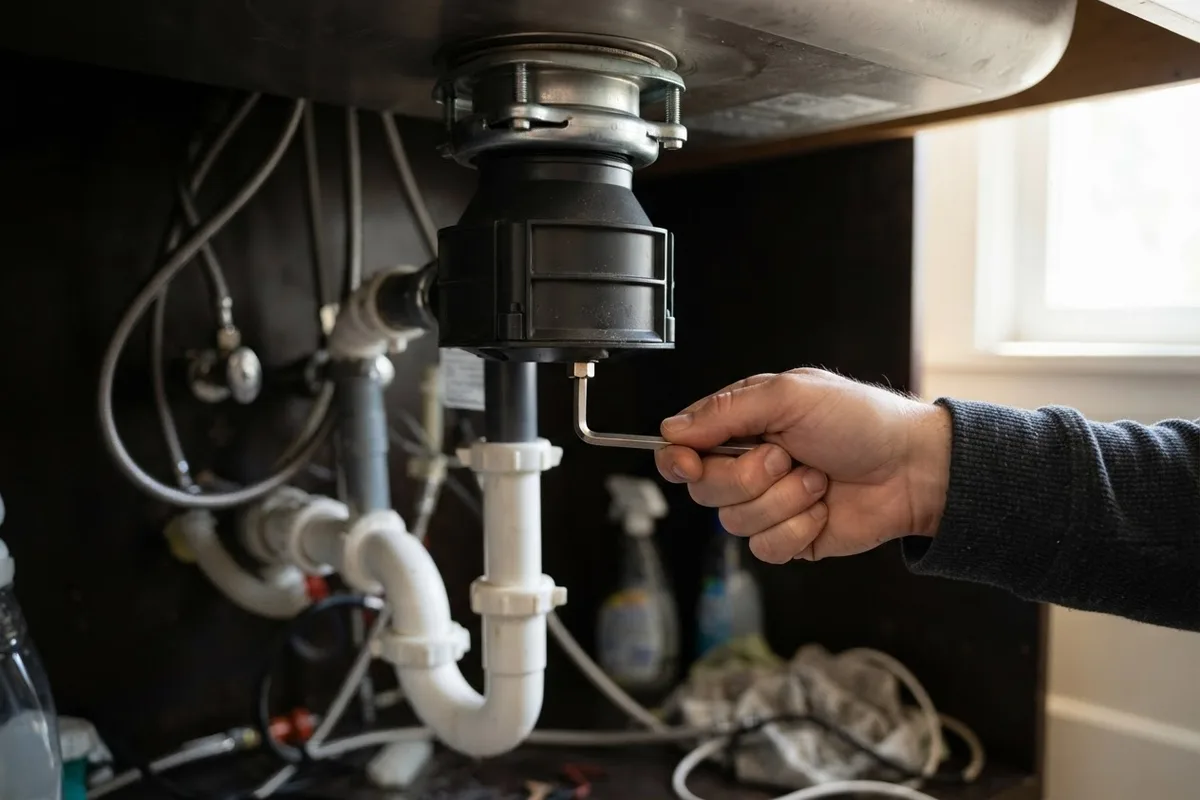
Almost every modern garbage disposal features a small hex hole located in the center of the bottom exterior housing. This socket directly connects to the motor shaft, allowing you to manually rotate the internal shredding plate and free jammed impellers without reaching into the hopper.
- Retrieve the offset 1/4-inch Allen wrench (hex key) that originally came with your unit, or use a standard hex wrench from a homeowner tool set.
- Clear out storage items from beneath your sink and shine a bright flashlight up at the bottom center of the garbage disposal cylinder.
- Insert the hex wrench firmly into the center socket until it seats completely.
- Rock the wrench back and forth in both clockwise and counterclockwise directions.
- Apply firm, steady pressure until you feel the resistance yield and the wrench spins freely in full 360-degree rotations.
If the hex wrench spins smoothly without binding, the primary jam on the shredding plate has been broken up. Remove the wrench from the bottom socket before restoring electrical power or running water down the drain.
Press the Red Motor Reset Button Below
When a disposal motor encounters a heavy mechanical jam, its internal circuit heats up rapidly. To protect the motor windings from burning out, an automatic thermal overload switch trips and cuts off power to the motor, stopping the humming sound entirely.
- Locate the small, round red button situated on the bottom surface or lower side edge of the disposal housing beneath your sink.
- Check if the red button is protruding outward about a quarter-inch from the casing, which confirms the thermal safety trip was activated.
- Allow the disposal motor to cool down undisturbed for 10 to 15 minutes after clearing any physical obstruction.
- Firmly push the red button inward until you hear or feel a distinct click, indicating the thermal overload circuit has reset.
If the red button refuses to stay down or pops back out immediately when pressed, the motor is still too hot or an unresolved electrical fault exists inside the housing. Give the unit additional cooling time before attempting another reset.
Dislodge Foreign Objects Above the Drain
While the hex wrench manually turns the motor shaft, hard debris such as fruit pits, chicken bones, silverware, or glass shards can remain trapped between the rotating impellers and the outer stationary grind ring inside the chamber.
- Ensure the disposal remains completely unplugged from the wall outlet.
- Shine a bright flashlight straight down through the black rubber splash guard into the sink drain opening.
- Inspect the perimeter of the turntable disk to spot wedged foreign objects, fibrous food materials, or metal items.
- Use long-nose needle pliers or kitchen tongs to reach down through the drain and grasp the trapped object firmly.
- Pull the object straight up and out of the sink assembly; never use your bare fingers to feel around inside the grinding chamber.
Even small hard objects like twist ties or bottle caps can wedge firmly beneath an impeller lug. Ignoring these items can lead to recurring jams or severe mechanical noise, similar to issues highlighted in our review of 7 Household Appliance Warning Signs You Should Never Ignore.
Test the Flywheel Manually for Free Movement
If your disposal model lacks a bottom hex socket or if you want to confirm that the impellers pivot freely, you can safely test movement from above using a sturdy wooden tool handle.
- Double-check that the electrical cord is disconnected from the wall receptacle.
- Take the thick wooden handle of a broom or heavy wooden spoon and insert it downward through the sink drain opening.
- Rest the end of the handle against one of the raised metal impeller lugs on the outer edge of the rotating disk.
- Apply lever force against the lug to rotate the internal turntable disk in either direction.
- Continue pushing until the disk spins freely without grinding or catching on the stationary walls.
Ensure that the two swiveling metal lugs attached to the disk move loosely on their rivets. If an impeller lug is frozen stuck by mineral deposits or corrosion, tap it gently with the wooden handle until it swivels freely again.
Reconnect Power and Flush with Cold Water
Once the jam is cleared and the internal flywheel turns smoothly, you must properly test the unit under actual running water conditions to purge lingering debris from the sink trap line.
- Remove all tools, pliers, flashlights, and wooden handles from inside the sink bowl.
- Reconnect the appliance power plug firmly back into the grounded wall outlet beneath the cabinet.
- Turn on the kitchen faucet to a strong stream of cold water and allow it to run down the drain for 15 to 20 seconds.
- Flip the wall switch ON while cold water continues to flow continuously.
- Listen for smooth, quiet motor operation without any underlying hum or mechanical grinding noise.
- Let the cold water run for another 30 seconds to flush all loosened particles out through the drain trap.
Always use cold water when operating a garbage disposal. Cold water keeps grease and fats in a solid state so the impellers can chop them up before they travel down the waste line, preventing clogs further along your plumbing branch.
Disposal Repair vs. Replacement Decision Matrix
Understanding whether a simple jam clearance will solve your problem or if the internal components have suffered permanent failure helps you manage home maintenance costs effectively. Use this quick reference guide to evaluate common disposal symptoms:
| Symptom / Observed Issue | Most Likely Cause | Primary Recommended Action | Typical US Cost Range |
|---|---|---|---|
| Loud hum, no spinning disk | Shredding plate mechanical jam | Rotate bottom hex socket with wrench; clear debris | $0 (DIY) |
| Silent unit, wall switch turned ON | Tripped thermal overload or breaker | Reset red button on bottom; check breaker panel | $0 (DIY) |
| Continuous dripping beneath unit | Cracked internal seal or body casing | Replace unit body or lower sink flange seal | $120 - $350 (varies by model/area) |
| Frequent trips after clearing jams | Worn motor windings or short circuit | Internal motor failure; full replacement needed | $150 - $400 (varies by model/area) |
| Loud metallic grinding every use | Broken impeller lug or rusted disk | Replace internal grinding components or entire unit | $100 - $300 (varies by model/area) |
If your evaluation shows that the motor housing is leaking water directly onto cabinet wood or that the electrical motor trips your household breaker repeatedly, continuing DIY attempts may cause broader water damage or electrical issues.
When to Call a Pro
While clearing a simple food jam or resetting a thermal overload button is well within the capabilities of most homeowners, certain disposal faults require professional attention. You should stop and contact a qualified technician if:
- Water drips continuously from the bottom casing seams of the disposal, which indicates a failed internal shaft seal.
- The disposal immediately trips your home's main breaker panel as soon as power is restored, suggesting an internal electrical short.
- The motor hums even after the flywheel spins 360 degrees smoothly, pointing to a burned-out motor capacitor or damaged internal windings.
- You are uncomfortable handling electrical disconnects or inspecting hardwired electrical connections beneath your kitchen sink.
For complex electrical faults or complete unit replacements, True Appliance Repair can match you with a local appliance pro to evaluate your kitchen setup safely. If you encounter broader issues across your kitchen or laundry room, exploring dishwasher repair options or booking through True Appliance Repair ensures your essential home equipment stays in top condition.
FAQ
Why does my garbage disposal hum but not turn on?
A humming garbage disposal indicates that electrical power is reaching the motor, but the internal grinding disk is physically prevented from rotating. This is almost always caused by food scraps, small bones, or foreign objects wedged tightly between the rotating impellers and the stationary shredder ring.
Can I use Drano or chemical drain openers to clear a jammed disposal?
No, you should never pour chemical drain cleaners into a garbage disposal. These harsh chemicals can damage internal rubber seals, corrode metal components, and remain trapped inside the grinding chamber, posing a severe burn hazard if liquid splashes out during manual jam clearance.
What size Allen wrench fits the bottom of a garbage disposal?
Most standard garbage disposals use a 1/4-inch hex wrench inserted into the socket at the center of the bottom exterior plate. Many manufacturers supply a specialized offset tool with the original installation, but any standard 1/4-inch Allen key will work.
Is it normal for the red reset button to pop out when the disposal jams?
Yes, the red button is a built-in thermal overload safety switch designed to protect the electrical motor. When an object jams the impellers, the motor draws excess current and heats up rapidly; the reset switch automatically pops out to cut power and prevent the motor from burning out.