
Flipping the kitchen switch only to hear a loud metallic clatter, high-pitched squeal, or violent vibration from the sink is enough to make any homeowner wince. Most of the time, a noisy garbage disposal is caused by a trapped foreign object, a loose mounting ring, or a worn rubber baffle rather than a ruined motor. By following a few safe troubleshooting steps, you can pinpoint the exact sound, clear the grinding chamber, and restore quiet operation in under 30 minutes.
Safety First: Before inspecting or reaching near your garbage disposal, always turn the wall switch off and unplug the power cord under the sink. If your unit is hardwired without a plug, go to your home's main electrical panel and flip the corresponding circuit breaker to the "Off" position. Never put your bare hand inside the grinding chamber.
1. Clear Foreign Objects From the Chamber
A harsh, metallic grinding or rattling sound almost always means a non-food item has dropped past the sink baffle. Forks, bottle caps, fruit pits,bone fragments, and small screws frequently bounce around on top of the spinning flywheel, making an awful racket without completely stalling the blades.
- Disconnect the power to the disposal underneath the sink and verify it will not turn on by flipping the wall switch.
- Fold back the flexible rubber splash guard (baffle) at the mouth of the drain and shine a bright flashlight straight down into the grinding chamber.
- Look closely around the perimeter of the turntable and underneath the two metal impellers (the swivel lugs attached to the plate).
- Use a pair of needle-nose pliers, long kitchen tongs, or a telescoping magnet tool to grab and lift out any coins, metal shards, glass, or hard fruit pits.
- Once the chamber looks completely clear, restore power, run a steady stream of cold water, and flip the switch for five seconds to see if the metallic clanking is gone.
2. Free a Stuck Impeller Blade
Contrary to popular belief, garbage disposals do not have sharp spinning knives like a blender. Instead, they use two blunt metal lugs—called impellers—that swivel on pins and use centrifugal force to push food waste against a stationary shredder ring. If starchy residue, fibrous peelings, or small grit gets wedged under one of these lugs, it can lock in place and make a rhythmic thumping or scraping sound.
- Unplug the unit from the outlet beneath the sink.
- Shine your flashlight into the drain and locate the two raised metal impellers on opposite sides of the flat flywheel plate.
- Insert a long wooden spoon handle or a wooden dowel into the sink opening and press gently against each impeller lug.
- Each lug should pivot smoothly back and forth on its mounting pin. If one feels stiff or frozen, work it back and forth with the wooden handle while spraying a small amount of warm water and dish soap onto the joint.
- If the whole turntable refuses to rotate at all, check out our guide on safe DIY fixes for a jammed garbage disposal to free the flywheel using a hex wrench from the bottom of the unit.
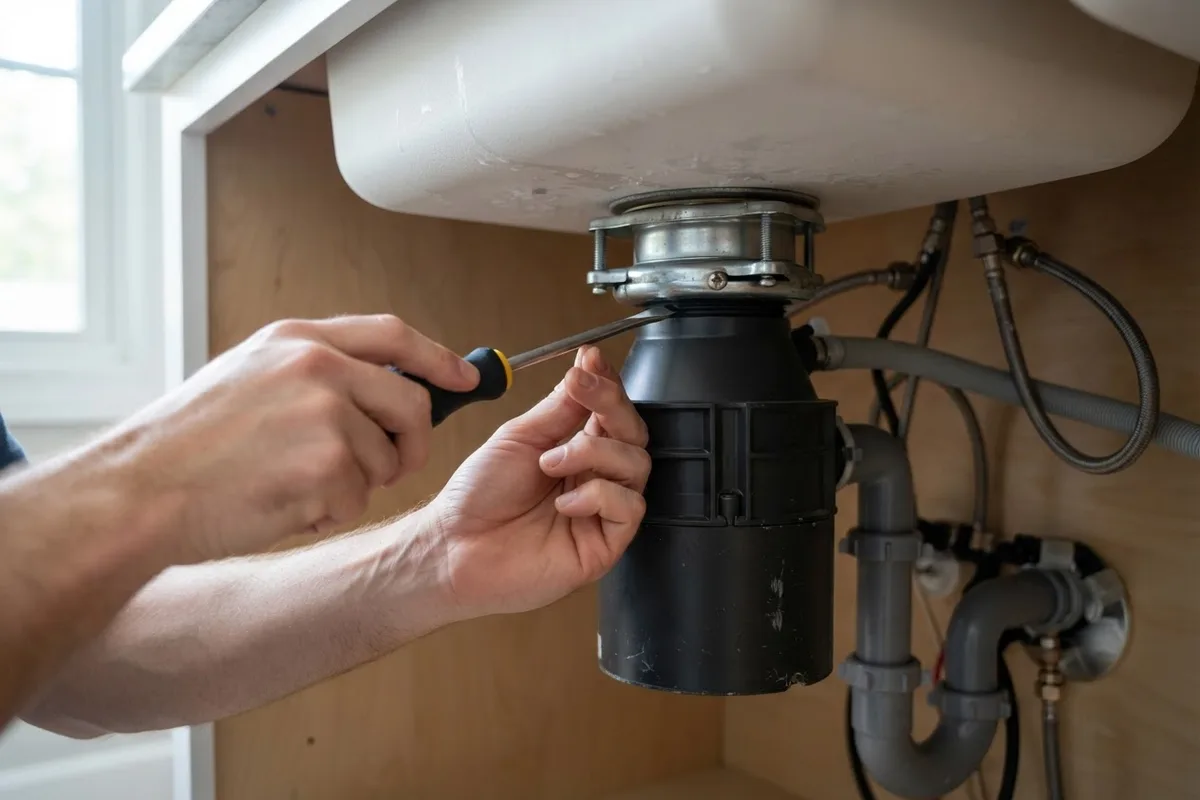
3. Tighten a Loose Sink Mounting Assembly
If your disposal sounds like a jackhammer and shakes the entire countertop when turned on, the noise is likely coming from the outside of the unit rather than the inside. Constant vibration over months of daily use can loosen the metal mounting ring and clamping screws that hold the heavy motor tight against the underside of the sink basin.
- Turn off the power and clear out any cleaning bottles stored under the kitchen sink so you have room to work.
- Grip the body of the garbage disposal with both hands and gently try to wiggle it side to side. If there is any play between the top of the disposal and the sink flange, the mount needs tightening.
- Inspect the three mounting screws pressing vertically against the metal backup ring. Use a screwdriver to snug each screw evenly so the flange sits completely flat.
- Check the lower mounting ring (the collar with three small metal loops or ears). Insert the tip of a screwdriver or your hex wrench into one of the loops and push it clockwise (to the right) to lock the collar tighter up the ramp.
- Inspect the black rubber cushion mount seated just above the collar. If the rubber is cracked, flattened, or deteriorating, it will transfer motor noise directly into the stainless steel sink and will need to be replaced.
4. Reseat or Replace the Rubber Splash Baffle
Sometimes a loud flapping, chattering, or gurgling noise is nothing more than a misaligned splash guard. The removable black rubber baffle sits inside the drain opening to keep water and food bits from flying back up into the kitchen, while also acting as a sound barrier.
- With the power off, pull the removable rubber baffle straight up and out of the sink drain throat (on collar-mounted units, you only can inspect it in place unless you drop the unit).
- Flip the rubber piece over and scrub away hardened grease, coffee grounds, and mineral buildup using warm soapy water and an old toothbrush. If you notice a sour odor while scrubbing, follow these easy DIY fixes for a smelly garbage disposal to sanitize the whole drain line.
- Check the rubber flaps for tears, warping, or missing sections. When flaps curl upward or stiffen with age, water and sound waves escape unimpeded.
- Press the clean baffle firmly back into the sink groove until the outer lip snaps evenly all the way around. If it is warped, pick up a universal replacement sink baffle at a hardware store for around $8 to $15.
5. Secure the Dishwasher and Drain Pipe Connections
A high-speed vibration or plastic rattling noise underneath the cabinet often comes from the plumbing lines attached to the sides of the disposal. When the motor spins up, any loose hose clamps or unbraced PVC drain traps will chatter loudly against the cabinet walls.
- Locate the flexible corrugated drain hose running from your dishwasher to the small inlet nipple on the upper side of the garbage disposal.
- Check the metal worm-gear clamp or spring clamp holding that hose onto the disposal. Use a nut driver or flathead screwdriver to tighten the clamp so the rubber boot cannot vibrate.
- Inspect the curved discharge tube exiting the side of the disposal into your sink's P-trap. Make sure the metal flange bolts holding the discharge elbow to the disposal body are snug.
- Hand-tighten the large plastic slip nuts along the P-trap assembly. Do not overtighten plastic nuts with a wrench, as they can crack.
- If the long dishwasher hose is knocking against the wooden cabinet divider when the disposal runs, wrap a piece of foam pipe insulation around the hose or secure it gently with a plastic zip tie.
6. Diagnose Worn Motor Bearings or Flywheel Damage
If you have cleared the chamber, freed the impellers, and tightened every bracket, yet the disposal still makes a loud, continuous squealing, whining, or rough roaring sound even with nothing inside, the internal mechanical components are wearing out.
- Unplug the disposal and look down into the grinding chamber with a flashlight one more time.
- Inspect the stationary metal shredder ring lining the inside wall and the edges of the rotating flywheel. Look for snapped impeller pins, cracked welds, or severe rust corrosion eating through the metal plate.
- Insert a 1/4-inch Allen wrench into the hex hole at the very bottom center of the motor housing and turn it back and forth by hand.
- If turning the motor shaft by hand feels gritty, binds up repeatedly without any debris inside, or squeaks loudly, the sealed lower motor bearings have failed due to age or a past internal water seal leak.
- Because garbage disposal bearings and internal seals are pressed together at the factory, they cannot be lubricated or repaired separately—a squealing bearing means it is time to replace the unit.
Garbage Disposal Noise Quick-Reference Guide
Use this table to match the sound coming from your kitchen sink with the most likely culprit and solution.
| Sound You Hear | Most Likely Cause | Typical Fix | DIY Difficulty |
|---|---|---|---|
| Loud metallic clanking / rattling | Coin, utensil, bone, or glass on the flywheel | Turn off power; remove object with long pliers | Easy |
| Low humming with no spinning | Jammed flywheel or tripped overload switch | Turn off power; turn bottom hex wrench & press red reset button | Easy |
| Rhythmic thumping or scraping | Impeller lug stuck on its pivot pin | Free the swivel lug with a wooden spoon handle | Easy |
| Violent shaking / cabinet vibration | Loose sink mounting ring or worn cushion mount | Tighten the 3 mounting screws and locking collar | Easy to Moderate |
| Loud water splashing & echoing | Torn or unseated rubber sink baffle | Reseat or replace the removable rubber splash guard | Easy |
| High-pitched squealing or roaring | Worn-out internal motor bearings | Replace the garbage disposal unit | Pro / Advanced DIY |
When to Call a Pro
Most noisy disposal troubles come down to a stray teaspoon or a loose mounting screw that you can fix in minutes with basic hand tools. However, you should stop DIY work and call a professional if you notice water dripping from the bottom motor housing, smell burning electrical insulation, or find that the unit repeatedly trips your kitchen circuit breaker. In addition, if your disposal is hardwired directly into household wiring or if corroded plumbing pipes crumble when you try to replace an old unit, bringing in an experienced technician saves time and prevents under-sink water damage.
Replacing a garbage disposal typically costs between $150 and $400 for labor and standard parts, though the total price varies by area, horsepower model, and existing plumbing setup. If you would rather skip crawling under the sink cabinet, True Appliance Repair can match you with a local pro for fast professional appliance repair or help you contact our team to get your kitchen running quietly again.
FAQ
Why does my garbage disposal sound like a helicopter when it runs?
A loud chopping or helicopter-like sound usually happens when a piece of rigid plastic—such as a bread bag clip, straw, or bottle cap ring—gets wedged just beneath the rubber splash baffle or stuck to the edge of the turntable. Unplug the disposal and use a flashlight and long-nose pliers to check the upper rim of the chamber and the underside of the rubber flaps.
Is it safe to put ice cubes in a noisy garbage disposal?
Yes, grinding two cups of ice cubes with a cup of rock salt and cold running water is a safe, effective way to knock loose stubborn food buildup wedged underneath the impellers. While ice does not actually sharpen the blunt metal lugs, the heavy slush scours the shredder ring and often stops minor scraping or out-of-balance vibrations.
How long do garbage disposals typically last before bearings wear out?
Most residential garbage disposals last between 8 and 12 years with normal household use. If your unit is over a decade old and begins making a loud, metallic squealing sound or leaking rusty water from the bottom reset button area, the internal water seal and bearings have reached the end of their lifespan and replacing the whole unit is more cost-effective than attempting repairs.
Can I use WD-40 inside my garbage disposal to stop squeaking?
Avoid spraying petroleum-based lubricants like WD-40 inside the grinding chamber. Chemical sprays wash down into the drain line, can degrade the rubber cushion gaskets and splash seals, and will not reach the sealed motor bearings underneath the grinding plate anyway. If the swivel lugs are sticky from grease buildup, flush them with hot water, dish soap, and white vinegar instead.